
Curriculum Design Process
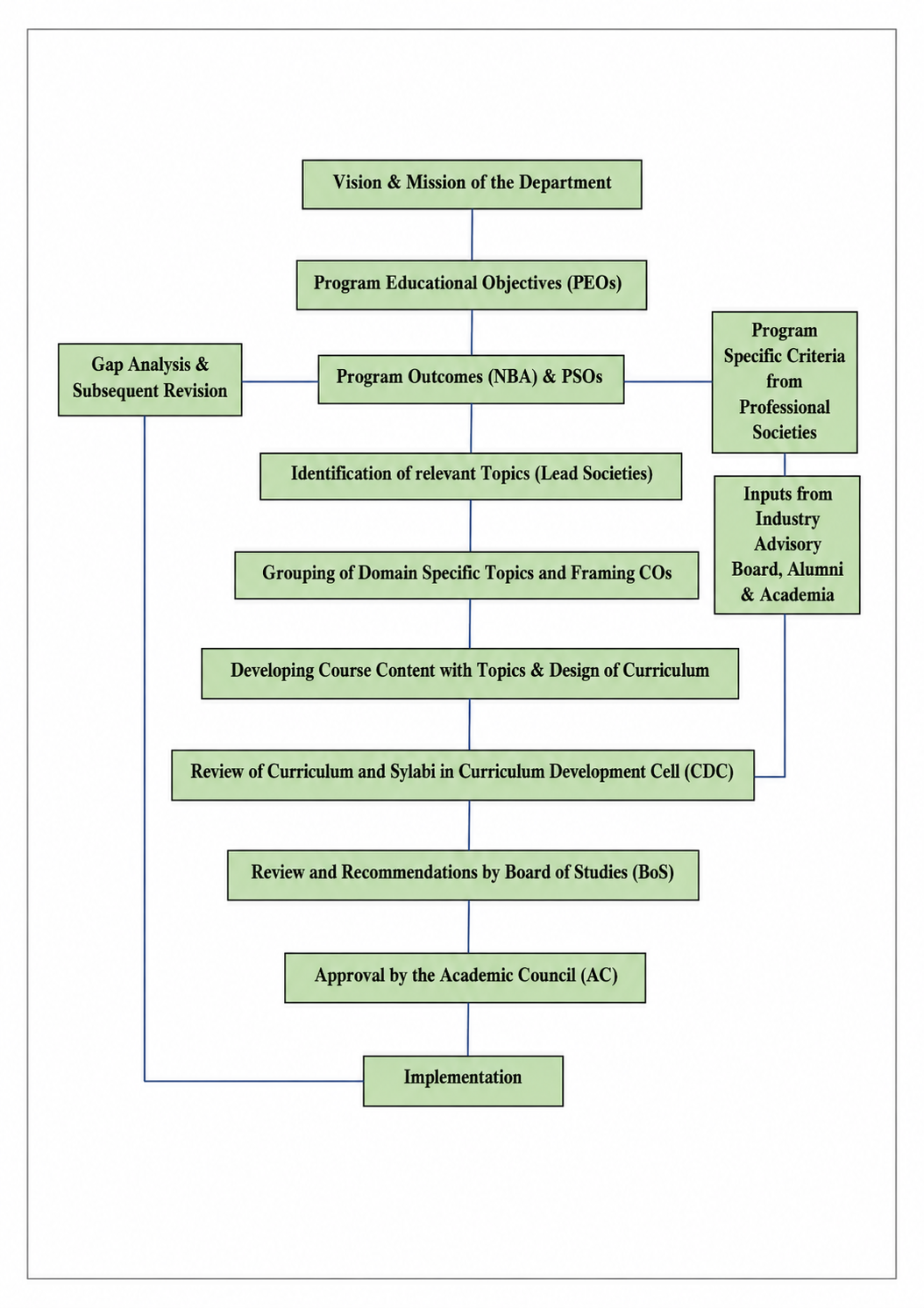
The curriculum is designed based on Program Educational Objectives (PEOs), Program Outcomes (POs) and also adopting the guidelines of All India Council for Technical Education (AICTE) model curriculum. The domain specific topics based on the lead societies including IEEE, ACM, CSI, and CSAB are identified. The curriculum and syllabi are discussed in Curriculum Development Cell (CDC) meetings along with student representatives. The recommendations of CDC are presented in the BoS comprising of experts from premier institutes, industries and alumni for scrutiny. The recommendations of BoS are placed in Academic Council (AC) for approval. Approved curriculum and syllabi are implemented and documented as Academic Hand Books.
The process flow is given in Fig 1.4. The continuous reviews are obtained from the stakeholders, industry, academia, external experts and faculty. The feedback is analysed and the required updates are incorporated if necessary.
Level of Program Curriculum
The divisions ensures adherence to the guidelines received from statutory regulatory bodies like UGC, AICTE on credit distribution for PG curriculum, while developing and/or restructuring it from time to time. The Courses offered in the curriculum are on par with the top national and international Institutions. A 360O feedback approach is practiced and input from stakeholders such as industry experts, employers, academia, parents, students, and alumni is obtained to identify and offer Courses on emerging technologies addressing the societal requirements. Involvement of industrial experts in BoS, feedback from alumni, formal and informal discussions with stakeholders ensure bridging any gap between the curriculum and requirement of industries, and recruiters. Courses are also offered in collaboration with the industries such as IBM, ORACLE, Infosys, SUSE, CISCO and EMURGO.
Overall Quality:
Courses on current technologies are identified from eminent National and international institutions and included in the curriculum as core and softcore Courses (Professional electives). More than 100 professional elective Courses have been identified on trending technologies. These Courses inspire the students to carry out research projects and publish their work in reputed conferences and refereed journals.
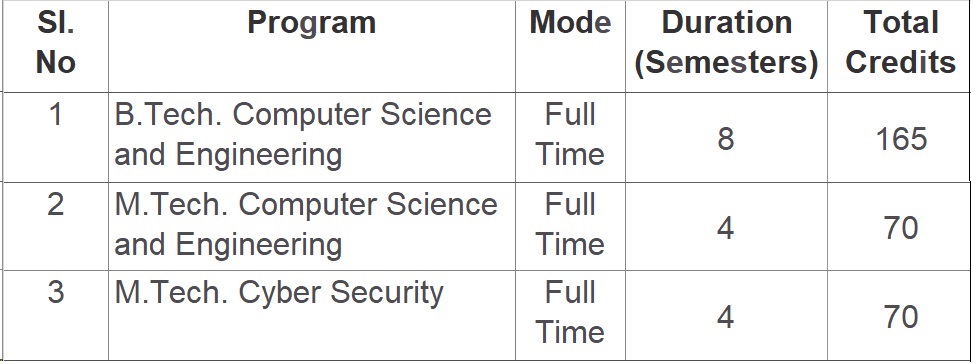
I. Programs and Credits
Course Components (B.Tech. Programs)
| Curriculum Components | Curriculum Content (% of total number of credits of the program) | Total Number of Contact Hours | Total Number of Credits |
|---|---|---|---|
| Basic Sciences | 11.87 | 570 | 19 |
| Basic Engineering | 8.75 | 420 | 14 |
| Humanities and Social Sciences | 7.5 | 360 | 12 |
| Program Core | 45.625 | 2190 | 73 |
| Program Electives | 13.125 | 630 | 21 |
| Open Electives | 3.75 | 180 | 6 |
| Project(s) | 8.75 | 420 | 14 |
| Internships/ Seminars | 0.62 | 30 | 1 |
| Any other(Please Specify) - MOOC | - | 150 | 5 |
| Total Number of Credits | 160 + 5* |
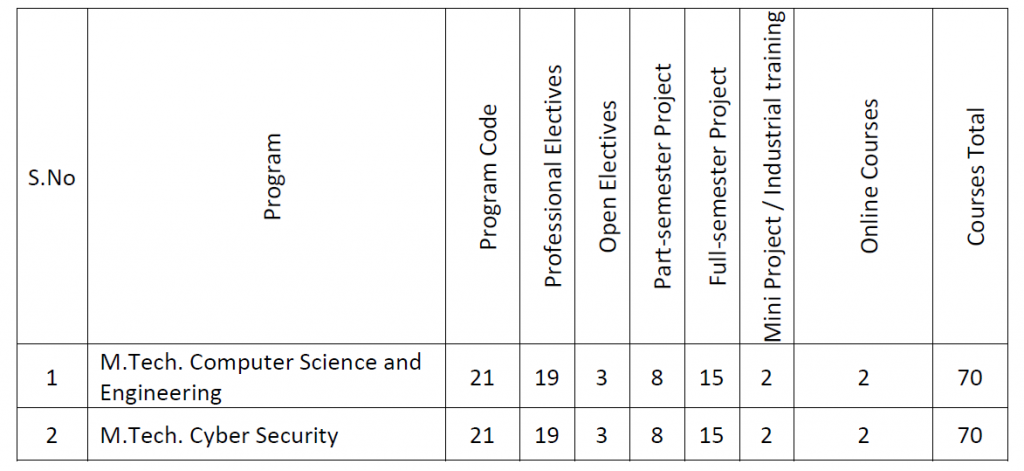
Courses & Credit Distribution (M.Tech. Programs) - 2021 -2022 Batch onwards
II. CONSTITUTION OF CURRICULUM CELLS
The Divisional Curriculum Development Cells are constituted as under for planning and updating of syllabus to be presented to the Board of Studies.
a) Divisional Curriculum Development Cell
Curriculum Development Cell is a standing internal committee with all the internal members of the BoS and AC and any other faculty co-opted / nominated by the Dean of School / HoD.
Chairman : Head of the Divisions
Secretary : Faculty nominated by HoD
b) Board of Studies
Chairman : Head of the Divisions
Internal Members : All Professors
: All Associate Professors
: Assistant Professors nominated by the HoD
External Members : One member each one from Academia, Industry and Alumni from the constituted Board.
Secretary : Faculty member nominated by the HoD.