
1. SDG Overview
Sustainable Development Goal 16 (SDG 16) promotes peaceful and inclusive societies, access to justice for all, and effective, accountable and inclusive institutions. For a higher-education institution, this goal is relevant to ethical leadership, transparent governance, student well-being, responsible citizenship, discipline, institutional accountability and the development of graduates who contribute positively to society.
Karunya Institute of Technology and Sciences (KITS) states that its vision and mission are grounded in social concern, ethical and spiritual discernment, and service to society. The Annual Report 2024–25 documents institutional governance through an Executive Council, a student mentoring system, and National Cadet Corps (NCC) activities that promote discipline, unity, responsibility and digital awareness. These activities provide institutional contributions relevant to SDG 16.
2. Institutional Policies and Commitments
SDG 16- Peace, Justice and Strong Institutions aims to promote peaceful and inclusive societies, provide access to justice for all, and build effective, accountable and transparent institutions.
For Karunya Institute of Technology and Sciences (KITS), the following institutional policies are relevant to SDG 16. They support ethical governance, transparency, accountability, equality, protection of rights, and institutional integrity.
- 16.2.1 & 16.2.2 Democratic Governance & Representation:
- Executive Council, Academic Council, and Student Mentoring/Council representation.
- 16.2.5 Financial Transparency:
- Annual audited financial statements published publicly on the university web portal.
- 16.2.6 Academic Freedom & Whistle-Blower Protection:
- Whistle-blower Policy (KITS/WBP/2025/01) and Institutional Ethics Committee guaranteeing academic freedom and reporting without fear of retaliation.
- Equity & Human Rights Protection:
- Grievance Redressal Policy, Equal Employment Opportunity Policy, Policy Against Harassment, Non-Discrimination Policy, Anti-Ragging Policy, and Internal Complaints Committee (ICC).
Grievance Redressal Policy
Establishes a fair, impartial and confidential mechanism for addressing grievances raised by students, faculty, parents and other stakeholders. Promotes accountability, transparency and access to justice.
Equal Employment Opportunity Policy
Ensures equal opportunities in recruitment, promotion, training and employment without discrimination. Supports equality, fairness and inclusive institutions.
Policy Against Harassment
Provides procedures to prevent and address harassment, protect affected individuals and ensure a safe working environment.
Whistle-blower Policy
Encourages employees to report misconduct, unethical practices and violations without fear of retaliation. Promotes institutional integrity and accountability.
Non-Discrimination and Harassment Policy for Students
Protects students against discrimination and harassment and provides mechanisms for reporting complaints and taking corrective action.
Non-Discrimination in the Admission Process Policy
Ensures transparent, fair and merit-based admission practices without discrimination based on protected characteristics.
Anti-Ragging Policy
Prevents ragging through awareness, monitoring, complaint mechanisms and disciplinary action, ensuring a safe and peaceful campus.
Policy on Sexual Harassment Prevention
Provides institutional mechanisms to prevent and address sexual harassment through the Internal Complaints Committee (ICC), ensuring a safe and just environment.
3. SDG Objectives
Promote ethical conduct, integrity, discipline and responsible citizenship among students.
Support a safe, inclusive and student-centred learning environment through mentoring, counselling and timely attention to student concerns.
Strengthen accountable institutional decision-making through established governance structures.
Develop leadership, teamwork, unity and civic responsibility through NCC training and participation in institutional activities.
Build awareness of responsible and safe use of digital platforms through student-led digital awareness activities.
4. Curriculum Integration
Karunya Institute of Technology and Sciences integrates the principles of peace, justice, human rights, ethical leadership and accountable institutions into its academic curriculum. Courses offered in Criminology and Psychology address criminal justice administration, constitutional rights, restorative justice, crime prevention, human rights, social harmony and ethical governance. These academic initiatives equip students with knowledge and skills to promote peaceful societies, uphold the rule of law and contribute to transparent, inclusive and accountable institutions.
Education for Law Enforcement, Criminology and Justice (THE Metric 16.4): KITS offers specialized full-time degree programmes through the Department of Criminology and the Department of Forensic Science (B.Sc. Forensic Science, M.Sc. Forensic Science, and B.Sc. Criminology & Criminal Justice), alongside specialized curricula in Information Security and Digital Forensics. In the 2024–25 graduating class, 142 graduates completed professional degrees dedicated to civil enforcement, forensic investigation, and justice administration.
| S.No. | Course title | Department | SDG 16 target |
|---|---|---|---|
| 1 | Fundamentals of Constitution of India | Criminology | 16.3, 16.7 |
| 2 | Police Administration | Criminology | 16.6 |
| 3 | Criminal Procedure Code | Criminology | 16.3 |
| 4 | Human Rights | Criminology | 16.3, 16.b |
| 5 | Restorative Justice | Criminology | 16.3 |
| 6 | Crime Prevention and Community Policing | Criminology | 16.1, 16.3 |
| 7 | Victimology and Victim Assistance | Criminology | 16.1, 16.3 |
| 8 | Child Protection | Criminology | 16.2 |
| 9 | Introduction to Cyber Crime | Criminology | 16.4 |
| 10 | Financial Frauds and Crime Prevention | Criminology | 16.5 |
| 11 | Forensic Psychology | Psychology | 16.3 |
| 12 | Advanced Social Psychology | Psychology | 16.1, 16.7 |
5. Research and Innovation
Publications
| Title | Authors | Year | Scopus Source title | Volume | Issue | Pages |
|---|---|---|---|---|---|---|
| RAG-Based LLM Chatbot Using Llama-2 | Vakayil, S.| Sujitha Juliet, D.| Anitha, J.| Vakayil, S. | 2024 | ICDCS 2024 - 2024 7th International Conference on Devices, Circuits and Systems | - | - | 195-199 |
| An Internet of Medical Things-Based Mental Disorder Prediction System Using EEG Sensor and Big Data Mining | Ambeth Kumar, V.D.| Surapaneni, S.| Pavitra, D.| Venkatesan, R.| Omar, M.| Bashir, A.K. | 2024 | Journal of Circuits, Systems and Computers | 33 | 11 | - |
| Birds Species Identification Using Deep Learning Model | Sherin, K.| Kelin, A.R.D.| Sanjai, P.| Senthilvelan, S. | 2024 | 2024 International Conference on Advances in Data Engineering and Intelligent Computing Systems, ADICS 2024 | - | - | - |
| Latent Semantic Analysis Based Sentimental Analysis of Tweets in Social Media for the Classification of Cyberbullying Text | Joy Winnie Wise, D.C.| Ambareesh, S.| Ramesh, B.P.| Sugumar, D.| Bhimavarapu, J.P.| Senthil Kumar, A. | 2024 | International Journal of Intelligent Systems and Applications in Engineering | 12 | 7s | 26-35 |
| Enhancing distributed agent environments with quantum multi-agent systems and protocols | Jenefa, A.| Vidhya, K.| Taurshia, A.| Naveen, V.E.| Kuriakose, B.M.| Vijula, V. | 2024 | Multiagent and Grid Systems | 20 | 2 | 109-127 |
| Online Gambling Addiction: A Study among College Students of Kerala State, India | Prakash, P.| Girdhar, S.| Jose, A. | 2024 | Pakistan Journal of Criminology | 16 | 2 | 929-942 |
| A Comparative Analysis of Machine Learning Algorithms for Crime Rate Prediction | Dileep, A.| Ramalakshmi, K.| Venkatesan, R.| Sundar, G.N.| Nancy, G.| Shirly, S. | 2024 | Proceedings of the 3rd International Conference on Applied Artificial Intelligence and Computing, ICAAIC 2024 | - | - | 732-736 |
| Pinkwashing and Capitalism Among Youth Culture | Philip, S.M. | 2024 | Forensic Justice: A Global Perspective | - | - | 105-118 |
| Government Schemes Recommendation API with Multi-Language Chatbot using RAG Vector Search and Conversational AI | Reddy, V.S.| Bell, J.B.B. | 2025 | Proceedings of the 4th International Conference on Innovative Mechanisms for Industry Applications, ICIMIA 2025 | - | - | 1667-1672 |
| Sustainable groundwater development using semi-supervised learning and community-led total forestry and pasture approach | S, U.M.| Alphy, A.| Deivasikamani, G.| Prakash, U.| Shadrach, F.D.| Kumar, M.A.| Manoj, S. | 2024 | Groundwater for Sustainable Development | 25 | - | - |
| Digital literacy initiatives, policy evaluation, and machine learning: Cyber laws and their role in safeguarding children online | Rawat, H.| Matta, P.| Singh, K.| Muzumdar, P.| Samson Arun Raj, A.| Sarangi, S.K. | 2025 | Child Protection Laws and Crime in the Digital Era | - | - | 281-303 |
| Observations on iNaturalist reveal the establishment of non-native Eucalyptus weevil Gonipterus platensis (Coleoptera: Curculionidae) in Tamil Nadu, India | H M, Y.| Viswanathan, A.| Hariharakrishnan, S.| Brown, S.D.J.| Karuppannasamy, A.| Hiremath, S.R. | 2025 | Journal of insect science (Online) | 25 | 2 | - |
| Advancements and Challenges in Flood Risk Assessment: A Scientometric Analysis of Global Trends | Singh, T.L.A.| Gautam, S.| Joshi, S.K. | 2025 | Blue Sky, Blue Water: Strategies for Protecting Air and Water Quality in the 21st Century | - | - | 395-412 |
| Biometric Authentication Voting System | Chetty, G.| Arunodhayam, T.P.P.| Maheswaran, C.P. | 2024 | Proceedings of 9th International Conference on Science, Technology, Engineering and Mathematics: The Role of Emerging Technologies in Digital Transformation, ICONSTEM 2024 | - | - | - |
| Forensic Analysis and Removal of Date-Rape Drug Present in the Spiked Drinks | Prabha, M.A.| Nesaraj, A.S.| Arunkumar, M. | 2024 | Journal of Forensic Science and Medicine | 10 | 4 | 267-273 |
| Blue Sky, Blue Water: Strategies for Protecting Air and Water Quality in the 21st Century | Gautam, S.| Joshi, S.K.| Ambade, B. | 2025 | Blue Sky, Blue Water: Strategies for Protecting Air and Water Quality in the 21st Century | - | - | 1-505 |
| Prediction of Cyberbullying Attacks on Twitter Data using ANN and NLP | Nixon, I.| Isravel, D.P.| Punitha Malar Dhas, J. | 2024 | 2024 3rd International Conference for Innovation in Technology, INOCON 2024 | - | - | - |
| Enhancing Text Classification with Cyberbullying and Machine Learning Algorithms | Denis, R.| Anita Jones Mary Pushpa, T.| Glory Sangeetha, R.| Bamane, K.D.| Sathya, S.| Selvakumar, S. | 2024 | International Research Journal of Multidisciplinary Scope | 5 | 4 | 519-530 |
| Observations on iNaturalist reveal the establishment of non-native Eucalyptus weevil Gonipterus platensis (Coleoptera: Curculionidae) in Tamil Nadu, India | Yeshwanth, H.M.| Viswanathan, A.| Hariharakrishnan, S.| Brown, S.D.J.| Karuppannasamy, A.| Hiremath, S.R. | 2025 | Journal of Insect Science | 25 | 2 | - |
| AI-Driven Open Ecosystem for Predictive and Participatory Disaster Risk Reduction | Gonsalo Godson, G.| Biju, J. | 2025 | Proceedings of the 2025 1st International Conference on Advances in Engineering and Computing Technologies for Sustainable Development, AECTSD 2025 | - | - | - |
| Model development and testing of medical negligence reduction dimensions using covariance structure analysis | Ganapathy, N.M.| Samson, S.| Linjiah, P.| Thangam, M.V. | 2025 | AIP Conference Proceedings | 3291 | 1 | - |
| Global perspectives: Comparative child protection laws across countries | Rawat, A.| Samson Arun Raj, A.| Richmond, J.O.| Rajavat, A.| González-Torres, A.| Bhardwaj, P. | 2025 | Child Protection Laws and Crime in the Digital Era | - | - | 133-153 |
| Blockchain for Cloud Security: Enhancing Trust and Data Integrity in Al- Based Systems | Seles, K.S.| Kelin, A.R.D.| Fabin, R. | 2025 | 16th International Conference on Advances in Computing, Control, and Telecommunication Technologies, ACT 2025 | 2 | - | 6224-6234 |
| The role of POSC Act in protecting children in India | Richmond, J.O.| Cinthia Jemima, N. | 2025 | Child Protection Laws and Crime in the Digital Era | - | - | 333-360 |
| Frames of Extremism: Indian Films, Human Rights Discourse, and Media Literacy | Shekhar, B.| Sahani, V. | 2024 | Indian Cinema and Human Rights: An Intersectional Tale | - | - | 173-196 |
| A study on the assessment of pollution and strategies for rejuvenation of Bharathapuzha river in Kerala, India | Anto, C.A.| Verghese, V.| Kurian, P.K.| Cyriac, M.G.| Archana, S. | 2024 | International Journal of Water | 16 | 1 | 42-68 |
| Cyberbullying Predictive Analysis on X Data with Multi Model Supervised Technique | Samsun, S.| Basil Xavier, S. | 2024 | Proceedings of the 3rd International Conference on Applied Artificial Intelligence and Computing, ICAAIC 2024 | - | - | 1524-1530 |
| Child protection laws and crime in the digital era | Rawat, R.| Sarangi, S.K.| Samson Arun Raj, A.| Richmond, J.O.| Bhardwaj, P. | 2025 | Child Protection Laws and Crime in the Digital Era | - | - | 1-520 |
| Screen time and safety: How parents can monitor and protect their kids online | Rimal, Y.| Parihar, S.| Raj, A.S.A.| Bhardwaj, P.| Rawat, A.| Sharma, A. | 2025 | Integrating Parental Consent and Child Engagement With Digital Protection Rules | - | - | 351-370 |
| The importance of parental monitoring and its impact on children's online safety | Richmond, J.O.| Cinthia Jemima, N. | 2025 | Integrating Parental Consent and Child Engagement With Digital Protection Rules | - | - | 251-279 |
| A Reflective Study on Rendering Services by The All-Women Police Station | Bhagavathy, P.G.S. | 2024 | Forensic Justice: A Global Perspective | - | - | 231-252 |
Research, Innovation and Entrepreneurship Supporting Peace, Justice and Strong Institutions
Karunya Institute of Technology and Sciences promotes research, innovation and entrepreneurship that contribute to public safety, security and social protection. Through its incubation ecosystem, initiatives such as Zephyr (women's safety technology), AI Sentinel (AI-based threat detection), Forensic Kit and Mine Detector address challenges associated with personal safety, security and forensic investigation. Patent innovations in women's safety, post-crash care and blockchain-based network security further demonstrate the institution's contribution to safer communities and secure digital environments.
Startups and incubated products related to SDG 16
| S.No. | Startup / incubated product | Innovator(s) | SDG 16 relevance |
|---|---|---|---|
| 1 | Zephyr – Empowering Women's Safety Through Smart Technology | Mr. Thomas Chandy and Ms. Rachana C. Nair | Women's safety, prevention of violence and protection from harassment (16.1, 16.2) |
| 2 | AI Sentinel – Advanced Threat Detection Using Machine Learning | Mr. Abin Shaji Thomas | Threat detection, security and prevention of potential cyber threats (16.4) |
| 3 | Forensic Kit – Rapid Action Kit to Detect Toxicity in Liquids | Mr. Rohith Sugu S, Ms. K. Iyeswarya and Ms. Anitha Mary A | Forensic investigation and support for evidence-based justice (16.3) |
| 4 | Mine Detector (Thiru Chakshu) | Mr. Joel Manu Alexander and student team | Detection of landmines and protection of people from explosive hazards (16.1) |
Patents related to SDG 16
| S.No. | Patent title | Application number | SDG 16 relevance |
|---|---|---|---|
| 1 | AI System for Post-Crash Care on Road Traffic Injuries | 202141007237 | Road safety, emergency response and protection of human life (16.1) |
| 2 | Women Safety Wearable Device | 202041046415 A | Prevention of violence against women and personal safety (16.1, 16.2) |
| 3 | Blockchain Based Network Security HUB | 216291 | Digital security and protection of information systems (16.4) |
Funded Project
Women Entrepreneurship Development Program - WEDP, DST
The Women Entrepreneurship Development Program, sanctioned on 20 September 2024 by the Department of Science and Technology (DST), is a research initiative at Karunya Institute of Technology and Sciences aimed at promoting women's entrepreneurial development. The project, led by Dr. Wasiya Farzana, focuses on empowering women through entrepreneurship and strengthening their opportunities for economic and professional participation.
The project aligns with Sustainable Development Goal 16 (SDG 16): Peace, Justice and Strong Institutions by potentially supporting women's participation in decision-making, promoting inclusive opportunities, and encouraging equitable access to institutional and entrepreneurial support systems. By fostering women's empowerment and leadership, the initiative can contribute to more inclusive and responsive institutions. Its primary focus is women's entrepreneurship, while its contribution to SDG 16 is indirect and depends on the project's implementation and outcomes.
Book Chapter
Forensic Justice: A Global Perspective (2024), edited by Beulah Shekhar and Purvi Pokhariyal, explores the role of forensic science in the criminal justice system, highlighting its contribution to criminal investigations, evidence-based decision-making and fair legal proceedings. The book addresses contemporary challenges in forensic practices and justice delivery, supporting SDG 16 – Peace, Justice and Strong Institutions, particularly Target 16.3, which promotes the rule of law and equal access to justice.
6. Events Organized Related to SDG
| # | Event | Coordinator | Date | Beneficiaries | SDG 16 target |
|---|---|---|---|---|---|
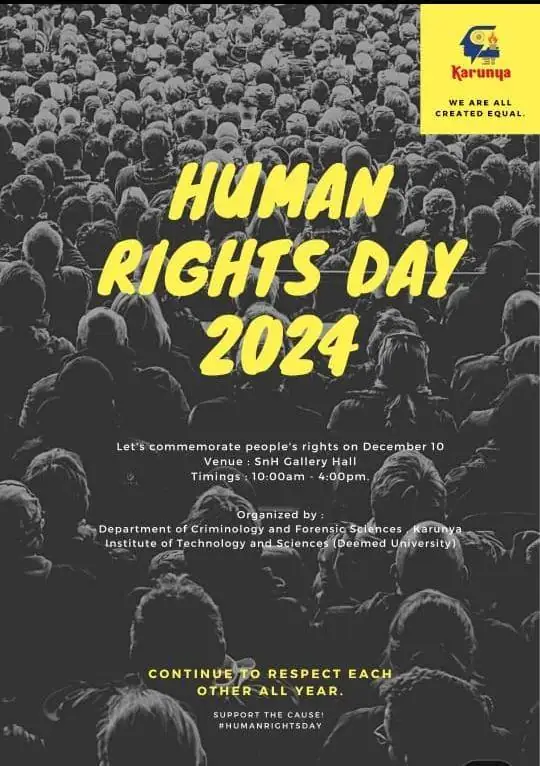
| 1 | Human Rights Day | Dr. Beulah Shekhar | 10/12/2024 | 80 | 16.10 (fundamental freedoms), 16.b (non-discriminatory laws) |
| 2 | Webinar on Legal Awareness | Dr. P.G. Sunanda Bhagavathy | 03/10/2024 | 38 | 16.3 (access to justice and rule of law) |
| 3 | Workshop on Corporate Securit | Dr. P.G. Sunanda Bhagavathy | 13/09/2024 | 45 | 16.4 (organized crime) and 16.5 (corruption and fraud), if it covered fraud or crime prevention |
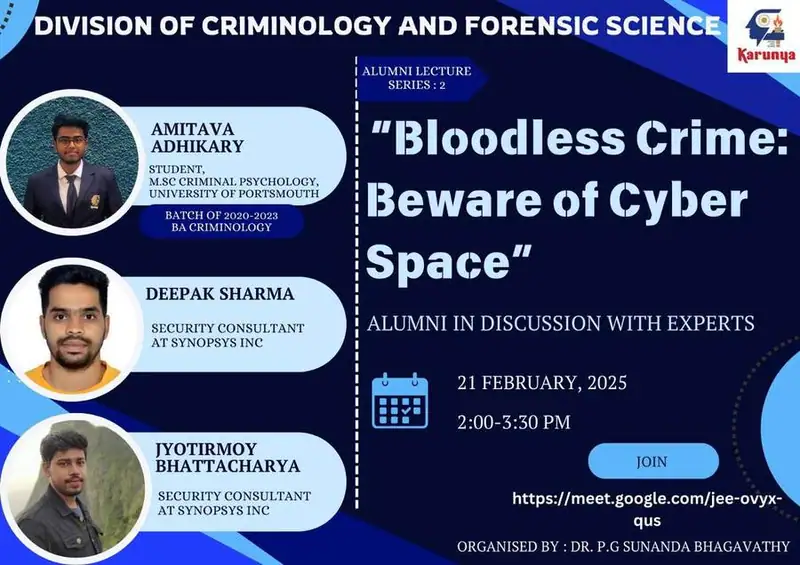
| 4 | Bloodless crime: Beware of Cyber Space | Dr. P.G. Sunanda Bhagavathy | 21/02/2025 | 38 | 16.a. It builds capacity to prevent crime, because students learn to recognise and guard against cybercrime. |
| 5 | Incel Subculture | Dr. P.G. Sunanda Bhagavathy | 25/03/2025 | 38 | 16.1. It addresses reducing violence and related deaths. Incel-linked online radicalisation has been tied to misogynistic violence and extremist attacks. |
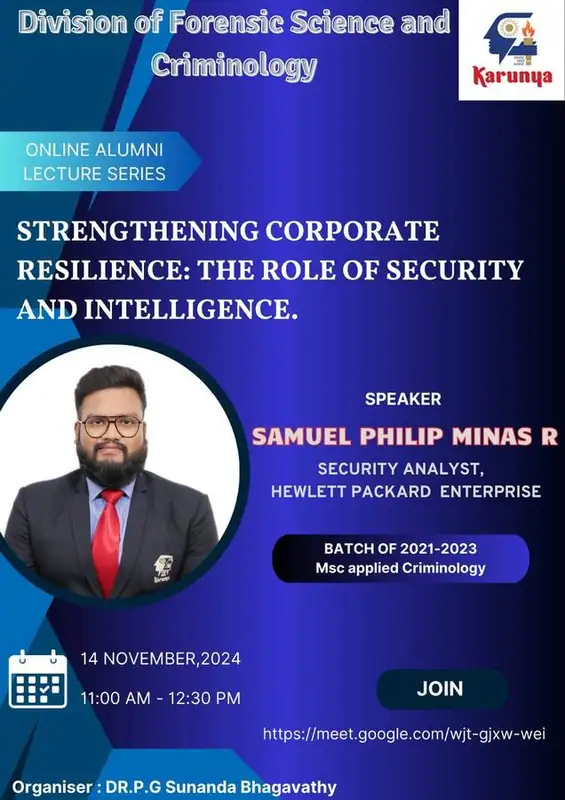
| 6 | Strengthening Corporate Resilience: The Role of Security and Intelligence | Dr. P.G. Sunanda Bhagavathy | 14/11/2024 | 38 | 16.6. Corporate resilience is about building effective, accountable, and transparent institutions. |

Short Term Certificate Programme
| 1 | Anti-Human Trafficking (Criminology and Forensic Science) | Short-term certificate programme, 30 hrs | 2024-25 | 16.2 (ending trafficking and exploitation) |
|---|---|---|---|---|
| 2 | Forensic Science & Forensic Medicine: Aid to Criminal Investigation | Short-term certificate programme, 30 hrs | 2024-25 | 16.3 (rule of law, access to justice), 16.a |
| 3 | Social Sciences and the Criminal Justice System | Short-term certificate programme, 40 hrs | 2024-25 | 16.3 |
7. Community Outreach and Extension Activities
| Sl. No. | Name of the Event | Date | Relevance to SDG 16 |
|---|---|---|---|
| 1 | EBSB (Ek Bharat Shreshtha Bharat) | 26/10/2024 to 05/11/2024 | National integration and social cohesion across states. This supports peaceful and inclusive societies (16.7). |
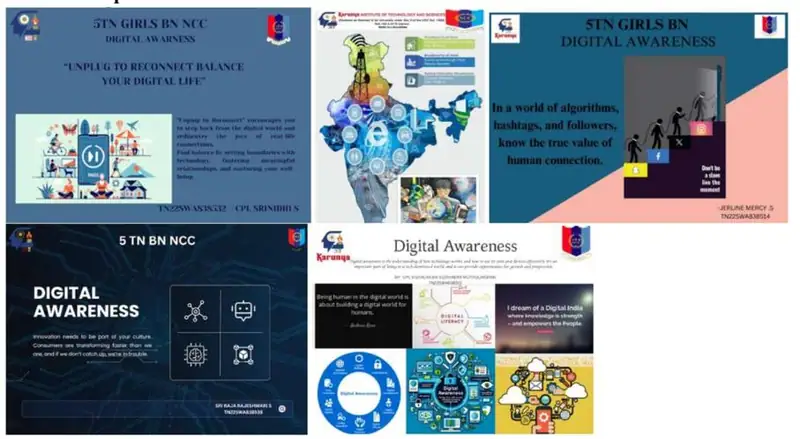
| 2 | Digital Awareness & Swabhav Swachatha Sanskar Swachatha | 21/11/2024 | Cadets made videos and posters on responsible and safe use of digital platforms. This builds awareness of cyber safety (16.a, 16.10). |
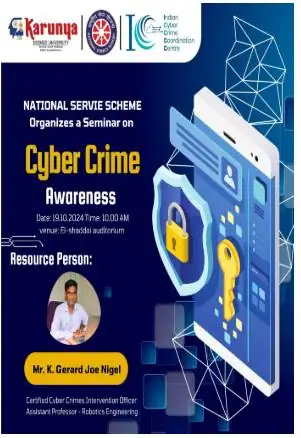
| 3 | Seminar on Cyber Crime Awareness | 19/10/2024 | Educates about cybercrime and online safety for 500 students. This builds crime-prevention capacity (16.a) and addresses cyber-enabled fraud and organised crime (16.4). |
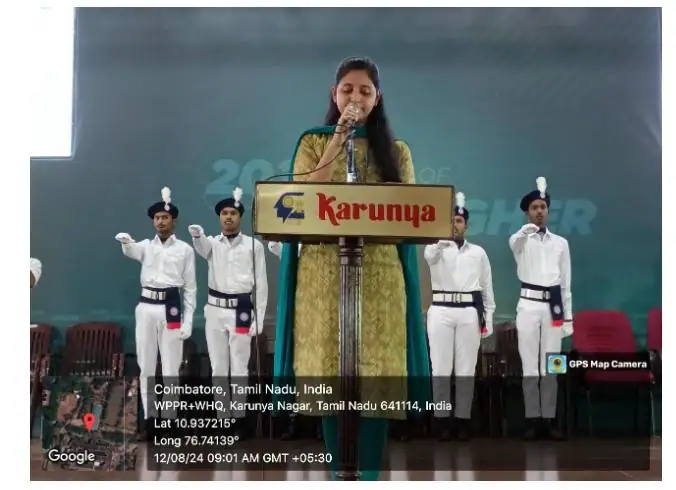
| 4 | Drug Prevention Pledge | 12/08/2024 | Pledge campaign with 1,500 participants against drug abuse and illicit drug use. It is mainly SDG 3.5 but links to curbing drug-related crime (16.4). Borderline. |
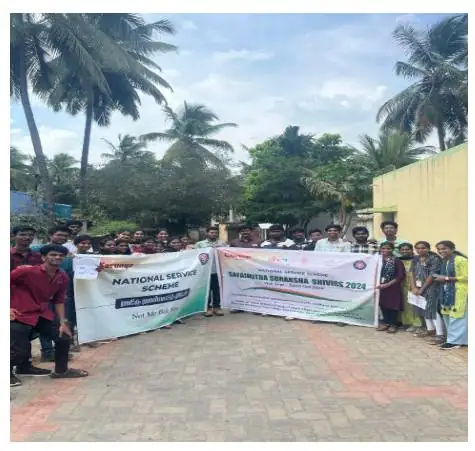
| 5 | Safaimitra Suraksha Shivirs | 28/09/2024 | Safety and welfare camps for sanitation workers, supporting their dignity and entitlements. This relates to equal rights and non-discrimination (16.b). Borderline. |
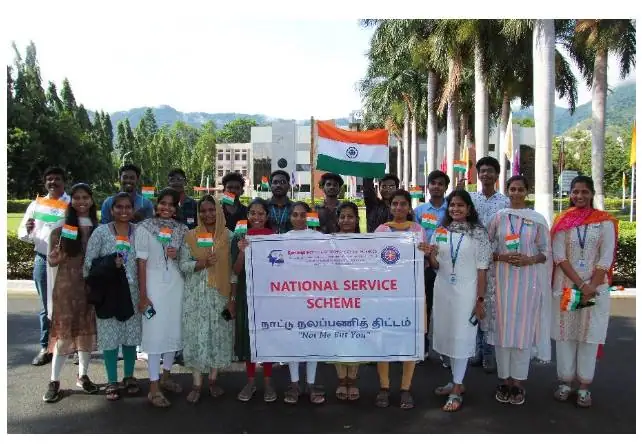
| 6 | Patriotic Rally for Independence | 15/08/2024 | Rally promoting national unity and civic values. This relates to inclusive, peaceful societies (16.7). Borderline. |
8. Partnerships and Collaborations
During 2024-25, KITS strengthened industry engagement through a formal Non-Disclosure Agreement (NDA) with Summits Hygronics Pvt. Ltd., effective 8 October 2024. The agreement provides a framework for the confidential exchange of information relating to carbon dioxide (CO₂) and hydrogen (H₂) testing, samples, and analysis, while protecting shared information against unauthorised disclosure and use.
This agreement demonstrates the importance of confidentiality, responsible information management, and clearly defined obligations in industry–academia collaboration. These practices support the principles of accountability, integrity, and responsible institutional partnerships associated with SDG 16: Peace, Justice and Strong Institutions.
KITS also entered into a Memorandum of Agreement with Amara Raja Advanced Cell Technologies Pvt. Ltd., effective 28 April 2025, to strengthen the curriculum of the five-year integrated postgraduate programme in Energy Science and Technology and align its educational objectives with industry standards. This agreement represents a subsequent institutional collaboration and falls outside the 2024–2025 academic reporting period ending 31 March 2025.
Working with Government and Law Enforcement : KITS maintains active collaborative engagement with state and national law enforcement bodies: • Tamil Nadu Police (Cyber Crime Wing): In the State Police Hackathon 2024, the KITS student team developed "Telegram Sentinel" (a specialized digital forensics crawler tracking illegal cyber-trafficking and cybercrime channels), securing the State Second Prize from senior police leadership. • District Legal Services Authority (DLSA Coimbatore): Regular collaborative legal literacy and anti-ragging camps conducted across campus residences. • State Forest & Police Departments: Deployment of sensor-based intrusion detection systems along forest-fringe human settlements.
| Partner organisation | Documented collaboration | SDG 16 relevance |
|---|---|---|
| Tamil Nadu Police - Cyber Crime Wing | Karunya students participated in the TN Police Hackathon 2024, organised by the Cyber Crime Wing. The Karunya team secured second prize for Telegram Sentinel, a digital security solution. | 16.1, 16.3 – Public safety, cybercrime prevention and support for law enforcement. |
9. Best Practices
| Sl. No. | Practice | KITS | SDG 16 target |
|---|---|---|---|
| 1 | Value education and ethics | Value Education is a core subject for all first-year students, run by a dedicated ethics department. It teaches tolerance, coexistence, justice, and peace. | 16.b, 16.7 |
| 2 | Grievance redressal | A Grievance Redressal Policy and Cell for students, faculty, and staff, plus an employee appeal channel ([email protected]) with a reply promised within 24 hours. | 16.6, 16.3 |
| 3 | Anti-corruption principles | Policies and a code of conduct on corruption and bribery, applied to keep academic processes fair and transparent. | 16.5 |
| 4 | Equality, diversity and inclusion | A written Equality, Diversity and Inclusion policy and a Disable-Friendly and Barrier-Free Environment policy, with regular reviews. | 16.b, 16.7 |
| 5 | Transparent, inclusive governance | An Executive Council and an IQAC with external members (alumni, industry, and a local-society nominee), a stated policy of publishing financial data, and a public mandatory-disclosures page (RTI, statutory committees). | 16.6, 16.10 |
| 6 | Education for justice and crime prevention | Degree programmes in Criminology, Forensic Science, and Information Security and Digital Forensics, and 2024-25 certificate programmes on Anti-Human Trafficking, Aid to Criminal Investigation, and Social Sciences and the Criminal Justice System. | 16.2, 16.3, 16.a |
| 7 | Research on peace and justice | 31 Scopus papers on SDG 16 themes, including cyberbullying detection, crime prediction, women’s safety, and policing. | 16.1, 16.a |
10. Conclusion
Karunya Institute of Technology and Sciences demonstrates an exemplary, evidence-backed institutional model for SDG 16 (Peace, Justice and Strong Institutions) during 2024–25 across four operational pillars:
1. Participatory Governance & Institutional Integrity: Enforcing eight statutory policies governing grievance redressal, whistle-blower protection, non-discrimination, anti-harassment, and equal employment opportunity, supported by an active Internal Complaints Committee (ICC) and full public disclosure of audited financial accounts.
2. Education for Justice & Civil Enforcement: Offering specialized undergraduate and postgraduate degree programmes in Forensic Science and Criminology & Criminal Justice, graduating 142 justice and enforcement professionals, supplemented by certified training in Anti-Human Trafficking and Criminal Investigation.
3. Law Enforcement Collaboration & Policy Engagement: Direct technical collaboration with the Tamil Nadu Police Cyber Crime Wing, winning the State Second Prize for the "Telegram Sentinel" cyber-forensics platform, paired with community legal literacy clinics conducted in partnership with state authorities.
4. Research in Digital Forensics, Crime Prevention & Public Safety: Production of 31 high-impact Scopus research publications (2024–2025) investigating cyberbullying detection, POCSO child protection legislation, biometric voting integrity, forensic toxicology, and All-Women Police Stations, supported by three granted security patents and student-engineered public safety technologies.