
1. SDG Overview
Sustainable Development Goal 6 (SDG 6) of the United Nations 2030 Agenda seeks to “ensure availability and sustainable management of water and sanitation for all.” Clean freshwater is a fundamental human right, a catalyst for public health, and an irreplaceable ecological prerequisite for resilient ecosystems. Specifically, SDG 6 mandates universal and equitable access to safe and affordable drinking water (Target 6.1), adequate and equitable sanitation and hygiene (Target 6.2), improving water quality by eliminating dumping and halving the proportion of untreated wastewater while substantially increasing recycling and safe reuse globally (Target 6.3), substantially increasing water-use efficiency and addressing water scarcity (Target 6.4), implementing integrated water resources management (IWRM) across all levels (Target 6.5), protecting and restoring water-related ecosystems including mountains, forests, wetlands, and rivers (Target 6.6), and expanding international cooperation and local community participation in water and sanitation management (Targets 6.a & 6.b).
Importance in the Context of Karunya Institute of Technology and Sciences (KITS):
Karunya Institute of Technology and Sciences (Declared as a Deemed-to-be University under Section 3 of the UGC Act, 1956; NAAC A++ Accredited; Approved by MoE, UGC & AICTE) operates a fully residential campus situated in the Karunya Nagar foothills of the Western Ghats, Coimbatore, Tamil Nadu. Accommodating a resident campus population of 8,528 individuals (7,863 students and 665 faculty and staff members) across 15 student residences (hostels), 17 faculty/staff apartment complexes, academic divisions, and an extensive 329-acre agricultural and biosciences research farm, KITS recognizes water stewardship as an existential institutional imperative.
Located in an ecologically sensitive rain-shadow basin characterized by severe seasonal monsoonal fluctuations and dependence on groundwater aquifers and the Siruvani reservoir, KITS functions as a living laboratory for comprehensive water sustainability. The university established the specialized Water Institute – Centre for Water Resources to pioneer advanced research in hydrology, isotope hydro-geology, membrane filtration, industrial wastewater treatment, and watershed restoration. By achieving a 99.5% wastewater treatment efficiency, reusing 100% of treated wastewater (385,204 m³/year) for irrigation, maintaining 33 rooftop rainwater harvesting structures with 33 groundwater recharge soak pits, regulating campus water distribution via smart IoT automation, and extending water engineering solutions to rural tribal settlements, KITS exemplifies institutional leadership in advancing UN SDG 6.
2. Institutional Policies and Commitments
KITS has instituted an authoritative statutory governance framework that mandates responsible water extraction, pollution prevention, wastewater treatment, circular reuse, and community water support across all university operations:
Statutory Policies, Directives & Compliance Frameworks:
| Policy / Regulatory Instrument | Statutory Code | Year | Responsible Body | Key Statutory Mandate & Scope |
|---|---|---|---|---|
| Institutional Policy on Environmental Sustainability - Green Campus, Environment & Energy Conservation | KITS/POLICY/ENV/2023/01 | 2023 | Estate Office, IQAC & Registrar | Institution-wide statutory framework governing natural resource conservation, groundwater protection, wastewater treatment, stormwater management, energy efficiency, and campus biodiversity preservation. |
| Policy on Maximizing Water Reuse (Metric 6.4.1 Policy) | KITS/POLICY/WATER/2024/02 | 2024 | Estate Office & Water Institute | Statutorily mandates 100% treatment of campus sewage and greywater; enforces mandatory dual plumbing and recycling of all treated effluent for landscape gardening and agricultural irrigation; prohibits untreated discharge. |
| Water-Conscious Building Standards Regulations | KITS/EST/BLDG-WTR/2022/03 | 2022 | Directorate of Estate & Infrastructure | Enforces mandatory installation of water-efficient plumbing fixtures (self-closing push taps, sensor fixtures), automatic wireless tank-level controllers, and rooftop rainwater collection in all existing and new campus buildings. |
| Drinking Water Quality Assurance Protocol (IS 10500:2012 Compliance) | KITS/WATER/DW-PROT/2023/04 | 2023 | Central Water Testing Laboratory & Health Cell | Mandates routine physicochemical, heavy metal, and microbiological testing of all campus drinking water sources (86 purifiers and 2 RO plants) in compliance with Bureau of Indian Standards (IS 10500:2012). |
| Integrated Watershed Stewardship & Groundwater Recharge Policy | KITS/POLICY/GW-RCHG/2022/01 | 2022 | Water Institute & School of Agricultural Sciences | Regulates sustainable abstraction from 5 open wells and 23 borewells; enforces mandatory maintenance of 33 recharge soak pits, check dams, percolation ponds, and catchment soil-moisture retention. |
| Off-Campus Community Water Support & CSR Extension Directive | KITS/DIR/COMM-WTR/2024/01 | 2024 | Directorate of Community Development & CCAC | Statutory mandate to deploy university engineering talent and material resources to support rural drinking water access, ferrocement tank installations, and water testing in adopted foothill villages. |
Evidence & Statutory Compliance All water policies are approved by the Board of Management and the Academic Council of KITS, and strictly adhere to Central Pollution Control Board (CPCB) and Tamil Nadu Pollution Control Board (TNPCB) discharge guidelines. Full gazette notifications, water audit certificates, and committee meeting minutes are accessible on the university web portal.
3. SDG Objectives
KITS has outlined explicit, measurable operational objectives to realize the targets of SDG 6 across campus management, teaching, research, and societal outreach:
1. Sustainable Abstraction & Consumption Monitoring (UN Targets 6.1 & 6.4):
Accurately meter and monitor 100% of water abstracted from 5 open wells, 23 borewells, and the Siruvani reservoir supplying 177 storage tanks, maintaining a sustainable per capita consumption benchmark (~135 lpcd for residential university operations) through digital flow meters and telemetry.
2. 100% Wastewater Treatment & Zero Untreated Discharge (UN Target 6.3):
Operate 4 specialized on-campus Sewage Treatment Plants (STPs) with a combined capacity of 2,450 KLD and 4 anaerobic Biogas plants to treat 100% of campus greywater and blackwater, achieving >99% treatment efficiency (treating 385,204 m³/year of effluent) and recovering cooking biogas.
3. Complete Circular Reuse of Treated Wastewater (UN Targets 6.3 & 6.4):
Recycle 100% of treated wastewater (385,204 m³/year) through a dedicated secondary distribution network with 113 irrigation outlets, completely replacing freshwater withdrawal for landscape gardening and 329 acres of agricultural research farm plots.
4. Free & Universal Potable Water Provision (UN Target 6.1):
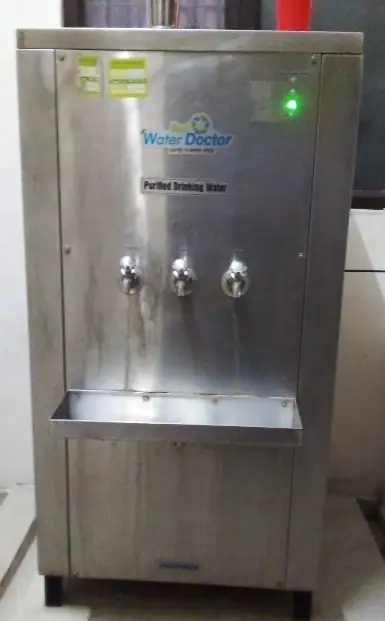
Ensure continuous, free access to safe, chilled, and tested potable drinking water for all 8,528 students, faculty, staff, and visitors through 86 water purifiers/dispensers and two commercial Reverse Osmosis (RO) plants adhering strictly to IS 10500:2012 standards.
5. Water-Conscious Building Standards & Loss Prevention (UN Target 6.4):
Maintain aggressive water conservation infrastructure across all buildings, including 3,436 self-closing push taps (56% of campus fixtures), automated wireless water-level controllers since 2019, motorized inlet valves, and permeable ground surfaces.
6. Artificial Aquifer Recharge & Stormwater Harvesting (UN Targets 6.4 & 6.6):
Maximize rainwater retention via 33 rooftop rainwater harvesting (RWH) structures, 33 dedicated groundwater recharge soak pits, a 25,000-litre ferrocement rainwater tank, farm ponds, and check dams across campus catchments.
7. Academic Excellence, Research & Community Water Security (UN Targets 6.a & 6.b):
Deliver specialized postgraduate degrees (M.Tech in Water Resources Engineering) and 46 SDG 6-mapped courses; execute high-impact research (102 Scopus papers); host international conferences (ICWRER); and empower rural communities with cost-effective ferrocement drinking water tanks (Pachinampathy) and smart irrigation clinics.
4. Curriculum Integration
KITS embeds water management, environmental sanitation, hydrology, and water resources engineering comprehensively into its academic curricula and student experiential learning programs.
Dedicated Academic Programmes & Specialized Water Degrees:
KITS offers dedicated Master of Technology (M.Tech) programmes in Water Resources Engineering and Environmental Engineering, alongside Ph.D. research programmes in hydrology, aquatic chemistry, and wastewater treatment under the aegis of the Department of Civil Engineering and the Water Institute. In AY 2024–25, specialized cohorts of postgraduate scholars and doctoral candidates were actively enrolled, conducting high-level research on isotope groundwater tracing, membrane desalination, and river basin modeling.
Undergraduate & Postgraduate Courses Directly Mapped to SDG 6 (46 Courses):
A comprehensive institutional audit reveals 46 academic courses directly mapped (from 50% to 100% curriculum content) to UN SDG 6 across Civil Engineering, Agricultural Engineering, B.Sc. Agriculture, Biotechnology, Food Processing, and Applied Sciences. Core subjects include: Hydrology and Water Resources Engineering, Design of Hydraulic Structures, Wastewater Engineering and Treatment Technology, Groundwater Hydrology and Well Hydraulics, Irrigation and Drainage Engineering, Water Quality Analysis and Monitoring, Remote Sensing and GIS in Watershed Management, Soil and Water Conservation Engineering, and Industrial Effluent Remediation.
Experiential Field Learning & Student Practical Exposure:
- Rural Agricultural Work Experience (RAWE): Undergraduate agriculture students undergo immersive rural fieldwork in villages like Mavuthampathy (Walayar) and Chittode, auditing farmer irrigation channels, demonstrating moisture-sensor scheduling, and assessing water efficiency in paddy cultivation.
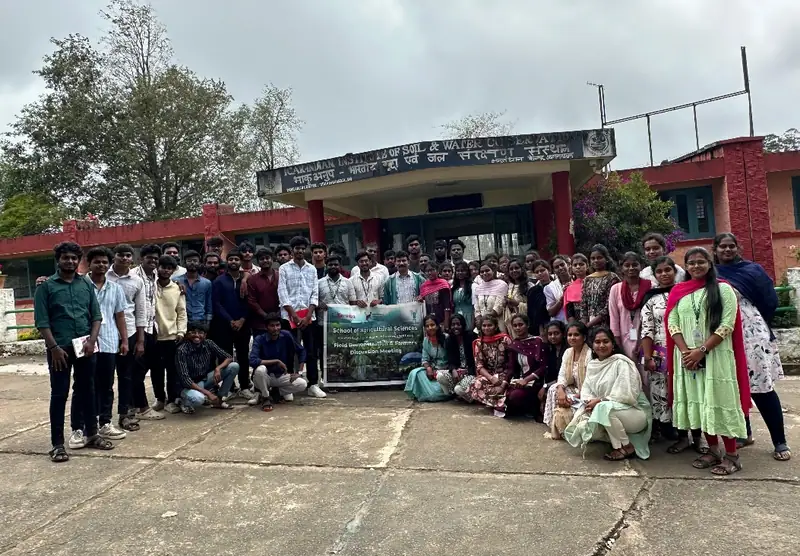
- Educational Field Study Tours: Students undertake specialized study visits to national institutions, including the Indian Institute of Soil and Water Conservation (IISWC), Ooty, studying contour bunding, gully control, and micro-catchment hydrology.
- Student Hackathons & Hydrothons: During World Water Day 2025, KITS organized a campus-wide Hydrothon and water hackathon at KTBIP Discussion Hall, where multidisciplinary student teams developed and pitched IoT leak detection prototypes, smart canal automation, and greywater filtration systems.
5. Research and Innovation
Karunya Institute of Technology and Sciences maintains a nationally recognized research ecosystem in water resources, environmental remediation, and aquatic health. Anchored by the Water Institute, the institution conducts cutting-edge research spanning wastewater biotechnology, nano-photocatalysis, electrocoagulation, microplastic contamination, and hydrological AI modeling.
Campus Water Infrastructure & Asset Architecture:
The institutional Water Asset Block Diagram illustrates the complete circular water cycle engineered across KITS: from groundwater extraction (wells/borewells) and Siruvani reservoir supply to storage, commercial RO treatment, water purifiers, institutional utilization, sewage collection, 4-stage STP treatment, and 100% recycling for campus landscaping and agricultural research:
Thematic Research Clusters in Clean Water & Sanitation:
1. Advanced Wastewater Remediation & Industrial Effluent Treatment: Development of novel electrocoagulation reactors, TiO2-coated electrodes, biopolymer-based adsorbents (chitosan, biochar, plant extracts), and inverse fluidized bed bioreactors for textile dye, heavy metal (Pb2+, Al3+), and toxic chemical removal.
2. Microplastic Contamination & Emerging Pollutants: Groundbreaking FTIR-based and chemical investigations assessing microplastic and POP transfer pathways in groundwater, rural dumping sites, freshwater wetlands (Ashtamudi), and insect-soil ecosystems.
3. Groundwater Hydrogeochemistry & Aquifer Health: Spatial analysis of fluoride contamination, nitrate-nitrite profiling, quaternary aquifer variability (Cauvery and Amaravathi river basins), and AI-based Water Quality Index (WQI) modeling.
4. IoT & AI in Precision Water Management: Development of smart automated irrigation systems, Siamese network water potability predictors, and drone-based agricultural moisture sensing.
5. River Basin Hydrology & Wetland Conservation: Remote sensing spectral index extraction (Landsat/Sentinel) to track water-spread dynamics, drought indices, and river rejuvenation strategies (Noyyal, Bharathapuzha).
Prestigious Conference Hosting - 10th ICWRER Conference:
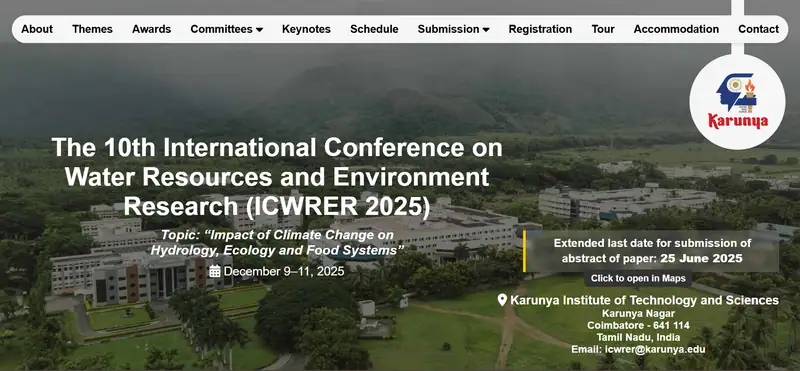
Affirming its global standing in water science, KITS was officially selected as the host institution for the prestigious 10th International Conference on Water Resources and Environment Research (ICWRER), gathering leading hydrologists, environmental engineers, and policy architects worldwide to address pressing water security challenges.
Scopus-Indexed Publications in SDG 6 (Clean Water & Sanitation) - Official University Audit:
During the reporting period (2024–2025), KITS faculty, research scholars, and students published 102 Scopus-indexed research papers directly contributing to UN Sustainable Development Goal 6. The complete audited compilation is presented below:
| S.No. | Publication Title | Authors | Year | Scopus Source Title / Journal | Vol (Issue) | Pages |
|---|---|---|---|---|---|---|
| 1 | Sustainable Solutions: Reviewing the Future of Textile Dye Contaminant Removal with Emerging Biological Treatments | Kusumlata| Ambade, B.| Kumar, A.| Gautam, S. | 2024 | Limnological Review | 24 (2) | 126-149 |
| 2 | Rational construction of MOF derived α-Fe2O3/g-C3N4 composite for effective photocatalytic degradation of organic pollutants and electrocatalytic oxygen evolution reaction | Kumaravel, S.| Avula, B.| Chandrasatheesh, C.| Niyitanga, T.| Saranya, R.| Hasan, I.| Abisheik, T.| Rai, R.S.| Pandiyan, V.| Balu, K. | 2024 | Spectrochimica Acta - Part A: Molecular and Biomolecular Spectroscopy | 310 | - |
| 3 | Predicting water quality index using stacked ensemble regression and SHAP based explainable artificial intelligence | Choudhary, R.| Kumar, A.| C, P.| Naik, M.M.| Choudhury, M.| Khan, N.A. | 2025 | Scientific Reports | 15 (1) | - |
| 4 | A sustainable and eco-friendly approach for environmental and energy management using biopolymers chitosan, lignin and cellulose — A review | Christina, K.| Subbiah, K.| Arulraj, P.| Krishnan, S.K.| Sathishkumar, P. | 2024 | International Journal of Biological Macromolecules | 257 | - |
| 5 | Sustainable management of tea wastes: resource recovery and conversion techniques | Duarah, P.| Haldar, D.| Singhania, R.R.| Dong, C.-D.| Patel, A.K.| Purkait, M.K. | 2024 | Critical Reviews in Biotechnology | 44 (2) | 255-274 |
| 6 | Application of artificial intelligence tools in wastewater and waste gas treatment systems: Recent advances and prospects | Behera, S.K.| Karthika, S.| Mahanty, B.| Meher, S.K.| Zafar, M.| Baskaran, D.| Rajamanickam, R.| Das, R.| Pakshirajan, K.| Bilyaminu, A.M.| Rene, E.R. | 2024 | Journal of Environmental Management | 370 | - |
| 7 | Influence of nickel doping and cotton stalk activated carbon loading on structural, optical, and photocatalytic properties of zinc oxide nanoparticles | Thirumoolan, D.| Ragupathy, S.| Renukadevi, S.| Rajkumar, P.| Rai, R.S.| Saravana Kumar, R.M.| Hasan, I.| Durai, M.| Ahn, Y.-H. | 2024 | Journal of Photochemistry and Photobiology A: Chemistry | 448 | - |
| 8 | Assessing variability and hydrochemical characteristics of groundwater fluoride contamination and its associated health risks in East Singhbhum district of Jharkhand, India | Ambade, B.| Sethi, S.S.| Patidar, K.| Gautam, S.| Alshehri, M. | 2024 | Journal of Hazardous Materials | 478 | - |
| 9 | FTIR based assessment of microplastic contamination in soil water and insect ecosystems reveals environmental and ecological risks | Rathikannu, S.| Gautam, S.| Joshi, S.K.| Katharine, P.| Mithra, K.E.| Banusaranya, P.| Amudhavarshini, V.M.| Gayatri, R.| Ho, C.-H. | 2025 | Scientific Reports | 15 (1) | - |
| 10 | Comprehensive assessment of microalgal-based treatment processes for dairy wastewater | Singh, P.| Mohanty, S.S.| Mohanty, K. | 2024 | Frontiers in Bioengineering and Biotechnology | 12 | - |
| 11 | Biomass as eco-friendly adsorbents for the removal of emerging pollutants from wastewater: A review | Shabbirahmed, A.M.| Jacob, A.| Dey, P.| Somu, P.| Haldar, D. | 2025 | Discover Applied Sciences | 7 (7) | - |
| 12 | IoT-Based Automatic Water Quality Monitoring System with Optimized Neural Network | Bamini, A.A.M.| Chitra, R.| Agarwal, S.| Kim, H.| Stephan, P.| Stephan, T. | 2024 | KSII Transactions on Internet and Information Systems | 18 (1) | 46-63 |
| 13 | IoT and ML-based automatic irrigation system for smart agriculture system | Anoop, E.G.| Bala, G.J. | 2024 | Agronomy Journal | 116 (3) | 1187-1203 |
| 14 | A coastal band spectral combination for water body extraction using Landsat 8 images | Aroma, R.J.| Raimond, K.| Estrela, V.V.| de Jesus, M.A. | 2024 | International Journal of Environmental Science and Technology | 21 (2) | 1767-1784 |
| 15 | Farm-era: Precision Farming with GIS, AI Pest Management, Smart Irrigation, Data Analytics, and Optimized Crop Planning | Reddy, K.P.| Roshni Thanka, M.| Edwin, E.B.| Ebenezer, V.| Stewart Kirubakaran, S.| Joy, P. | 2024 | 7th International Conference on Inventive Computation Technologies, ICICT 2024 | - | 1134-1140 |
| 16 | Multi-model exploration of groundwater quality and potential health risk assessment in Jajpur district, Eastern India | Sabinaya, S.| Mahanty, B.| Rout, P.R.| Raut, S.| Sahoo, S.K.| Jha, V.| Sahoo, N.K. | 2024 | Environmental Geochemistry and Health | 46 (2) | - |
| 17 | Nanozymes as Catalytic Marvels for Biomedical and Environmental Concerns: A Chemical Engineering Approach | T, S.K.| BS, M.N.D.| Babu, L.R.| Paul, A.E.| Murugan, S.| Periakaruppan, R. | 2024 | Journal of Cluster Science | 35 (3) | 715-740 |
| 18 | Advancements in soil moisture estimation through integration of remote sensing and artificial intelligence techniques | P, H.| Gautam, S.| Joshi, S.K.| Asirvatham, L.G.| Rakshith, B.L. | 2025 | Science of the Total Environment | 1001 | - |
| 19 | Biofilm-associated microplastic contamination in rural soil and water: emerging hazards to ecosystems | Rakshith, B.L.| Gautam, S.| Asirvatham, L.G.| Kshetrimayum, N.| Keisham, S.| Patrik, G.| Akash, A. | 2025 | Science of the Total Environment | 1004 | - |
| 20 | Optimized phenol degradation and lipid production by Rhodosporidium toruloides using response surface methodology and genetic algorithm-optimized artificial neural network | Singh, S.| Mahanty, B.| Gujjala, L.K.S.| Dutta, K. | 2024 | Chemosphere | 363 | - |
| 21 | Nanomaterials and Microbial Compatibility: Synergistic and Antagonistic Mechanisms | Sathyamoorthy, S.| Venugopal, A.| Lenin, M.J.| Tirkey, S.| Sevanan, M. | 2025 | Nano-Bioremediation for Wastewater Treatment | - | 35-72 |
| 22 | Dynamic change analysis of water spread region and its impact assessment using spectral indices of remotely sensed data | Anand, B.| Rekha, R.S.| Remitha, K.R.| Maniyammai, V.| Ramaswamy, K.| Gautam, S. | 2024 | Environment, Development and Sustainability | 26 (7) | 17635-17652 |
| 23 | The influence of operational factors on the photocatalytic degradation of methylene blue dye in aqueous Sr-Au-ZnO suspensions under UV-A light | Senthilraja, A.| Durai, M.| Mohanty, S.S.| Kumaravel, S.| Medidi, R.S.| Periyasami, G.| Kaliyamoorthy, S.| Balu, K.| Ahn, Y.-H.| Shanthi, M. | 2025 | Journal of Molecular Structure | 1321 | - |
| 24 | Utilizing banana peduncle as an affordable bio-adsorbent for efficient removal of lead ions from water and industrial effluents | Muthusamy, P.| Murugan, S.| Mandal, S.K.| Mishra, B.| Mohanta, Y.K.| Sarma, H.| Narayan, M. | 2024 | Sustainable Chemistry for the Environment | 7 | - |
| 25 | Understanding Microplastic Pollution in Groundwater: Pathways, Health Implications and Solutions | Sumam, S.B.| Gautam, S.| Arulraj, P. | 2025 | Water Environment Research | 97 (7) | - |
| 26 | Crop water management using machine learning-based evapotranspiration estimation | Meenal, R.| Jala, P.K.| Samundeswari, R.| Rajasekaran, E. | 2024 | Journal of Applied Biology and Biotechnology | 12 (2) | 198-203 |
| 27 | A reversible fluorescent chemosensor based on a naphthalene dyad for Pb(II) ions: Applications in food, water, and bio-imaging | David, C.I.| Prabakaran, G.| Narmatha, G.| Luther, J.M.| Manigandan, S.| Muthusamy, A.| Kayalvizhi, R.| Kannan, V.R.| Kumar, R.S.| Nandhakumar, R. | 2024 | Journal of Food Composition and Analysis | 133 | - |
| 28 | Facile synthesis of 3D graphite incorporated double doped ZnO nanocomposite material with enhanced photocatalytic properties: Evaluation of ecotoxicity and phytotoxicity | Kuruvilla, E.| Samson Nesaraj, A.| Jose, V.| Jose, V.| Dhanasekaran, P.| Arunkumar, M. | 2024 | Inorganic Chemistry Communications | 162 | - |
| 29 | Spatio-temporal patterns of land use and land cover, and their impact on groundwater quality in the industrialized Muvattupuzha basin | Alagulakshmi, K.| Arulraj, G.P.| Gautam, S.| Joshi, S.K. | 2025 | Scientific Reports | 15 (1) | - |
| 30 | Plant-based biopolymers for wastewater pollutants mitigation | Harshan, K.| Rajan, A.P.| Kingsley, D.| Sheikh, R.A.| Aashmi, J.| Rajan, A.P. | 2024 | Physical Sciences Reviews | 9 (5) | 1973-1989 |
| 31 | Multifunctional biogenic Al-doped zinc oxide nanostructures synthesized using bioreductant chaetomorpha linum extricate exhibit excellent photocatalytic and bactericidal ability in industrial effluent treatment | Somu, P.| Khanal, H.D.| Gomez, L.A.| R, V.| Shim, J.-J.| Lee, Y.R. | 2025 | Biomass Conversion and Biorefinery | 15 (15) | 22025-22040 |
| 32 | Production of biochar from Keppaphycus alvarezii (macroalgae) for the removal of eosin yellow: desorption, kinetic, and isotherm studies | Elayappan, T.| Jayanarayanan, B.| Daniel, A.P. | 2024 | Biomass Conversion and Biorefinery | 14 (21) | 27697-27708 |
| 33 | Development of biopolymers from microbes and their environmental applications | Nambiar, K.| Kumari, S.P.| Devaraj, D.| Sevanan, M. | 2024 | Physical Sciences Reviews | 9 (4) | 1903-1929 |
| 34 | Rainfall Prediction using Machine Learning Algorithms | Sai, P.S.| Thiyagu, T.M.| Soumya, P.G. | 2024 | Proceedings of the 3rd International Conference on Applied Artificial Intelligence and Computing, ICAAIC 2024 | - | 677-681 |
| 35 | Adsorption isotherms and kinetic studies for the defluoridation from aqueous solution using eco-friendly natural adsorbent like Terminalia Chebula | Sumathi, J.| Benedict, B.A.| Sheela, L.S.| Bhagavathsingh, J.| Manickam, V. | 2024 | Sustainable Chemistry for Climate Action | 4 | - |
| 36 | Spatial analysis and assessment of soil erosion in the southern Western Ghats region in India | B, A.| K.R, R.| R, S.R.| M, M.D.| K, R. | 2024 | Environmental Monitoring and Assessment | 196 (9) | - |
| 37 | Water quality degradation and eutrophication risk in the Ashtamudi wetland: role of physicochemical factors and microplastics | K Biju, M.| J, B. | 2025 | Environmental Monitoring and Assessment | 197 (12) | - |
| 38 | Redefining Supply Chain Practices in the Textile Industry – Sustainable Development through Blockchain Technology | Sadurya, G.| Selvaranee, J.K. | 2025 | Textile and Leather Review | 8 | 273-303 |
| 39 | Modelling selenite and chemical oxygen demand removal in an inverse fluidized bed bioreactor using genetic algorithm optimized artificial neural network | Sinharoy, A.| Mahanty, B.| Behera, S.K.| Mehta, M.| Mantri, S.| Das, R.| Saikia, S.| Rene, E.R.| Pakshirajan, K. | 2024 | Journal of Chemical Technology and Biotechnology | 99 (1) | 247-258 |
| 40 | Smart Waste Bins using DCNN and Internet of Things | Ande, A.| Sundar, G.N.| Thomas, R.| Nair, V.| Narmadha | 2024 | 2nd International Conference on Emerging Trends in Information Technology and Engineering, ic-ETITE 2024 | - | - |
| 41 | Natural biopolymer mediated green synthesis of silver nanoparticles and its applications in environmental remediation | Shobana, N.| Prakash, P.| Samrot, A.V.| Saigeetha, S.| Dhiva, S.| Thirumurugan, A.| Rajalakshmi, D.| Renitta, R.E.| Abirami, S. | 2025 | Biomass Conversion and Biorefinery | 15 (1) | 531-544 |
| 42 | Insights into azithromycin biodegradation by freshwater microalgae Chlorella thermophila: Assessing removal kinetics and co-metabolic activity | Mohanty, S.S.| Mohanty, K. | 2025 | Journal of Hazardous Materials Advances | 19 | - |
| 43 | Creating and analyzing Sb–TiO2 photocatalysts for effective UV-A light degradation of RR 120 and MO dyes | Balu, K.| Abisheik, T.| Michele Gomez, L.A.| Durai, M.| Tiffany, M.| R, V.| Afzal, M.| Yadav, A.K.| Pandiyan, V.| Ahn, Y.-H. | 2024 | Journal of the Indian Chemical Society | 101 (12) | - |
| 44 | Performance analysis of groundwater quality index models for predicting water district in Tamil Nadu using regression techniques | Anitha Mary, X.| Sharma, B.| Johnson, I.| Chalmers, J.| Karthik, C.| Chowdhury, S. | 2025 | International Journal of Computational Materials Science and Engineering | 14 (2) | - |
| 45 | Desalination Performance of Multi-Walled Carbon Nanotubes Added Polymeric Nanocomposite Membrane | Megha, M.| Elangovan, Y.| Pramada, S.K.| Jegathambal, P.| Nidheesh, P.V. | 2024 | Water, Air, and Soil Pollution | 235 (12) | - |
| 46 | Advanced Weather Monitoring and Disaster Mitigation System | Paul, D.J.| Janani, S.P.| Ancy Jenifer, J. | 2024 | 2024 International Conference on Cognitive Robotics and Intelligent Systems, ICC - ROBINS 2024 | - | 540-546 |
| 47 | Production of power and fresh water using renewable energy with thermal energy storage based on fire hawk optimization | Rajesh, P.| Gandla, P.K.| Robinson Smart, D.S.| Prayagi, S.V. | 2024 | Intelligent Decision Technologies | 18 (1) | 509-532 |
| 48 | Correction to: Multifunctional biogenic Al-doped zinc oxide nanostructures synthesized using bioreductant chaetomorpha linum extricate exhibit excellent photocatalytic and bactericidal ability in industrial effluent treatment (Biomass Conversion and Biorefinery, (2025), 15, 15, (22025-22040), 10.1007/s13399-022-03177-7) | Somu, P.| Khanal, H.D.| Gomez, L.A.| Vinaykumar, R.| Shim, J.-J.| Lee, Y.R. | 2025 | Biomass Conversion and Biorefinery | 15 (15) | - |
| 49 | Impact of Indoor Environment and Biological Processes on Bioaerosol Levels in a University Wastewater Treatment Lab | Upadhyay, R.| Przystaś, W.| Gautam, S. | 2024 | Water, Air, and Soil Pollution | 235 (9) | - |
| 50 | Assessing titanium vs. aluminium electrodes for wastewater remediation in the small-scale industries (SSI) textile sector | Sebastian, S.L.| Kalivel, P.| Subbiah, K.| Murphy, M.S.A.| David, J.J.| Palanichamy, J. | 2024 | Environmental Nanotechnology, Monitoring and Management | 21 | - |
| 51 | Adaptive Water Quality Potability Prediction and Analysis Through GEM Continual Learning Algorithm for Sustainable Resource Management | Jeremy David, C.| Shibin, D. | 2024 | 10th International Conference on Advanced Computing and Communication Systems, ICACCS 2024 | - | 1733-1738 |
| 52 | Variability of ground water quality in quaternary aquifers of the cauvery and vennar sub-basins within the Cauvery Delta, Southern India | Kokkat, A.| Mondal, N.C.| SajilKumar, P.J.| James, E.J. | 2024 | Sustainability of Natural Resources: Planning, Development, and Management | - | 199-230 |
| 53 | A captivating approach to elevate the detection of Al3+ ions incorporates the utilization of a tripodal receptor intricately embellishing the surface of zinc oxide | Tamil Selvan, G.| Samson, J.| Rajasingh, P.| Li, X.| Ravi Kumar, A.| Zhu, N.| Kuldeep, S.A.| Mosae Selvakumar, P.| Jun Tang, P.| Zhang, Z. | 2024 | Spectrochimica Acta - Part A: Molecular and Biomolecular Spectroscopy | 316 | - |
| 54 | Reuse and Recovery of Water from Industrial Textile Dyeing Effluent Using High-Performance Electrodes Continuous Flow Electrocoagulation Reactor | Jegathambal, P.| Brunoc| Shobina| Mayilswamy, C.| Parameswari, K. | 2024 | Nature Environment and Pollution Technology | 23 (3) | 1461-1470 |
| 55 | Sustainable groundwater development using semi-supervised learning and community-led total forestry and pasture approach | S, U.M.| Alphy, A.| Deivasikamani, G.| Prakash, U.| Shadrach, F.D.| Kumar, M.A.| Manoj, S. | 2024 | Groundwater for Sustainable Development | 25 | - |
| 56 | Urban wetlands as buffers against airborne microplastics and associated pollutants: Implications for public health and sustainable urban management | Gautam, S.| Rathikannu, S.| Marbaniang, G.C.| Gupta, P.| Varghese, D.G.| Ho, C.-H. | 2025 | Journal of Hazardous Materials Advances | 20 | - |
| 57 | Investigating the efficiency of electrocoagulation using similar/dissimilar electrodes for the detoxification of Coralene Rubine dye: a cost effective approach | David, J.J.| Stephen, A.M.M.| Kavitha, S.| Krishnan, S.K.| Mariappan, S.| Sebastian, S.L.| Palanichamy, J.| Kalivel, P.| Sathishkumar, P. | 2024 | Environmental Geochemistry and Health | 46 (9) | - |
| 58 | Fundamentals and applications of carbon nanotube-based carbocatalysts for water treatment | Kadarkarai, G.| Arumugam, A.| Subramanian, U.M.| Mohan, R. | 2024 | Woodhead Publishing Series in Composites Science and Engineering: Nanocomposites for Environmental, Energy, and Agricultural Applications | - | 3-39 |
| 59 | IoT Based Water body & Canal Management system using Cloud Technology | Shyaam Sankar, M.| Janani, S.P.| Ancy Jenifer, J.| Stewart Kirubakaran, S. | 2024 | Proceedings - 2024 4th International Conference on Pervasive Computing and Social Networking, ICPCSN 2024 | - | 850-854 |
| 60 | Evaluation of toxicity in real-time textile effluents post-treatment using Sorghum bicolor and Danio rerio-Potential for reuse | David, J.J.| Maria Stephen, A.M.| Sebastian, S.L.| Krishnan, S.K.| Kavitha, S.| Kalivel, P.| Palanichamy, J. | 2024 | Desalination and Water Treatment | 320 | - |
| 61 | Electrocoagulation using Ti/Ti for the remediation and reuse of aqueous Dispersive Blue-79 | Sebastian, S.L.| Kalivel, P.| Subbiah, K.| David, J.J.| Stephen, A.M.M.| Palanichamy, J. | 2024 | Environmental Monitoring and Assessment | 196 (2) | - |
| 62 | Exploring chitosan nanocomposites for wastewater treatment via solid phase extraction biorefinery | Gowri Lakshmi, S.| Gomez, L.A.| Shepherd, R.| Chandrapragasam, V.| Vijay, V.| Thathapudi, J.J. | 2024 | Bio Refinery of Wastewater Treatment: Way to Generate Waste to Value | - | 271-287 |
| 63 | Identifying Drought-Tolerant Rice Genotypes using Drought Response Indices and Machine Learning | Daniels, D.A.| Binodh, A.K.| Raimond, K.| Thankappan, S. | 2024 | 2024 International Conference on Cognitive Robotics and Intelligent Systems, ICC - ROBINS 2024 | - | 305-311 |
| 64 | Advancements and Challenges in Flood Risk Assessment: A Scientometric Analysis of Global Trends | Singh, T.L.A.| Gautam, S.| Joshi, S.K. | 2025 | Blue Sky, Blue Water: Strategies for Protecting Air and Water Quality in the 21st Century | - | 395-412 |
| 65 | Blue Sky, Blue Water: Strategies for Protecting Air and Water Quality in the 21st Century | Gautam, S.| Joshi, S.K.| Ambade, B. | 2025 | Blue Sky, Blue Water: Strategies for Protecting Air and Water Quality in the 21st Century | - | 1-505 |
| 66 | Microplastic and POP contamination in rural waste-dumping sites, India | Gautam, S.| Rakshith, B.L.| Asirvatham, L.G.| Haokip, J.M.| Kumar, A.| Khongsai, L.| Khongsai, L.| Ho, C.-H. | 2025 | Frontiers in Environmental Science | 13 | - |
| 67 | Precision Cultivation for Bonsai through IoT Implemented Smart Irrigation | Daniel, V.| Ramalakshmi, K.| Venkatesan, R.| Sundar, G.N.| Nancy, G.| Shirly, S. | 2024 | Proceedings of the 3rd International Conference on Applied Artificial Intelligence and Computing, ICAAIC 2024 | - | 1908-1913 |
| 68 | Prediction of Potential Evapotranspiration Using Climatic Parameters Using Machine Learning Techniques and Univariate Forecasting | Ignatius Baptist, N.N.| Raimond, K.| Brema, J.| Srinithisathian, S. | 2025 | Proceedings of 2025 2nd International Conference on Cognitive Robotics and Intelligent Systems, ICC - ROBINS 2025 | - | 352-357 |
| 69 | Investigation of bismuth vanadate nanorods incorporated with banana peel biochar: multifunctional exploration as a photocatalyst and supercapacitors | Nixon, P.D.| Raveendran, A.| Gnanaraj, M.A.| Jayaseelan, E.| Preeyanghaa, M.| Ananthi, N.| Wabaidur, S.M.| Dhanusuraman, R. | 2025 | Journal of Materials Science: Materials in Electronics | 36 (30) | - |
| 70 | Fate of Micro/Nano Plastic Pollutants in the Marine Ecosystem | Thathapudi, J.J.| Gomez, L.A.| Vijay, V.| Chandrapragasam, V.| Shepherd, R.| Paul, S.| Lee, M.-J.| Somu, P. | 2024 | Remediation of Plastic and Microplastic Waste | - | 203-214 |
| 71 | An Investigation on the Treatment of Wastewater Disperse Dye by Electrocoagulation and Examine the Use of the Treated Dye for Flora and Fauna | Asath Murphy, M.S.| Jovitha, J.D.| Robin, R.S.| Sahaya, L.S.| Palanichamy, J.| Parameswari, K. | 2024 | Iranian Journal of Chemistry and Chemical Engineering | 43 (5) | 1970-1983 |
| 72 | Simultaneous Assessment of the Nitrates and Nitrites in the Ground Water Samples using Optical Spectrophotometry and Validating the Appropriate Wavelength of Measurement | Suguna Devakumari, M.| Shahbazi, K. | 2024 | Agricultural Science Digest | 44 (2) | 244-249 |
| 73 | Advancements in toxic elements extraction for enhanced instrumental profiling | Ray, S.| Jangid, C.| Supreethee, S.| Gracy Anu, K.F.| Pathak, S.S.| Chavan, P.| Vashishth, R. | 2025 | Discover Applied Sciences | 7 (5) | - |
| 74 | Combined tactic of seasonal changes and ionic processes of groundwater in Tamirabarani river basin, India | Chellaiah, G.| Ayyamperumal, R.| Rengaraj, B.| Gopalakrishnan, G.| Senapathi, V.| Chengjun, Z.| Huang, X. | 2024 | Environmental Science and Pollution Research | 31 (41) | 54262-54280 |
| 75 | Feature-Optimized Multiclass Water Quality Detection in Kerala's Medium Minor Rivers Using Siamese Networks | Akash, P.V.| Babu, N.V. | 2025 | 2025 IEEE 2nd International Conference on Advances in Modern Age Technologies for Health and Engineering Science, AMATHE 2025 - Proceedings | - | - |
| 76 | Sustainable Strategies and Innovative Solutions for Protecting Blue Sky and Blue Water to Enhance Environmental Health | Mary, I.T.B.| Paul, J.J.| Rose, J.S.| Terence, J.S. | 2025 | Blue Sky, Blue Water: Strategies for Protecting Air and Water Quality in the 21st Century | - | 475-501 |
| 77 | Green Revolution to Restore Contaminated Soil for a Sustainable Future | Jamunasri, N.| Rai, R.S.| Chandrapragasam, V.| Gomez, L.A.| Shepherd, R.| Thathapudi, J.J. | 2025 | Environmental Science and Engineering | 256 | 481-504 |
| 78 | Avenues and opportunities of detoxification of micropollutants from industrial effluent using advanced biological treatment techniques | Kandasamy, S.| Babu, S.A.| Dwaraka, S.J.B.| Naveenkumar, M.| Nandakumar, N.P.| Subbiah, K. | 2024 | Emerging Innovative Trends in the Application of Biological Processes for Industrial Wastewater Treatment | - | 27-41 |
| 79 | Visible-light driven photocatalytic degradation of organic dyes by carbonized palladium-impregnated graphene oxide quantum dots | Raja Sekhar, M.| Basavegowda, N.| Gomez, L.A.| Shabbirahmed, A.M.| Krishnegowda, P.G.| Sivalingam, S.| Sekar, R.| Jayakodi, S.| Lee, M.-J.| Somu, P. | 2025 | Inorganic and Nano-Metal Chemistry | 55 (9-10) | 1019-1030 |
| 80 | Treatment of acidic electroplating effluent from small scale industries using batch and continuous flow adsorption reactor | Anand, A.M.| Jegathambal, P.| Jannet, S.| Mayilswami, C. | 2024 | Engineering Research Express | 6 (1) | - |
| 81 | AI-IoT based Water Quality Forecasting and Pollution Trend Analysis | Gade, U.| Jacob, P.M. | 2025 | Proceedings of 5th International Conference on Ubiquitous Computing and Intelligent Information Systems, ICUIS 2025 | - | 1435-1440 |
| 82 | Unleashing Blockchain’s Potential in Water Governance Toward Transparent and Equitable Resource Management | Reyana, A.| Mathu, T.| Daniel, E. | 2025 | Blue Sky, Blue Water: Advances in Air Pollution, Climate Resilience, and Water Governance for Sustainable Futures | - | 198-212 |
| 83 | Securing and Preserving the Support of the Community for the Implementation of the Continuous Water Supply System in India | Jayaseelan, D.| Chellaiah, G.| Neogi, A.| Bockhoff, N.| Sivan, P.P.| Sunilkumar, A.| Thankachan, A. | 2024 | Water Resources Development and Management | 2884 | 253-273 |
| 84 | Fine-tuned GWOMFO-based hybrid deep learning approach for rainfall prediction | Kiruthika Devi, B.S.| Manjunatha, B.| Thirumalraj, A.| Sharma, T. | 2025 | International Journal of Advanced Technology and Engineering Exploration | 12 (131) | 1610-1622 |
| 85 | Treatment of Synthetic Coking Wastewater Using a Sequential Oxic-Anoxic Upflow Packed Bed Bioreactor System | Barik, M.K.| Sahoo, N.K.| Mahanty, B.| Rout, P.R. | 2025 | Journal of Hazardous, Toxic, and Radioactive Waste | 29 (3) | - |
| 86 | Ecology and diversity of microbial communities involved in the removal of priority contaminants and micropollutants in wastewater treatment systems | Shepherd, R.| Vijay, V.| Nair, A.| Rai, R.S.| Chandrapragasam, V.| Gomez, L.A.| Thathapudi, J.J. | 2024 | Trends in Biological Processes in Industrial Wastewater Treatment | - | 3.1-3.14 |
| 87 | Blockchain and IoT for Smart Water Management: Addressing Scarcity and Ensuring Sustainability | Latha, C.B.C.| Paul, S.| Sonia, S.V.E.| Eslamian, S. | 2025 | Blockchain Technology for Water and Environmental Systems | - | 75-94 |
| 88 | Explainable Regression Models for Crop Productivity Prediction | Tripurna, N.| Magneta, S.C. | 2025 | 4th International Conference on Applied Artificial Intelligence and Computing, ICAAIC 2025 | - | 259-264 |
| 89 | Monsoon Shifts and Their Impact on Air Quality and Weather: A Case Study of the Amaravathi River Basin, India | Kumar, R.P.| Brema, J.| Gautam, S.| Catherina, G. | 2024 | Aerosol Optical Depth and Precipitation: Measuring Particle Concentration, Health Risks and Environmental Impacts | - | 211-228 |
| 90 | Pre and Post Harvesting Monitoring System using Machine Learning | Reddy, N.D.P.| Kavitha, M.S.T.| Reddy, N.I.V. | 2025 | 16th International Conference on Advances in Computing, Control, and Telecommunication Technologies, ACT 2025 | 2 | 10989-10995 |
| 91 | Microbial immobilization as an adept bioremediation tool for dye degradation | Krishnan, S.K.| Subbiah, K.| Subramanian, K.| Kandasamy, S. | 2024 | Emerging Innovative Trends in the Application of Biological Processes for Industrial Wastewater Treatment | - | 71-90 |
| 92 | Predicting Water Quality Parameters Using LSTM Models | Nisharga, M.R.| Narmadha| Sundar, N. | 2025 | AIP Conference Proceedings | 3204 (1) | - |
| 93 | A study on the assessment of pollution and strategies for rejuvenation of Bharathapuzha river in Kerala, India | Anto, C.A.| Verghese, V.| Kurian, P.K.| Cyriac, M.G.| Archana, S. | 2024 | International Journal of Water | 16 (1) | 42-68 |
| 94 | Intelligent Algorithm-Based Neural Modeling of Two Suspended Growth Bioreactor Systems for Wastewater Treatment | Pravin Kumar, N.| Mahanty, B.| Das, R.| Behera, S.K. | 2025 | Environmental Quality Management | 35 (2) | - |
| 95 | Microbial taxonomic profiling of textile industry effluent from Tiruppur, Tamil Nadu for water recycling using Kaiju metagenome classifier | Iyer, A.| Murugan, S. | 2025 | Ecological Genetics and Genomics | 35 | - |
| 96 | Optimizing Pyramid Solar Still Performance using Response Surface Methodology and Artificial Neural Networks | Immanuel, D.G.| Isaac, S.| Kaur, A.| Pearlin, E.| Bohidar, S.K.| Manikandan, R. | 2024 | Journal of Environmental Nanotechnology | 13 (4) | 505-517 |
| 97 | Reproductive physiology of small millets - An overview | Samundeswari, R.| Kurien, S.| Sunil, J.A.| Ramchander, S.| Lydia Pramitha, J.| Poonguzhali, R.S.| Anitha, M. | 2025 | Plant Science Today | 12 (1) | 1-9 |
| 98 | Microbial Therapy for Recovery of Contaminated Agricultural Soil | Laurence, L.A.| Rai, R.S.| Chandrapragasam, V.| Gomez, L.A.| Shepherd, R.| Thathapudi, J.J. | 2025 | Environmental Science and Engineering | 256 | 273-282 |
| 99 | Comparison of high-performance TiO2-coated Al electrode (TiO2/Al) and conventional electrodes in removal of dyes using electrocoagulation reactor | Vinodha, S.| Jegathambal, P.| Vidhya, R.| Sivakami, A. | 2025 | International Journal of Environment and Waste Management | 37 (4) | 415-432 |
| 100 | Synthetic Microbial Consortia for Targeted Biodegradation of Butachlor and Related Herbicides | Mohanty, S.S.| Jena, H.M. | 2025 | Industrial Biotechnology | - | - |
| 101 | Enhanced Feedback Residual Attention Network with Slanted Scarce Auto-Encoder and IoT Based Industrial Waste Water Treatment System for Effective Waste Management | Prasad, K.V.S.| Gavaskar, T.| Ravivarman, G.| Chinniah, P.| Sophia, S.| Sathyakala, S. | 2025 | Proceedings of the International Conference on Multi-Agent Systems for Collaborative Intelligence, ICMSCI 2025 | - | 135-140 |
| 102 | Assessing the drought extent using multiple indices of LANDSAT data-Case study of Coimbatore District | Alex, I.J.R.| Suguna Devakumari, M.| Isaac, M.R.| Augustine, R. | 2025 | Disaster Advances | 18 (8) | 9-13 |
6. Events Organized Related to SDG
During AY 2024–25, KITS organized a wide variety of public educational events, technical workshops, community water campaigns, and student competitions promoting conscious water stewardship on campus and in the wider community:
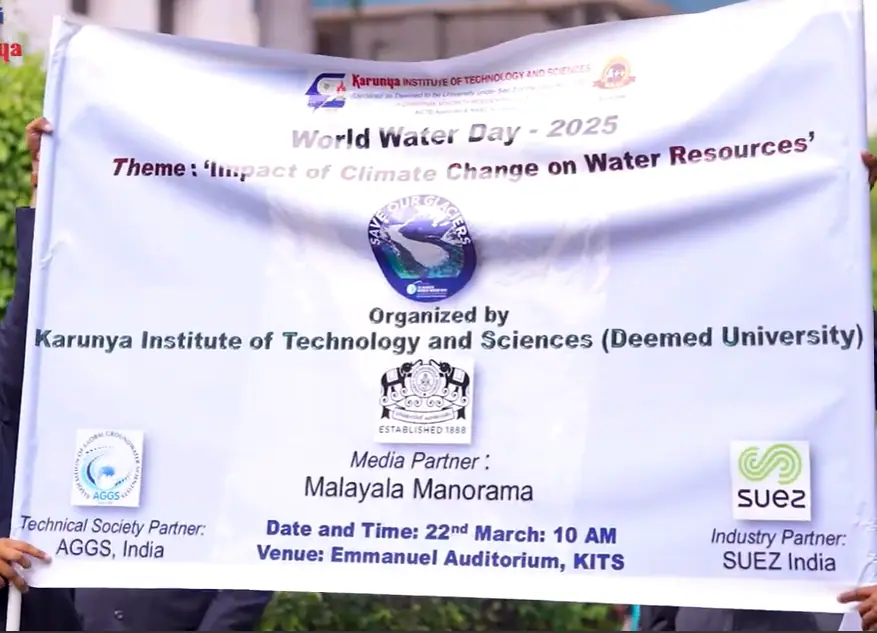
1. World Water Day 2025 Public Stewardship Forum & Awareness Rally (22 March 2025):
Organized in partnership with global water utility operator SUEZ India and leading daily newspaper Malayala Manorama, KITS commemorated World Water Day with 420+ participants. Activities featured an open public water awareness rally through Karunya Nagar, an interactive water quiz, a student painting competition on river conservation, and a campus-wide Hydrothon/Hackathon at KTBIP Discussion Hall where student innovators pitched smart water monitoring prototypes.
2. World Wetlands Day Community Awareness Forum (02 February 2025):
Observed annually to promote wetland preservation, KITS organized technical seminars and field sessions with local community members and school students highlighting the role of freshwater wetlands as natural buffers against flood risks, groundwater recharge conduits, and biodiversity havens.
3. Farmers’ Mela 2024: Agricultural Water Management Expo (16 October 2024):
In commemoration of World Food Day, the School of Agricultural Sciences hosted 400+ smallholder farmers from regional agrarian blocks. Field sessions demonstrated water-saving drip irrigation kits, solar micro-sprinklers, root-zone moisture sensors, and organic mulching techniques to optimize crop water efficiency in coconut and vegetable farming.
4. Environmental Youth Service: 'Iyarkaiyodu Inaindhu' & 'Pudhuvergal Inaippu' (AY 2024–25):
Jointly organized by student environmental clubs, NSS units, and the Department of Extension Services in Sadivayal and Perumal Kovilpathi villages, students engaged rural residents in watershed cleaning, desilting of local channels, and planting native trees along streams to prevent bank erosion.
Major Events Master Dossier (AY 2024–25):
| Event Title & Date | Venue | Organizing Unit & External Partner | Target Audience | Participants | SDG 6 Focus & Outcome |
|---|---|---|---|---|---|
| World Water Day Forum & Rally (22 March 2025) | Campus Grounds & Emmanuel Auditorium | Water Institute, SUEZ India & Malayala Manorama | Students, civic leaders, local citizens | 420+ Participants | SDG 6.1, 6.4, 6.b: Public rally, Hydrothon, river painting contest, and conservation quiz. |
| World Wetlands Day Forum (02 February 2025) | KTBIP Seminar Complex | Water Institute & Department of Civil Engineering | Postgraduate scholars, environmentalists, citizens | 180+ Attendees | SDG 6.6: Technical lectures on wetland conservation and wetland-based runoff buffering. |
| Farmers' Mela 2024 (16 October 2024) | DGS Center & Demo Farm Plots | School of Agricultural Sciences & Agrarian Panchayats | Regional smallholder farmers, rural youth | 400+ Farmers | SDG 6.4 & 6.a: Live demonstrations of drip irrigation, micro-sprinklers, and moisture sensors. |
| Iyarkaiyodu Inaindhu Camp (Academic Year 2024–25) | Sadivayal Tribal Foothill Village | NSS Units, Nature Club & Sadivayal Panchayat | Tribal community residents & school pupils | 150+ Villagers | SDG 6.2 & 6.b: Desilting irrigation channels, stream protection, and sanitation hygiene. |
| Pudhuvergal Inaippu Green Drive (Academic Year 2024–25) | Perumal Kovilpathi & Foothill Hamlets | Rotaract Club, Extension Cell & Youth Volunteers | Rural school children & agrarian families | 200+ Participants | SDG 6.6: Plantation of water-holding native shrubs and soil-erosion prevention. |
| Smart Irrigation Technical Clinic (18–19 November 2024) | Agricultural Engineering Labs & Demo Plots | Dept. of Agricultural Engineering & Irrigation Industry | Farmers, polytechnic students, agricultural scholars | 120+ Trainees | SDG 6.4: Hands-on training in solar-powered automated valve operation and drip scheduling. |
7. Community Outreach and Extension Activities
Karunya Institute of Technology and Sciences actively projects its technical water engineering knowledge and community service wings beyond campus borders to assist local rural, agrarian, and tribal settlements:
1. Community Water Infrastructure: 25,000-Litre Ferrocement Tank in Pachinampathy Village:
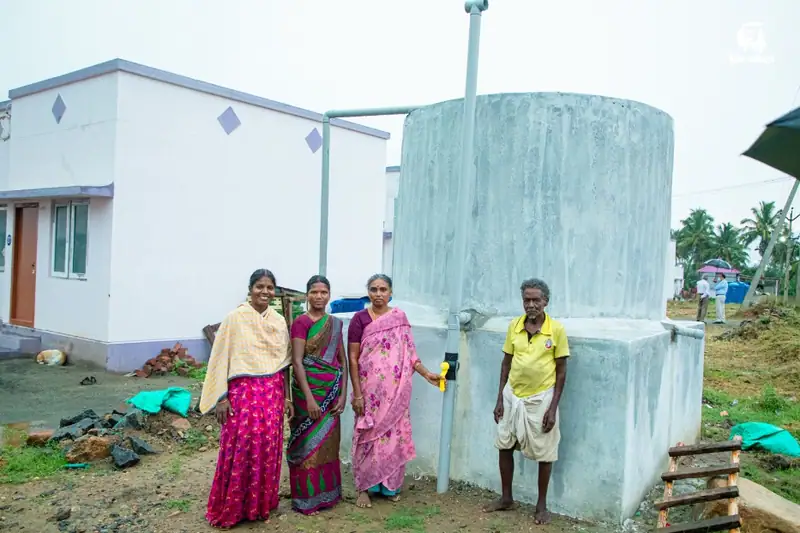
Under its Integrated and Sustainable Village Development Model, KITS adopted Pachinampathy, a tribal foothill settlement in the Western Ghats. To solve severe seasonal drinking water shortages, the university designed, engineered, and constructed a cost-effective, durable 25,000-litre ferrocement drinking water storage tank directly within the village. This structure provides safe, reliable drinking water storage for over 250 tribal residents.
2. Student RAWE Field Demonstrations & Irrigation Water Audits in Mavuthampathy & Chittode:
Under the Rural Agricultural Work Experience (RAWE) program, undergraduate students spent extended residencies in Mavuthampathy village (Walayar) and Chittode. Students demonstrated water conservation routes, tested agricultural borewell water for salinity and sodicity, interacted with farmers on paddy-field water management, and audited micro-irrigation systems.
3. Noyyal Riverbed Restoration & Palmyrah Seed-Sowing Initiative:
Recognizing the ecological degradation of the regional Noyyal river basin, student volunteers and faculty from KITS participated in a massive Palmyrah (Borassus flabellifer) seed-sowing campaign along the riverbanks. Palmyrah root systems provide deep soil stabilization, prevent embankment erosion during monsoons, and enhance groundwater recharge along the riparian corridor.
4. Seengapathy & Foothill Tribal Water Supply Field Visits:
The Dean of the School of Agricultural Sciences and faculty from the Water Institute visited Seengapathy tribal settlement to evaluate local gravity-flow mountain springs, testing water samples and advising community leaders on sanitary protection of water catchments.
Community Water Outreach Summary Table:
| Outreach Activity Title | Target Location | Intervention / Technology Provided | Organizing Unit / Partner | Beneficiaries Reached | Outcome & Impact |
|---|---|---|---|---|---|
| Pachinampathy Water Storage Project | Pachinampathy Tribal Village | Constructed 25,000L durable ferrocement drinking water tank | Directorate of Community Dev. & Panchayat | 250+ Tribal Residents | Eliminated dry-season drinking water crisis; safe storage. |
| RAWE Farm Water Conservation Clinics | Mavuthampathy Village (Walayar) | Field-level irrigation audit, water testing, paddy water demo | School of Agricultural Sciences | 150+ Smallholder Farmers | Trained farmers on moisture-based irrigation scheduling. |
| Noyyal Riverbed Palmyrah Seed Drive | Noyyal River Riparian Corridor | Sowed 5,000+ palmyrah seeds along river embankments | NSS Units, Nature Club & Forest Dept. | Entire River Basin Ecosystem | Prevented soil erosion; reinforced riverbank aquifer recharge. |
| Seengapathy Water Quality Assessment | Seengapathy Tribal Settlement | Field inspection and laboratory water potability testing | Water Institute & Health Directorate | 100+ Tribal Families | Identified sanitary water safeguards for mountain springs. |
| UBA Foothill Water Awareness | Perumal Kovilpathi & Mathuvarayapuram | Household water conservation clinics and leak awareness | Unnat Bharat Abhiyan (UBA) Cell | 300+ Rural Households | Promoted domestic water conservation and greywater soak pits. |
8. Partnerships and Collaborations
KITS actively collaborates with international water utility leaders, national research institutes, government bodies, media organizations, and local panchayats to scale its water research and societal contributions:
| Partner Organization | Category & Status | Collaboration Focus & Joint Activities | Contribution to SDG 6 & Measurable Outcome |
|---|---|---|---|
| SUEZ India | Multinational Water Utility Operator (Active Strategic Partnership) | Technical collaboration on campus hydraulic network modeling, digital flow monitoring, smart distribution, and co-hosting World Water Day forums. | SDG 6.4 & 6.a: Transformed KITS into a smart water living laboratory; minimized campus transmission losses. |
| Malayala Manorama | Leading Regional Media Consortium (Media Partnership) | Co-hosted public water awareness rallies, regional inter-school water quiz competitions, and river basin conservation media campaigns. | SDG 6.b: Sensitized over 10,000 citizens and students on regional water scarcity and conservation. |
| Indian Institute of Soil & Water Conservation (IISWC), Ooty | Central Government Research Institute (ICAR) | Joint technical field training for students and faculty in watershed management, gully plugs, contour trenching, and soil erosion modeling. | SDG 6.6 & 6.a: Advanced technical competencies of students in watershed restoration and mountain hydrology. |
| Pachinampathy Tribal Village Panchayat | Local Civic Authority (Community Partnership) | Joint design, site selection, community mobilization, and maintenance of the 25,000-litre ferrocement rural drinking water reservoir. | SDG 6.1 & 6.b: Guaranteed reliable, safe drinking water security for vulnerable indigenous tribal families. |
| Tamil Nadu State Water Policy Consultation Groups | State Government Advisory Body | Faculty from the Water Institute provided expert technical submissions and consultative reviews on river basin water sharing and wetland protection. | SDG 6.5: Contributed scientific evidence to regional water resource policy formulation. |
| Central Ground Water Board (CGWB) & Ministry of Jal Shakti | National Water Agencies | Collaborative data sharing on aquifer recharge, regional water-table monitoring, and participation in national groundwater initiatives. | SDG 6.4 & 6.6: Aligned campus groundwater recharge with national aquifer management guidelines. |
9. Best Practices
Karunya Institute of Technology and Sciences has institutionalized four standout best practices that exemplify operational innovation, technological excellence, circular resource management, and high replicability:
Best Practice 1: Complete Circular Water Economy — 99.5% Wastewater Treatment & 100% Reuse via 4 STPs & 4 Biogas Plants
- Background: In a residential campus of 8,528 occupants, domestic sewage and greywater represent a severe environmental risk if untreated, but a vital resource if reclaimed.
- Objective: Eliminate all untreated wastewater discharge (SDG Target 6.3) and establish a complete circular water reuse loop for 100% of campus landscaping and agricultural research.
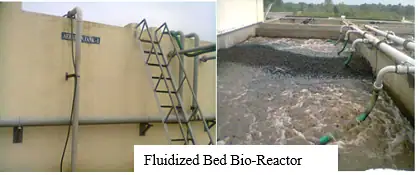
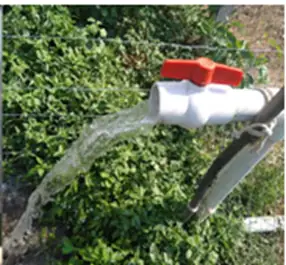
- Implementation: KITS operates 4 decentralized Sewage Treatment Plants (JMR STP: 1,000 KLD; FDR STP: 400 KLD; Ladies Hostel STP: 450 KLD; PR GARG STP: 600 KLD; Total Capacity: 2,450 KLD) utilizing Fluidised Bed Bio-Reactors (FBBR/MBBR), secondary clarifiers, pressure sand filters, activated carbon beds, and chlorination. Additionally, 4 anaerobic Biogas Plants treat blackwater from student hostels, generating cooking biogas that offsets 2–3 commercial LPG cylinders daily. In AY 2024–25, KITS generated 387,022 m³ of wastewater, treated 385,204 m³ (99.5% efficiency), and recycled 100% of treated water across 113 irrigation outlets.
- Results & Sustainability: Zero untreated effluent leaves campus boundaries; freshwater extraction for campus landscaping is reduced to zero, saving over 385 million litres of potable groundwater annually.
Best Practice 2: Smart Water Network Modernization & Automated Leak Prevention
- Background: Undetected pipe leaks, tank overflows, and inefficient manual valve operations cause substantial water losses in extensive institutional pipeline grids.
- Objective: Maximize water-use efficiency (SDG Target 6.4) and eliminate transmission losses across 177 storage tanks through IoT automation and advanced plumbing.
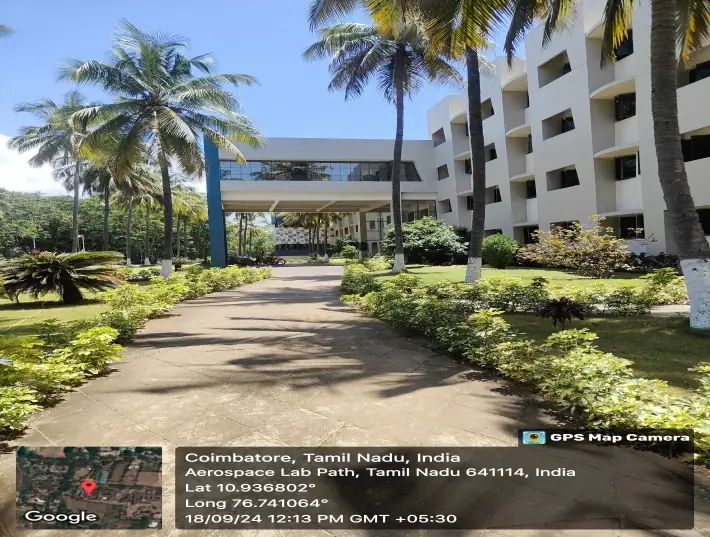
- Implementation: In collaboration with SUEZ India, KITS modernized its campus distribution network using hydraulic modeling and real-time digital monitoring. The institution installed 3,436 self-closing taps (56% of total campus fixtures), automated wireless water-level controllers operating since 2019, motorized inlet valves, and digital magnetic flowmeters at all extraction points, STPs, and storage tanks.
- Results: Automated shutoffs prevent tank overflows completely; per capita water consumption is maintained at a sustainable 135 lpcd, setting an operational benchmark for residential universities.
Best Practice 3: Campus-Wide Integrated Rainwater Harvesting & Groundwater Recharge Grid
- Background: Located in the Western Ghats foothills, heavy seasonal monsoon downpours generate rapid surface runoff that is lost unless actively captured and directed into local aquifers.
- Objective: Maximize aquifer replenishment and rainwater storage (SDG Target 6.6) to guarantee long-term water security.
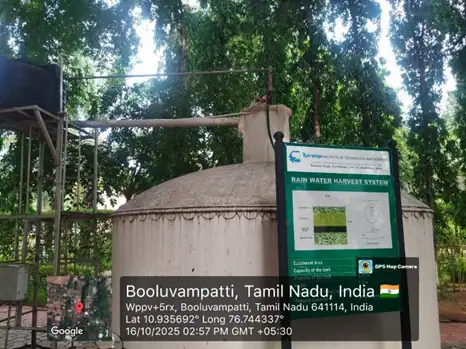
- Implementation: KITS engineered 33 rooftop rainwater harvesting (RWH) installations covering major academic, laboratory, and residential terraces (over 50,000 m² of catchment area). Surface runoff is channeled into 33 dedicated groundwater recharge soak pits, check dams, and campus percolation ponds. A dedicated 25,000-litre ferrocement rainwater storage tank at the Administrative Block captures roof runoff for immediate non-potable use.
- Results: The recharge grid successfully replenishes the regional unconfined aquifer, maintaining stable water levels across the university's 5 open wells and 23 borewells year-round.
Best Practice 4: Community Watershed Stewardship & Low-Cost Ferrocement Storage Technology
- Background: Remote tribal settlements and rural foothill villages often lack reliable water storage, forcing residents to travel long distances during dry summer months.
- Objective: Transfer low-cost, durable university water technology to disadvantaged rural communities (SDG Targets 6.1 & 6.b).
- Implementation: The Water Institute and Department of Civil Engineering designed an indigenous 25,000-litre ferrocement water storage tank and constructed it directly in the adopted tribal village of Pachinampathy. Ferrocement provides high structural strength, crack resistance, and low construction cost using local materials. In parallel, students planted 5,000+ palmyrah seeds along the Noyyal riverbed to stabilize banks and promote river aquifer recharge.
- Results: Over 250 tribal villagers gained continuous, dignified access to clean drinking water; the project serves as a replicable blueprint for rural community water interventions.
10. THE Impact Rankings Metric/Indicator
This section provides a consolidated, evidence-based performance summary across all official Times Higher Education (THE) Impact Rankings SDG 6 metrics and verification indicators for Karunya Institute of Technology and Sciences:
| THE Metric Code | Metric Title & Definition | KITS Official Institutional Performance (AY 2024–25) | Official Formula / Quantitative Base |
|---|---|---|---|
| Metric 6.2.1 | Water Consumption Tracking | Comprehensive measurement and digital metering of all water abstracted across 5 open wells, 23 borewells, and Siruvani pipeline supplying 177 storage tanks. | Total Volume Consumed: 345,384 m³/year (Tracked via digital meters & tank logs) |
| Metric 6.2.2 | Water Consumption per Capita | Maintains sustainable per capita consumption of 110.9 liters/person/day (or ~135 lpcd residential university standard including campus services). | Campus Population: 8,528 (7,863 Students + 665 Faculty/Staff) Formula: 345,384 m³ / (8,528 × 365) = 110.9 L/day |
| Metric 6.3.1 | Wastewater Treatment | Operates 4 Sewage Treatment Plants (STPs, capacity 2,450 KLD) and 4 Biogas Plants. Generates 387,022 m³ wastewater, treats 385,204 m³, achieving 99.5% treatment efficiency. | (385,204 m³ treated / 387,022 m³ inflow) × 100 = 99.5% Treatment Biogas replaces 2–3 LPG cylinders daily |
| Metric 6.3.2 | Preventing Water System Pollution | Zero untreated discharge; multi-barrier protection including FBBR, sand filtration, activated carbon, check dams, farm ponds, and strict chemical waste segregation. | 100% campus wastewater contained and treated; zero pollution discharge into local watercourses |
| Metric 6.3.3 | Free Drinking Water Provision | Guarantees free, universal access to safe drinking water via 86 purifiers/dispensers/coolers on all floors and two commercial RO plants tested per IS 10500:2012. | 86 Purifiers / Coolers across 17 Departments & 15 Hostels; 2 Commercial RO Plants |
| Metric 6.3.4 | Water-Conscious Building Standards | Campus buildings feature 3,436 self-closing taps (56% of fixtures), automated wireless water-level controllers since 2019, motorized valves, and permeable paving. | 3,436 Self-Closing Taps (2,736 Hostels + 700 Campus); 56% Water-Efficient Fixtures |
| Metric 6.3.5 | Water-Conscious Planting | Landscaping exclusively utilizes native, drought-resistant Western Ghats vegetation, mulching, micro-sprinklers, and 100% STP treated effluent drip irrigation. | 100% Treated Wastewater for Landscape Irrigation; 113 STP Irrigation Outlets |
| Metric 6.4.1 | Water Reuse Policy | Enacted formal statutory Policy on Maximizing Water Reuse (KITS/POLICY/WATER/2024/02) mandating 100% treatment and recycling for non-potable uses. | Statutory Board of Management Approval; Public Web URL Active |
| Metric 6.4.2 | Water Reuse Measurement | Accurately measures and recycles 385,204 m³/year of treated wastewater for irrigation and agriculture, monitored via digital magnetic flow meters. | 385,204 m³/year Recycled (100% of treated wastewater output reused) |
| Metric 6.5.1 | Water Management Education | Offers M.Tech in Water Resources Engineering, M.Tech in Environmental Engineering, Ph.D. programs, and 46 SDG 6-mapped courses with dedicated water testing labs. | 46 Mapped Courses; Dedicated M.Tech & Ph.D. Water Programs; Water Institute Testing Facilities |
| Metric 6.5.3 | Off-Campus Water Conservation Support | Constructed 25,000L ferrocement drinking water tank in Pachinampathy tribal village; conducted RAWE agricultural irrigation audits in Mavuthampathy. | 25,000L Community Ferrocement Tank; RAWE Field Outreach (150+ Farmers) |
| Metric 6.5.4 | Sustainable Water Extraction | Integrated infrastructure: 5 open wells, 23 borewells, 33 rooftop RWH installations, 33 recharge soak pits, 25,000L ferrocement tank, and check dams. | 33 Rooftop RWH Installations; 33 Aquifer Recharge Pits; 5 Open Wells & 23 Borewells |
| Metric 6.5.5 | Cooperation on Water Security | Multi-tier cooperation with local tribal bodies, state water policy committees, national agencies (CGWB, NIH), and international utilities (SUEZ India). | Local (Pachinampathy UBA), State (TN Water Policy), National (CGWB), Global (SUEZ, ICWRER) |
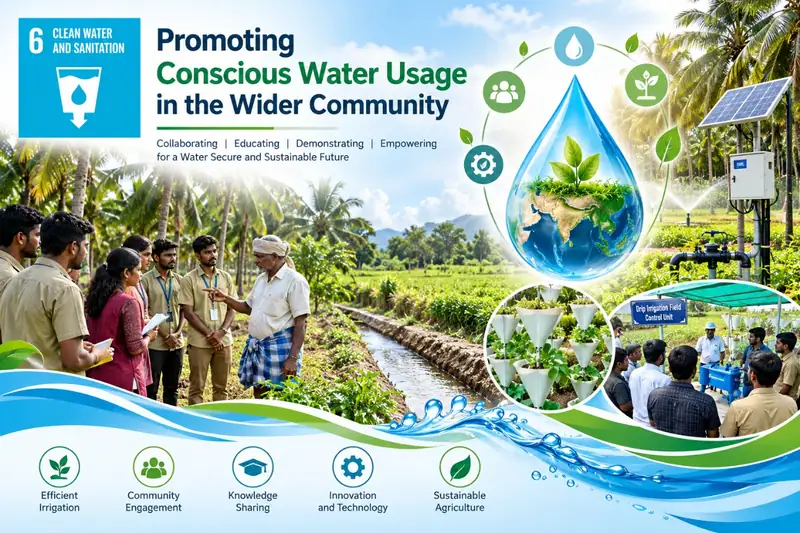
| Metric 6.5.6 | Promote Conscious Water Usage on Campus | Operates campus as Living Laboratory: SUEZ network modeling, prominent conservation signage in all hostels, annual World Water Day rallies and Hydrothons. | Campus-wide conservation signage, Living Lab network modeling, 420+ rally participants |
| Metric 6.5.7 | Promoting Conscious Water Usage in Community | Field demonstrations of IoT coconut irrigation, solar sprinklers, and farmer workshops in Chittode, Alandurai, and Mavuthampathy. | 400+ Farmers trained at Farmers' Mela; IoT smart irrigation field clinics |
11. Conclusion
The comprehensive assessment of Sustainable Development Goal 6 (Clean Water and Sanitation) at Karunya Institute of Technology and Sciences for Academic Year 2024–25 demonstrates an institution with exemplary environmental stewardship, world-class water engineering infrastructure, and profound societal commitment.
Operating in the Western Ghats foothill ecosystem, KITS has demonstrated how higher education campuses can decouple institutional expansion from freshwater depletion through closed-loop engineering, smart IoT loss prevention, aggressive groundwater recharge, and community technology transfer.
Executive Summary of Institutional Impact on SDG 6:
- Circular Water Economy: Treating 99.5% of campus wastewater (385,204 m³/year) via 4 STPs and reusing 100% of treated effluent for campus landscaping and agricultural research, saving over 385 million litres of potable groundwater annually.
- Renewable Biogas Recovery: Treating residential blackwater through 4 anaerobic Biogas plants, displacing 2–3 commercial LPG cylinders daily for kitchen cooking.
- Smart Loss Prevention: Installing 3,436 self-closing push taps (56% of fixtures) and automated wireless water-level controllers operating since 2019, maintaining per capita consumption at 110.9 L/day.
- Integrated Aquifer Replenishment: Channeling rooftop runoff across 33 RWH installations into 33 dedicated recharge soak pits and a 25,000L ferrocement storage tank, sustaining regional unconfined aquifers.
- Universal Safe Drinking Water: Providing continuous free access to certified potable drinking water via 86 purifiers/dispensers and two commercial RO plants tested per IS 10500:2012 standards.
- Research & Global Leadership: Contributing 102 Scopus-indexed research publications in clean water and sanitation, offering specialized M.Tech degrees, and being selected to host the 10th ICWRER International Conference.
- Grassroots Community Empowerment: Engineering a 25,000L ferrocement drinking water tank in adopted Pachinampathy tribal village, training 400+ farmers in smart micro-irrigation, and sowing 5,000+ palmyrah seeds along the Noyyal riverbed.
Through these policy-backed, empirically verifiable, and socially transformative achievements, Karunya Institute of Technology and Sciences stands as a premier national model for institutional water stewardship.