
1. SDG Overview
The United Nations Sustainable Development Goal 7 (SDG 7) aims to ensure access to affordable, reliable, sustainable and modern energy for all. Energy is fundamental to economic development, social well-being, technological advancement and environmental protection. Access to clean and reliable energy supports essential services, including education, healthcare, water supply, transportation and industrial development. However, dependence on fossil fuels, rising energy demand and greenhouse gas emissions present significant challenges to achieving global sustainability. SDG 7 therefore emphasizes expanding access to modern energy, increasing the share of renewable energy, improving energy efficiency and strengthening international cooperation in clean energy technologies.
For higher education institutions, SDG 7 has particular significance because universities are substantial energy consumers and important centres of research, innovation and capacity building. Academic buildings, laboratories, libraries, hostels, residential facilities and other campus infrastructure require a continuous and reliable energy supply. Integrating clean energy into campus operations can reduce dependence on conventional energy sources, improve energy efficiency, lower operational costs and reduce carbon emissions. Universities also have a responsibility to educate students, develop sustainable technologies and prepare future professionals to address emerging energy challenges.
At Karunya Institute of Technology and Sciences (KITS), Coimbatore, SDG 7 is closely connected with the institution's commitment to sustainable campus development, renewable energy adoption, climate change mitigation and technological innovation. The institution has a substantial campus infrastructure, with a reported building footprint of approximately 2,44,339.76 square metres. Meeting the energy requirements of this infrastructure sustainably is important for reducing the environmental impact of campus operations while maintaining a conducive learning and research environment.
KITS has established renewable energy infrastructure comprising four solar power plants and 30 solar water heaters. The institutional report on renewable energy records total energy production of 1,851,269.31 kWh, demonstrating the practical application of renewable energy technologies within the campus. Solar power generation and solar water heating contribute to the use of cleaner energy resources and support the institution's efforts to reduce conventional energy consumption. The replacement of conventional lighting with energy-efficient LED lighting and the promotion of energy-conscious infrastructure further support energy conservation.
The institution's Climate Change Mitigation and Sustainability Policy provides a formal framework for integrating sustainability into governance, academic activities, research, innovation and campus operations. The policy commits KITS to achieving net-zero carbon emissions for Scope 1 and Scope 2 by 2035 and Scope 3 by 2040. Its renewable energy roadmap envisages installing 1 MW of solar capacity by 2027 and an additional 1 MW by 2035, with the long-term objective of achieving 100% renewable-based campus energy by 2040, subject to technical feasibility. These commitments demonstrate the institution's intention to connect energy management with its broader climate action strategy.
KITS also promotes sustainability awareness through training programmes, workshops, student-led societies and sustainability literacy assessments. Such initiatives help students and staff understand energy conservation, renewable technologies and responsible energy consumption. By integrating these activities with engineering education and research, the institution can encourage innovation and develop graduates capable of contributing to the clean energy transition.
Thus, SDG 7 is relevant to KITS not only as an environmental objective but also as a framework for responsible institutional management, technological advancement and societal contribution. Through renewable energy generation, energy efficiency measures, carbon accounting, sustainability policies and stakeholder engagement, KITS seeks to establish a campus model that supports affordable, reliable and sustainable energy while contributing to India's clean energy transition and the United Nations Sustainable Development Goals.
2. Institutional Policies and Commitments
Karunya Institute of Technology and Sciences (KITS), Coimbatore, supports Sustainable Development Goal 7 (Affordable and Clean Energy) through institutional policies, renewable energy initiatives, energy-efficiency measures, carbon-reduction commitments and sustainability awareness programmes. These measures connect campus energy management with the institution's broader objectives of environmental sustainability, climate change mitigation, responsible resource utilization and technological innovation.
The institution's Climate Change Mitigation and Sustainability Policy and Sustainable Investment Policy, both revised on 29 August 2025, provide important governance frameworks for sustainability and responsible institutional decision-making. These policies are complemented by the institutional renewable energy programme, greenhouse gas emission accounting, energy-efficient infrastructure and student-led sustainability activities.
The following policies and initiatives are identified from the institutional documents provided. Where a formal committee constitution, office order or exact commencement date is not available in the evidence, it is indicated rather than assumed.
2.1 Policies, strategic commitments and supporting initiatives
| Policy / initiative | Institutional details and contribution to SDG 7 |
|---|---|
| 1. Climate Change Mitigation and Sustainability Policy | Year: Created July 2022; revised 29 August 2025. Purpose: Establishes a university-wide framework for reducing greenhouse gas emissions, promoting renewable energy, improving resource efficiency and integrating sustainability into education, research and operations. Responsible office: Registrar's Office and Internal Quality Assurance Cell (IQAC), under the oversight of the Vice-Chancellor, Registrar and Chief Engineer. SDG 7 contribution: Commits to installing 1 MW of solar capacity by 2027 and an additional 1 MW by 2035. It also targets net-zero Scope 1 and 2 emissions by 2035 and Scope 3 emissions by 2040. Annual energy and carbon-footprint audits are specified. Coverage: Institution-wide. Evidence: Climate Change Mitigation and Sustainability Policy, Ref. KITS/CCMSP/2025/01, particularly the preamble and Articles 1–3. |
| 2. Sustainable Investment Policy | Year: Created July 2022; revised 29 August 2025. Purpose: Integrates Environmental, Social and Governance (ESG) considerations into institutional financial decisions and promotes ethical, transparent and sustainability-oriented investment. Responsible office: Registrar's Office, Finance Office and IQAC; responsible executives include the Vice-Chancellor, Registrar and Finance Officer. SDG 7 contribution: Encourages investments in clean energy, energy-efficient technologies, green mobility and climate-resilient infrastructure while discouraging environmentally harmful investments. Coverage: Institution-wide financial investments, portfolios, funded projects and relevant institutional collaborations. Evidence: Sustainable Investment Policy, Ref. KITS/SIP/2025/01, particularly the preamble, purpose and scope. |
| 3. Carbon Reduction Target and Net-Zero Commitment | Year: 2023 Purpose: Establishes measurable targets for renewable energy expansion, campus energy-intensity reduction and long-term decarbonization. Responsible office: Institutional leadership and the offices responsible for campus engineering, energy management and sustainability. SDG 7 contribution: Targets 80% renewable energy contribution by 2035 and 100% renewable-based campus energy by 2040, subject to technical feasibility. It also envisages annual energy audits, digital monitoring and energy-efficient infrastructure. Coverage: Institution-wide campus energy management. Evidence: Carbon Reduction Target & Net Zero Commitment and the corresponding provisions in the Climate Change Mitigation and Sustainability Policy. |
| 4. Renewable Energy Generation Programme | Year: 2024–2025 Purpose: Generate clean energy on campus and reduce dependence on conventional energy sources. Responsible office: Campus engineering and facilities management, with institutional oversight SDG 7 contribution: The reported infrastructure comprises four solar power plants and 30 solar water heaters, with documented renewable energy production of 1,704,783.71 kWh. The installations include a 95 kW solar plant in the Administrative Block and a 20 kW plant in the EVR/Oprah Mess Building. Coverage: Campus-wide infrastructure, with installations at specific buildings and facilities. Evidence: Energy Generated through Renewable Sources, including the installation photographs and generation records. |
| 5. Energy Efficiency and Sustainable Infrastructure | Year: Ongoing operational measures; Purpose: Improve the efficiency of campus energy consumption and reduce avoidable electricity use. Responsible office: Chief Engineer and campus facilities management, under institutional administration. SDG 7 contribution: Measures include replacing conventional lighting with LED lighting, incorporating energy efficiency into renovations and new buildings, monitoring electricity consumption and expanding renewable energy infrastructure. Coverage: Academic blocks, laboratories, hostels, residential facilities and other campus buildings. Evidence: Energy Generated through Renewable Sources and Total Scope 1 and 2 Carbon Emissions. |
| 6. Greenhouse Gas Accounting and Reporting | Year: 2024–2025 Purpose: Quantify and monitor emissions associated with campus operations using the GHG Protocol Corporate Standard. Responsible office: Institutional administration and the departments responsible for electricity, transport and environmental reporting. SDG 7 contribution: Electricity-related emissions and transport-related emissions are identified separately, helping the institution monitor the carbon implications of energy consumption and prioritize mitigation measures. Coverage: Institution-wide reporting of relevant Scope 1 and Scope 2 emissions. Evidence: GHG Protocol Corporate Standard and Total Scope 1 and 2 Carbon Emissions. |
| 7. Student-Led Societies for Sustainability | Year: 2024-25 Purpose: Promote sustainability awareness, student leadership, interdisciplinary collaboration and practical engagement with environmental challenges. Responsible office: Academic divisions and their respective student associations, supported by institutional academic structures. SDG 7 contribution: Student-led technical activities, awareness programmes and projects provide opportunities to explore renewable energy, energy conservation and sustainable engineering applications. Coverage: Department-based, with opportunities for interdisciplinary participation. Evidence: Student Led Society for Sustainability, including the departmental society listing. |
| 8. Sustainability Training and Awareness Programmes | Year: 2024–2025 Purpose: Build sustainability knowledge and technical capacity among students, faculty and other stakeholders. Responsible office: Training Division, IQAC and relevant centres of excellence, including the Centre for Renewable Energy. SDG 7 contribution: Training, workshops, seminars and conferences support awareness of renewable energy, sustainable technologies, environmental conservation and responsible resource use. Coverage: Institution-wide participation, with individual events targeting particular academic or stakeholder groups. Evidence: Training on Environmental Aspects of Sustainability, which documents events, resource persons, dates and beneficiary numbers. |
| 9. Sustainability Literacy Assessment | Year: 2024-25. Purpose: Assess sustainability awareness among students and staff and identify areas for improvement in sustainability education. Responsible office: Institutional academic and sustainability-awareness activities; the specific coordinating office is not identified in the supplied document. SDG 7 contribution: Provides an opportunity to assess awareness of clean energy and broader sustainability issues, supporting informed energy-use practices and sustainability education. Coverage: Institution-wide assessment activity, with documented sessions for students and staff. Evidence: Assessing Sustainability Literacy, including the Sulitest session and results screenshots. |
2.2 Institutional governance and accountability
The institutional documents identify several offices with responsibilities relevant to SDG 7:
Vice-Chancellor and Registrar: Institutional oversight of sustainability policies, governance and implementation.
Chief Engineer: Responsibility identified in the climate policy for supporting campus operations and sustainability implementation.
Finance Office: Responsible for financial decisions and sustainable investment practices.
Internal Quality Assurance Cell (IQAC): Supports policy review, institutional quality processes and sustainability-related governance.
Training Division and Centre for Renewable Energy: Support capacity building, renewable energy awareness and sustainability education.
Academic divisions and student societies: Support student engagement, technical activities and sustainability awareness.
The Climate Change Mitigation and Sustainability Policy specifies periodic review and continuous improvement, including annual energy and carbon-footprint audits. The Sustainable Investment Policy also provides for periodic policy review. These mechanisms support institutional accountability and enable the university to evaluate progress toward its clean energy and decarbonization objectives.
2.3 Evidence and supporting documents
| Evidence document | Relevant information |
|---|---|
| Climate Change Mitigation and Sustainability Policy (KITS/CCMSP/2025/01) | Policy approval details, institutional scope, renewable energy targets, net-zero commitments and audit provisions |
| Sustainable Investment Policy (KITS/SIP/2025/01) | ESG investment principles, responsible offices and support for clean energy investments |
| Carbon Reduction Target & Net Zero Commitment | Solar installation milestones and long-term renewable energy targets |
| Energy Generated through Renewable Sources | Solar installations, solar water heaters, energy generation records and photographs |
| Total Scope 1 and 2 Carbon Emissions | Electricity consumption, transport emissions and annual carbon reporting |
| GHG Protocol Corporate Standard | Emissions accounting methodology and classification |
| Training on Environmental Aspects of Sustainability | Training programmes, event records and beneficiary details |
| Student Led Society for Sustainability | Departmental societies and student engagement |
| Assessing Sustainability Literacy | Sustainability assessment sessions and results screenshots |
3. SDG Objectives
Karunya Institute of Technology and Sciences (KITS), Coimbatore, has implemented various initiatives supporting Sustainable Development Goal 7 (Affordable and Clean Energy) through renewable energy generation, energy-efficient campus infrastructure, sustainability education, carbon-emission monitoring and student engagement. The institution has established clean energy infrastructure and adopted sustainability policies that integrate energy conservation and climate action into campus operations, teaching, research and outreach.
3.1 Objectives and achievements
1. Promote awareness of affordable and clean energy
KITS has conducted training programmes, workshops, seminars and conferences on environmental sustainability, sustainable technologies and climate-related topics through the Training Division, Internal Quality Assurance Cell (IQAC) and relevant centres of excellence, including the Centre for Renewable Energy. Sustainability literacy assessments through Suli test have also been conducted for students and staff, supporting awareness of environmental responsibility and sustainable development.
2. Implement renewable energy generation on campus
KITS has established renewable energy infrastructure comprising four solar power plants and 30 solar water heaters. The institutional records document total energy production of 1,851,269.31 kWh from the reported renewable energy installations. These facilities demonstrate the practical adoption of solar photovoltaic generation and solar water heating to support campus energy requirements.
3. Improve energy efficiency across campus facilities
The institution has implemented energy-conservation measures, including replacing conventional lighting with energy-efficient LED lighting and incorporating energy-efficiency considerations into building renovations and new infrastructure. These measures support optimized electricity consumption, reduced energy wastage and improved operational efficiency across academic and residential facilities.
4. Monitor and reduce institutional carbon emissions
KITS has established carbon-emission monitoring and reporting practices aligned with the GHG Protocol Corporate Standard. During the 2024–2025 reporting year, the institution recorded total Scope 1 and Scope 2 emissions of 4,705.11 tonnes of CO₂. The reported emissions were 146.89 tonnes lower than those recorded in 2023–2024. The institution has also documented a reduction in electricity consumption compared with its 2015 baseline, supporting its ongoing energy-conservation and carbon-reduction efforts.
5. Integrate sustainability into teaching and learning
KITS has integrated sustainability awareness into educational and training activities involving students, faculty and other stakeholders. Through workshops, seminars, conferences and departmental activities, the institution promotes understanding of renewable energy, sustainable technologies, environmental conservation and responsible resource utilization. These activities connect sustainability concepts with engineering education and practical applications.
6. Encourage research, innovation and clean energy technology development
KITS supports sustainability-oriented research, technical learning and innovation through its academic divisions and centres of excellence. Its institutional emphasis on sustainable energy provides a framework for engaging students and researchers with renewable energy systems, energy efficiency and related technological challenges. Training and interdisciplinary activities also provide opportunities to explore practical sustainability solutions.
7. Integrate sustainability into institutional investment decisions
Through its Sustainable Investment Policy, created in July 2022 and revised on 29 August 2025, KITS has established an institutional framework for incorporating Environmental, Social and Governance (ESG) principles into financial decision-making. The policy promotes responsible investment practices and encourages investments associated with clean energy, energy-efficient technologies and climate-resilient infrastructure.
8. Promote student participation in sustainability initiatives
KITS has established student-led societies across its academic divisions to encourage student leadership, interdisciplinary collaboration and practical engagement with sustainability. These societies provide platforms for awareness activities, technical projects, workshops and initiatives addressing environmental challenges. They contribute to embedding sustainability awareness within the institutional academic culture.
9. Promote sustainability awareness among external stakeholders
The institution has conducted training programmes, workshops, seminars and conferences involving students, faculty members, resource persons and other stakeholders. These activities disseminate knowledge of environmental sustainability and sustainable technologies and strengthen awareness of the importance of clean energy and responsible resource utilization.
10. Establish institutional sustainability monitoring and accountability
KITS has formalized its sustainability commitments through the Climate Change Mitigation and Sustainability Policy, revised on 29 August 2025. The policy establishes institutional responsibilities for climate action, renewable energy expansion, carbon-footprint monitoring and continuous improvement. The institution also documents renewable energy generation and carbon-emission data to support sustainability reporting and assessment.
3.2 Alignment of achievements with SDG 7 targets
| SDG 7 target | Institutional achievement |
|---|---|
| Target 7.2 – Increase the share of renewable energy | Established four solar power plants and 30 solar water heaters, with reported renewable energy production of 1,704,783.71 kWh. |
| Target 7.3 – Improve energy efficiency | Implemented LED lighting replacement, energy-efficient infrastructure measures and electricity-consumption monitoring. |
| Target 7.a – Promote clean energy research and cooperation | Conducted sustainability-related training and technical programmes through the Training Division, IQAC and relevant centres of excellence. |
| Target 7.b – Expand and upgrade energy infrastructure | Installed campus solar power systems and solar water-heating facilities to support the use of renewable energy. |
3.3 Summary of institutional Achievements
KITS has demonstrated its commitment to SDG 7 through the establishment of renewable energy infrastructure, implementation of energy-efficiency measures, systematic carbon-emission reporting, sustainability-oriented policies and awareness programmes. Its documented renewable energy generation, solar water-heating facilities, LED replacement initiatives and reduction in reported Scope 1 and Scope 2 emissions reflect practical institutional action.
These achievements establish a foundation for integrating affordable and clean energy into campus operations, academic activities and institutional governance. Through continued implementation and documentation of its existing initiatives, KITS contributes to the broader objectives of sustainable energy utilization, improved energy efficiency and environmental responsibility.
The Energy and Carbon Management Policy (KITS/ECMP/2025/01) provides an additional operational framework for energy conservation and carbon management. It covers campus facilities, hostels, laboratories, administrative units, students, faculty, staff, contractors and relevant partners. Its provisions address energy conservation, renewable-energy integration, sustainable infrastructure, awareness and training, community engagement, transparency, monitoring, corrective action and periodic review.
The policy also assigns implementation responsibilities across institutional leadership, the Registrar, IQAC, Chief Engineer, Finance Officer, Energy and SDG Teams, faculty, students and external contractors. It provides for annual energy audits, quarterly divisional energy reports, an institutional Energy and Carbon Register, financial planning and review through a Plan–Do–Check–Act approach.
Additional infrastructure evidence in the indicator documents records a 115 kW grid-connected solar PV capacity, comprising a 95 kW plant in the Administrative Block and a 20 kW plant at the EVR/Oprah Mess Building. The campus also has a solar water-heating system rated at 87,600 litres per day, reported as 30 units, and seven solar-powered street lights. The wider institutional renewable-energy record reports 1,851,269.31 kWh per annum from solar PV and solar thermal installations.
The energy-efficiency indicator document reports the following coverage levels for selected efficient appliances and systems. These percentages represent the reported implementation levels in that document and should be interpreted as coverage figures, not as measured percentage reductions in electricity consumption.
| Energy-efficient system / appliance | Reported implementation |
|---|---|
| Conventional tube lights and street lights converted to LED | 97% |
| Star-rated air conditioners | 65% |
| Energy-efficient computers | 55% |
| Passenger and goods lifts | 65% |
| Motors and pumps with wireless water-level controllers and capacitors | 95% |
| Reported average implementation | 75.4% |
4. Curriculum Integration
4.1. Overview
SDG 7 is built into teaching and learning through dedicated energy courses, energy modules inside core courses, laboratory experiments on renewable energy, and applied topics such as electric mobility, energy harvesting, smart grids and green buildings. The coverage spans Engineering (Mechanical, Electronics, Civil, Computer Science, Food Technology), Sciences (Chemistry) and Life Sciences (Biotechnology, Agriculture). Students therefore meet clean-energy concepts from several disciplinary angles: generation, storage, efficiency and end-use.
4.2. Courses related to SDG 7
| Programme | Code and course | SDG 7 content |
|---|---|---|
| B.Tech Mechanical | 21ME2015 Design of Electric Vehicles and Battery Management | EV dynamics, motor drives, battery types and parameters, design of a battery management system (BMS) for EVs. |
| B.Tech Mechanical | 23ME1005 Introduction to Mechanical Systems | Module 6 “Energy Systems” covers thermal, hydroelectric, solar, wind, geothermal, tidal and OTEC power. Course Outcome 6: analyse the performance of renewable energy production systems. |
| B.Tech ECE | 22EC2025 Energy Harvesting for IoT Devices | Photovoltaic and kinetic harvesting, RF energy harvesting, power-conditioning circuits, metamaterial harvesters, design of a harvested power supply. |
| B.Tech ECE | 22EC1001 Physical Electronics | Module 5 “Green Energy Physics”: solar PV, wind energy conversion, wind-diesel hybrid systems, ocean and tidal energy, fuel cells and fuel-cell vehicles. |
| B.Tech ECE | 22EC1002 Physical Electronics Laboratory | Objective: study of renewable energy sources. Experiments: characteristics of a solar cell, electricity from wind using a trainer kit, electricity from a fuel cell using a trainer kit, study of biofuel for energy conversion. |
| B.Tech Food Technology | 20EE1001 Basic Electrical and Computer Engineering | Comparison of conventional and renewable power generation; hybrid electric vehicles; smart grids. Lab: PV characteristics of a solar cell, energy-consumption analysis of fluorescent, CFL and LED lamps, speed control of a DC motor for a mini electric vehicle, battery-charging circuit. |
| B.Tech Civil | 20CE1003 Green Design and Life Cycle Assessment | Energy use and carbon emissions in buildings, energy-efficiency principles, building energy management, embodied energy, green design techniques. |
| M.Tech Civil | 20CE3024 Sustainable Construction | Module 5 “Energy Efficient and Environment Friendly Buildings”: building energy-load audit, solar radiation, photovoltaic buildings. Module 6: LEED, IGBC, GRIHA and the Energy Conservation Building Code (ECBC). |
| M.Sc Chemistry | 23CH3022 Applied Electrochemistry | Module 5 “Electrochemical Power Sources”: primary and secondary batteries, lithium batteries, fuel cells, batteries in electric vehicles. |
| B.Tech / M.Sc Biotechnology | 20BT2005 Basics of Industrial Biotechnology; 20BT2054 Environmental Biotechnology; 20BT3031 Advanced Environmental Biotechnology | Bioenergy and fuel from biomass, biogas, biorefineries; integrated bio-digester for biogas and electricity generation; Module 5 “Biomass and Biofuels” covering biogas, bioethanol, biodiesel and biohydrogen. |
| B.Tech CSE | 20CS3006 Applications of Cyber Physical Systems | Energy management systems in smart grids; dual-axis solar tracking and monitoring of solar panels using IoT. |
| B.Tech ECM / ECE | 21EC2016 Internet of Things | IoT applications in smart grids and the Internet of Vehicles. |
| M.Sc Agronomy | 24AG3012 Principles and Practices of Organic Farming | Practical component includes a visit to a biogas plant. |
Syllabus evidence: www.karunya.edu/academics
4.3. How the SDG is incorporated in teaching and learning
Theory. Energy-related modules are written into course outcomes, so they are assessed, not just mentioned. For example, 23ME1005 has an explicit outcome on renewable energy production systems, 21ME2015 has outcomes on battery parameters and BMS design, and 22EC2025 has an outcome on designing an energy harvesting system.
Laboratory. Hands-on work on solar cell characteristics, wind and fuel-cell trainer kits, biofuel energy conversion, LED versus CFL energy-consumption analysis, and battery-charging and motor-control circuits turns concepts into measured results. Students from non-electrical programmes such as Food Technology also take these experiments.
Interdisciplinary reach. Clean energy appears in biotechnology (biogas, biofuels), chemistry (batteries, fuel cells), civil engineering (energy-efficient buildings) and computing (smart grids, solar tracking), so energy literacy is not limited to electrical and mechanical students.
Affordability and efficiency. Green Design and Life Cycle Assessment, Sustainable Construction (ECBC, GRIHA, IGBC) and the LED/CFL consumption study address the “affordable” and efficiency dimensions of SDG 7, not only generation.
5. Research and Innovation
Karunya Institute of Technology and Sciences (KITS), Coimbatore, has developed a research and innovation ecosystem that supports clean energy technologies, renewable energy generation, energy efficiency, sustainable transportation and energy management. The institution's research activities are supported by its multidisciplinary research framework, Technology Missions, Intellectual Property Rights (IPR) Cell, innovation and incubation ecosystem, funded research projects and academic–industry collaborations.
The Annual Report 2024–2025 identifies sustainable energy as one of the institution's four major research thrust areas. It also documents the Green Energy Technology Mission, which promotes solar, wind and bioenergy technologies, including the use of artificial intelligence and nanotechnology to optimize clean energy solutions. The accompanying SDG Publications.xlsx file contains 220 research publication records under the SDG 7 category, providing a substantial publication base for documenting the institution's contribution to affordable and clean energy.
5.1 Research publications and their relevance to SDG 7
The SDG 7 publication list includes research on solar photovoltaic technology, renewable energy forecasting, smart grids, energy management, energy storage, electric vehicles, power electronics and energy-efficient systems. These research areas contribute to the development, integration and effective utilization of clean energy technologies.
The following representative publications illustrate the direct relevance of KITS's documented research portfolio to SDG 7. Publication details are reproduced from the supplied spreadsheet; the relevance statements explain their connection to clean energy.
| S. No. | Research publication | Year | Direct relevance to SDG 7 |
|---|---|---|---|
| 1 | Optimized Controller Design for Renewable Energy Systems by Using Deep Reinforcement Learning Technique | 2024 | Applies intelligent control methods to renewable energy systems, supporting improved operating performance and energy utilization. |
| 2 | Random Forest Machine Learning Algorithm Based Seasonal Multi-Step Ahead Short-Term Solar Photovoltaic Power Output Forecasting | 2025 | Supports solar generation forecasting, helping improve renewable energy scheduling and grid integration. |
| 3 | Adaptive Solar Power Generation Forecasting using Enhanced Hybrid Function Networks with Weather Modulation | 2024 | Addresses weather-dependent solar generation prediction, supporting more reliable use of photovoltaic energy. |
| 4 | A Topology Review and Comparative Analysis on Transformerless Grid-Connected Photovoltaic Inverters and Leakage Current Reduction Techniques | 2025 | Examines inverter architectures and leakage-current reduction, relevant to the safe and efficient integration of solar PV systems into electrical grids. |
| 5 | Design of a Modular Converter in Hybrid EV Charging Station with Efficient Energy Management System | 2024 | Supports efficient power conversion and energy management in electric vehicle charging infrastructure. |
| 6 | Energy Management System for Distributed Energy Resources using Blockchain Technology | 2025 | Investigates digital coordination of distributed energy resources, relevant to decentralized energy management. |
| 7 | Cellulose Acetate-Based Polymer Electrolyte for Energy Storage Application with the Influence of BaTiO₃ Nanofillers on the Electrochemical Properties: A Progression in Biopolymer-EDLC Technology | 2024 | Investigates materials for electrochemical energy storage, which can support renewable energy integration and energy-management applications. |
| 8 | Smart Home Energy Management Systems in India: A Socio-Economic Commitment Towards a Green Future | 2024 | Examines household energy management and its relationship with sustainability and responsible electricity consumption. |
| 9 | Design and Simulation of a Highly Efficient Eco-Friendly, Non-Toxic Perovskite Solar Cell | 2025 | Investigates photovoltaic materials and device performance for potential clean electricity generation. |
| 10 | Design and Analysis of Solar Cell Coplanar Antenna for Wireless Applications | 2024 | Explores solar-cell-related device design, contributing to research at the intersection of photovoltaic and electronic technologies. |
| 11 | Enhancing Performance of Interleaved Boost Converter with Water Cycle Optimized PO Algorithm for MPPT in Solar-Powered Electric Vehicles | 2024 | Addresses maximum power point tracking and power conversion in solar-powered EV applications. |
| 12 | Design of a Helical-Blade Vertical-Axis Wind Turbine (published as Design, Analysis, and Fabrication of Helical Blades for a Vertical-Axis Wind Turbine) | 2025 | Contributes to wind energy conversion technology and the development of renewable electricity generation systems. |
| 13 | Production of Power and Fresh Water Using Renewable Energy with Thermal Energy Storage Based on Fire Hawk Optimization | 2024 | Explores renewable energy utilization and thermal energy storage for combined power and water production. |
| 14 | Accurate State of Charge Estimation for Lithium-Ion Batteries in Electric Vehicles Using PSO-Optimized ANN Approach | 2025 | Supports battery monitoring and management, which are important for efficient energy storage and electric mobility. |
| 15 | Optimized Tariff Structures with Incentive-Based Pricing for Demand-Side Management in Smart Grids | 2025 | Examines demand-side management and pricing mechanisms that can encourage efficient electricity consumption and grid operation. |
Collectively, these publications demonstrate research activity across several technically important dimensions of SDG 7: improving renewable generation, forecasting intermittent energy resources, developing efficient power converters, advancing energy storage, and optimizing electricity consumption.
5.2 Funded research projects
The table includes projects with a direct or clearly identifiable connection to clean energy, solar energy applications or energy management.
| S. No. | Project title | Principal investigator(s) | Funding agency | Sanction date | Sanctioned amount |
|---|---|---|---|---|---|
| 1 | Blockchain Powered Smart Energy Meter | Dr. J. Jayakumar | DST-IHub, IIT Palakkad | 29 January 2024 | ₹10,00,000 (₹10.00 lakh) |
| 2 | Assessing the socio-economic impact of solar-powered technologies in Tamil Nadu's agricultural landscape | Dr. B. Navaneetham | Indian Council of Social Science Research (ICSSR) | 19 December 2024 | ₹10,00,000 (₹10.00 lakh) |
| 3 | Scale Up of Heat Pipe Assisted Solar Drying System for Agricultural Products in Tribal Areas | Dr. A. Asha Monicka | IIT Palakkad Technology IHub Foundation (IPTIF) | 16 December 2024 | ₹9,99,000 (₹9.99 lakh) |
.
| Project | SDG 7 relevance |
|---|---|
| Blockchain Powered Smart Energy Meter | Supports smart electricity metering and energy monitoring. The technology can facilitate more informed electricity consumption and demand management. |
| Socio-economic impact of solar-powered technologies in Tamil Nadu's agricultural landscape | Evaluates the socioeconomic implications of solar-powered technologies in agriculture, providing evidence relevant to clean-energy adoption and its accessibility in rural communities. |
| Heat Pipe Assisted Solar Drying System for Agricultural Products in Tribal Areas | Uses solar thermal energy for agricultural drying, supporting renewable energy utilization and potentially reducing dependence on conventional heat sources in rural and tribal areas. |
5.3 Patents, intellectual property and technology development
The IPR Cell at KITS, established in 2014, supports the validation, protection and commercialization of scientific and technological innovations.
SDG 7: Patents and Energy-Related Intellectual Property at KITS
The following tables list the patents related to renewable energy, energy storage, electric vehicles, energy harvesting or energy efficiency.
Table 1. Energy-related published patent applications
| S. No. | Patent title | Inventors listed in the annual report | Application number | Publication date | Relevance to SDG 7 |
|---|---|---|---|---|---|
| 1 | Macrocyclic Amines Intercalated Two Dimensional Anodic Materials and Thereof for Energy Storage Materials | Dr. Jebasingh Bhagavathsingh; Ms. Sneha A.R. | 202441090773 | 29 Nov 2024 | Directly related to the development of materials for energy storage. |
| 2 | Modified Lignin PVA Membrane for Flexible Supercapacitors | Mr. Matbiangthew Shadap; Dr. A. Sakunthala | 202441091496 | 29 Nov 2024 | Supports research into flexible supercapacitors and advanced energy-storage materials. |
Table 2. Energy-related granted patents
| S. No. | Patent title | Inventors listed in the annual report | Patent grant number | Grant date | Relevance to SDG 7 |
|---|---|---|---|---|---|
| 1 | A Half Coil Manufactured from a Novel Composition for Brushless DC Motor Windings with Improved Efficiency | Dr. Prawin Angel Michael; Dr. S.J. Vijay | 509624 | 12 Feb 2024 | Supports improved motor-winding efficiency, relevant to efficient electrical energy conversion. |
| 2 | Battery Charging Method and System | Mr. John Paul; Mr. Ashish Johney | 530606 | 27 Mar 2024 | Directly relevant to battery charging and energy-storage management. |
| 3 | Hybrid Power Source System for Elevators | Dr. Prawin Angel Michael; Dr. S.J. Vijay; Dr. Victor Du John | 530683 | 27 Mar 2024 | Supports hybrid power supply and potentially more efficient energy utilization in elevator systems. |
| 4 | Biowaste Derived Carbon Electrode Supercapacitor | Dr. D. Nirmal; Dr. S. Vasanth Kumar; Mr. Godfrey; Dr. Subramanian Ramanathan; Dr. Arulapan Durairaj | 532929 | 15 Apr 2024 | Combines waste-derived materials with supercapacitor technology, supporting energy storage and resource utilization. |
| 5 | Lithium Trivanadate Thin Film Nanorods by Pulsed Laser Deposition Technique | Dr. Rajesh; Dr. Sakunthala Ayyasamy; Dr. Vidhya; Mr. Nandhakumar Raju; Mr. Rojin Varghese; Mr. Shobin Vijay | 533081 | 15 Apr 2024 | Relevant to advanced electrode materials research with potential applications in electrochemical energy storage. |
| 6 | Method of Making Vertically Aligned LiV₃O₈ Thin Films on FTO by Spray Pyrolysis | Dr. A. Sakunthala; Dr. S. Rajesh; Dr. R. Nandhakumar; Dr. B. Vidhya; Mr. Rojin Varghese; Mr. Shobin Vijay | 535442 | 28 Apr 2024 | Supports the development of thin-film materials with potential applications in energy-storage devices. |
| 7 | Flexible Self Driven Energy Harvesting Device for Portable Biomedical Devices | Dr. Subha Hency Jose; Nimi W.S. | 538525 | 17 May 2024 | Directly addresses energy harvesting for portable devices and may support reduced dependence on conventional battery charging. |
| 8 | A Broadband Optically Transparent Metamaterial Absorber Self-Energy Harvesters | Dr. Victor Du John; Dr. Jackuline Moni; Dr. D. Narain Ponraj | 546451 | 30 Jul 2024 | Relevant to energy-harvesting technology and the development of devices that capture ambient energy. |
| 9 | Intelligent Integrated Control System for Electric Vehicle Battery | Dr. Jayakumar; Mr. Dileepan | 553831 | 4 Nov 2024 | Supports intelligent monitoring and control of EV batteries, relevant to electric mobility and efficient battery utilization. |
These patents and the prototype demonstrate KITS's contributions to energy-related materials research, energy storage, efficient electrical systems and intelligent energy management. They support SDG 7 by addressing technologies that can improve energy utilization and enable clean-energy applications.
5.4 Technology Missions and innovation initiatives
KITS has multidisciplinary framework of 25 Technology Missions through which faculty and students work on research, innovation and societal problems. Two missions have particularly strong relevance to SDG 7.
Green Energy Technology Mission
The mission promotes renewable energy technologies, including solar, wind and bioenergy, and explores the use of artificial intelligence and nanotechnology to improve clean-energy solutions.
SDG 7 relevance: renewable energy development, improved generation performance and clean-energy innovation.
Smart Intelligent Buildings Mission
The mission integrates artificial intelligence, the Internet of Things and sensors to improve building energy efficiency and safety.
SDG 7 relevance: energy-efficient infrastructure, intelligent monitoring and reduced avoidable electricity consumption.
These missions provide an interdisciplinary environment for combining electrical engineering, computing, materials science and intelligent control. Their significance lies in linking research activity to practical energy challenges, including renewable integration and efficient energy use.
5.5 Research collaborations and consultancy
KITS has established academic and industrial collaborations through memoranda of understanding, agreements and related partnership arrangements. The annual report identifies collaborations with universities and organizations in India and overseas, including the University of Vigo, the University of the West of England and several technology and industry partners. These partnerships support joint research and technology-transfer activities.
The institution also encourages faculty members to undertake consultancy and testing assignments for industries, institutions and individuals. Consultancy provides a mechanism for applying academic expertise to practical engineering problems, potentially including energy systems, electrical equipment, control systems and energy-efficiency assessment.
Table 1. MoUs and MoAs signed or renewed during 2024–25
| S. No. | Department | Collaborating agency | Date signed/renewed |
|---|---|---|---|
| 1 | EEE | e-Royce Motors India Limited | 01.07.2024 |
| 2 | IIE | Biotech Consortium India Limited | 08.07.2024 |
| 3 | IIE | Indigram Labs Foundation | 19.08.2024 |
| 4 | IIE | Karpagam Innovation and Incubation Council (KIIC) | 31.08.2024 |
| 5 | IIE | iTNT | 09.09.2024 |
| 6 | Agriculture | Central Tuber Crops Research Institute (CTCRI) | 10.09.2024 |
| 7 | Aerospace | CIRCOR Flow Technologies India Pvt. Ltd. | 16.09.2024 |
| 8 | Biotechnology | CSIR–National Institute for Interdisciplinary Science and Technology (NIISTT), Thiruvananthapuram | 16.10.2024 |
| 9 | Aerospace | Garuda Aerospace Private Limited | 20.11.2024 |
| 10 | Robotics | ABE Semiconductor Designs | 29.11.2024 |
| 11 | IIE | HLL Lifecare Ltd. | 10.12.2024 |
| 12 | Management | ESAF Small Finance Bank | 11.12.2024 |
| 13 | Management | Freedom Ophthalmic Pvt. Ltd. | 12.12.2024 |
| 14 | IIE | Ynos Venture Engine CC Pvt. Ltd. | 14.12.2024 |
| 15 | Physical Education | Joshua Football Academy, Thane | 12.03.2025 |
| 16 | Commerce | Global FTI Private Limited | 22.03.2025 |
| 17 | IIE | Confederation of Indian Industry (CII) | 22.03.2025 |
| 18 | Physical Sciences | Microbiological Laboratory Research and Services India Pvt. Ltd. | 22.03.2025 |
| 19 | Commerce | Arivu Educational Consultants Pvt. Ltd. | 28.03.2025 |
| 20 | Physical Sciences | Edveon Technologies Pvt. Ltd., Chennai | 16.04.2025 |
Table 2. International academic collaborations
| S. No. | University / Institution | Country |
|---|---|---|
| 1 | Leeds Beckett University | England |
| 2 | Australian Catholic University | Australia |
| 3 | Worcester Polytechnic Institute | United States |
| 4 | Georgian Aviation University | Georgia |
| 5 | City University of Seattle | United States |
| 6 | University of Vigo | Spain |
| 7 | Università Cattolica del Sacro Cuore | Italy |
| 8 | Khujand State University | Tajikistan |
| 9 | University of the West of England | United Kingdom |
| 10 | Woosong University | South Korea |
| 11 | Southern Methodist University | United States |
| 12 | Skyline University College | United Arab Emirates |
| 13 | Vincent Pol University | Poland |
| 14 | ISEP School of Digital Engineers | France |
| 15 | UCAM Catholic University of Murcia | Spain |
| 16 | University of Sfax | Tunisia |
| 17 | International Black Sea University | Georgia |
| 18 | Ming Chi University of Technology | Taiwan |
| 19 | University of Taipei | Taiwan |
Table 3. Consultancy and testing assignments
| Parameter | Information reported |
|---|---|
| Activity | Consultancy and testing assignments undertaken by faculty members |
| Clients | Industries, institutions and individuals |
| Reporting period | Academic year 2024–25 |
| Number of listed consultancy entries | 129 |
| Total consultancy income reported | ₹27,90,944 |
5.6 Conferences, books and research dissemination
KITS faculty and students participated in and presented technical papers at national and international conferences during 2024–2025. 125 books and book chapters published during the year across the institution. It also documents faculty participation in workshops, seminars and other research-development activities.
The SDG 7 publication includes conference proceedings on topics such as solar forecasting, electric vehicle charging, renewable energy integration, battery state-of-charge estimation and smart-grid optimization. These outputs disseminate research methods and findings relevant to clean-energy technologies.
Table 1. SDG 7-related conference publications
| S. No. | Year | Conference paper title | Authors as listed in Excel | Conference / Proceedings |
|---|---|---|---|---|
| 1 | 2024 | An Improved MPPT Approach Using Artificial Neural Network for PV Grid System | Rahiman, B.A.; Jayakumar, J.; Meenal, R. | RAEEUCCI 2024 |
| 2 | 2024 | Enhancing Solar PV Deployment: Land Suitability Assessment and Site Selection using AHP | Tryphena, B.; Priyadharsini, C.; Vidhya, J. | AMATHE 2024 |
| 3 | 2024 | Enhancement of Photovoltaic Dust Detection Using Deep Learning Technique | Gracia, R.L.; Priyadharsini, C.; Caroline, B.E. | AMATHE 2024 |
| 4 | 2024 | OPTIMIZED WIND ENERGY SYSTEM INTEGRATION WITH VSC HVDC FOR POWER TRANSMISSION | Karunakar, T.; Josh, F.T.; Joseph, J.J.; Jayakumar, J.; Mayurappriyan, P.S. | Proceedings on Engineering Sciences |
| 5 | 2024 | Detection of Faults in Solar Grids Using Convolutional Neural Network | Chinthaguntla, M.M.; Priyadharsini, C. | ICACCS 2024 |
| 6 | 2024 | Energy Meter Data Analysis and Tariff Optimization for Consumption Management | Akkara, S.; Selvakumar, A.I. | AREIS 2024 |
| 7 | 2024 | Fault Classification based on Deep Learning for Photovoltaic Systems | Kelin, A.R.D.; Sudhakar, K.; Surekha, P.; Palanivel, R.; Al-Jawahry, H.M. | ICDCOT 2024 |
| 8 | 2024 | Statistical Analysis and Electric Range Distributions in Battery EVs and Hybrid EVs | Perattur, N.; Jala, P.K.; Priyanka, S.S.; Venkateshwarlu, M.; Vasanth, K.; Subramanyam, R. | CICN 2024 |
| 9 | 2024 | A PV Fed Grid Connected SEPIC-ZETA Converter Along with High Frequency Isolation Fly Back Converter for Multiport EV Applications | Vendoti, S.; Kiran, T.A.; Thomas Thangam, T.J.; Nagini, R.S.; Kavin, K.S.; Rahiman, B.A. | IC4 2024 |
| 10 | 2025 | Hybrid Approaches to Renewable Energy Forecasting for Grid Stability Enhancement | Sathiyaseelan, J.; Isravel, D.P.; Malar Dhas, J.P. | ICOEI 2025 |
| 11 | 2025 | Smart Energy Optimization using Random Forest for Accurate Forecasting and Sustainable Growth | Nivethitha, R.; Pearly Princess, J.; Ancylin Albert, P. | INCET 2025 |
| 12 | 2025 | Optimized Tariff Structures with Incentive-based Pricing for Demand-Side Management in Smart Grids | Akkara, S.; Selvakumar, A.I. | ICICV 2025 |
| 13 | 2025 | ACO-Enhanced DSM for Smart Grid Optimization | Akkara, S.; Selvakumar, A.I. | ICoICI 2025 |
| 14 | 2025 | Scalable and Efficient Solution for EV based-Lithium-Ion Battery SOH Estimation through a Novel CatBoost-Enhanced Predictive Analytics | Manoj, D.; Josh, F.T.; Buvanesh Pandian, V.; Swathi, M. | RCSM 2025 |
| 15 | 2025 | Artificial Intelligence based Solar Energy Prediction using Deep Learning Models | Sasikumar, V.; Daniel, E.; Seetha, S.; Durga, S.; Ebenezer, V.; Stewart Kirubakaran, S. | ICOSEC 2025 |
| 16 | 2025 | Robust Energy Management Strategy in Fuel Cell Electric Vehicles Via Optimized Attention-Guided MLP | Lakshmi Priya, G.; Benin Pratap, C. | CNC 2025 |
| 17 | 2025 | Hybrid AI Models for Solar Forecasting: Bi-LSTM, LightGBM, Gaussian Process Regression | Mercy Jeffins, D.; Jayakumar, J.; Gnana Kavi Nilavan, S. | ICIIET 2025 |
| 18 | 2025 | Supercapacitor Aided Battery System for ElectricVehicle | Kingsly, A.A.S.; Akkara, S.; Star, A.A.M.; Mahil, J.; Jarin, T. | AIP Conference Proceedings |
| 19 | 2025 | Enhancing Solar Power Forecasting Through Integrated GRNN, ENN, and BPN Stacking Ensemble for Improved Accuracy and Adaptability | Melvin Babu, T.; Golden Nancy, R.; Jerlin Rajan, J. | ICC-ROBINS 2025 |
| 20 | 2025 | Optimizing Microgrid Efficiency through Edge Computing: A Comparative Analysis with IoT Technologies | Devadhas, S.; Rengaraj, R.; Supriya, M.; Bastin Rogers, C.; Preethi, D.; Abeth, R. | GIEST 2025 |
| 21 | 2025 | Solar Intelligence Predictive Models for Power Generation and Radiation | Akash, K.; Praveenchandar, J. | ICICCS 2025 |
| 22 | 2025 | Accurate State of Charge Estimation for Lithium-Ion Batteries in Electric Vehicles Using PSO-Optimized ANN Approach | Kowsalya, M.; Anitha, J.; Lakshmi Priya, G.; Sathiabama, N.; Surendar, M.; Manikandan, S. | ICCPCT 2025 |
| 23 | 2025 | Evaluating Sustainable Power Electronics in Electric Vehicles using Real-World Performance Data | Panicker, I.; Jaspher Willsie Kathrine, G. | ICOIICS 2025 |
| 24 | 2025 | Field testing of helical-bladed Savonius hydrokinetic turbines for micro power generation | Jayaram, V.; Salam, N.A.; Fahad, M.; Amjith, L.R.; Pradeep, J.; Raj, R.A. | AIP Conference Proceedings |
Table 2. Main research themes represented
| Research theme | Evidence from the listed publications | Relevance to SDG 7 |
|---|---|---|
| Solar energy prediction and forecasting | Artificial Intelligence based Solar Energy Prediction; Hybrid AI Models for Solar Forecasting; GRNN–ENN–BPN solar forecasting | Supports improved prediction of renewable generation and integration into power systems. |
| Solar PV performance and reliability | ANN-based MPPT; PV dust detection; solar-grid fault detection; PV fault classification | Supports improved PV energy harvesting, monitoring and operational reliability. |
| Renewable energy integration | Wind energy integration with VSC-HVDC; renewable forecasting for grid stability; hydrokinetic microgeneration | Supports integration and utilization of renewable energy sources. |
| Electric vehicles and energy storage | EV range analysis; multiport EV converter; battery state-of-health and state-of-charge estimation; supercapacitor-aided battery systems | Supports efficient electric mobility, battery management and storage performance. |
| Smart grids and energy management | Energy-meter data analysis; tariff optimization; demand-side management; microgrid optimization | Supports energy monitoring, efficient consumption and optimized grid operation. |
| AI and digital technologies for energy | Random Forest energy forecasting; deep learning for PV systems; edge computing for microgrids | Supports data-driven energy optimization and intelligent operation. |
5.7 Start-ups, incubation and entrepreneurship
The Karunya Technology Business Incubation Park (KTBIP), functioning under the Karunya Incubation Foundation, supports ideation, mentoring, prototype development, product validation, intellectual property support and market linkage. The annual report identifies renewable energy and sustainability solutions among the areas addressed by the institution's wider innovation ecosystem.
This incubation structure supports SDG 7 by providing a pathway through which clean-energy research and engineering innovations can be developed into prototypes and potentially viable products or services. It also connects technical education with entrepreneurship and industry engagement.
KITS Start-ups and Entrepreneurship Relevant to SDG 7
| S. No. | Name of inventor | Incubated product / start-up | Relevance to SDG 7 |
|---|---|---|---|
| 1 | Dr. A. Brusly Solomon | Advanced Passive Cooling Solutions — uses flexible heat pipes to efficiently transfer heat between components on different planes | Thermal management may improve the efficiency and reliability of energy-consuming equipment. |
| 2 | Dr. Dinesh K. | Converting biowaste into useful composite materials through pyrolysis (alternative for plastics) | Biomass and biowaste valorisation; energy-related benefits would require further verification. |
| 3 | Mr. Robin Wilson; Mr. Dinesh T.; Mr. Madesh T. | Biomass Briquettes — eco-friendly fuel alternative; briquette manufacturing | Direct relevance to alternative fuels and biomass-based energy. |
Product development
| S. No. | Inventor | Product title | Relevance to SDG 7 |
|---|---|---|---|
| 1 | Mr. Dinesh T. | Z waste-biofuel alternate from agricultural waste | Directly relevant to biomass-derived alternative fuel. |
| 2 | Mr. Jenin J. Harry | Wall climbing robot for solar panel cleaning | Supports solar PV maintenance; potential benefits to panel performance require field validation. |
| 3 | Dr. S. Rajesh | NavIC-assisted Cooperative Adaptive Cruise Control | Indirect relevance to transport efficiency; energy savings are not quantified in the report. |
| 4 | Dr. B. Vidhya | Speed measurement in Brushless DC Motor for Battery Vehicles | Supports electric-vehicle motor monitoring and control. |
6. Events Organized Related to SDG
During 2024-25, the academic Divisions of Karunya Institute of Technology and Sciences (KITS) organised seminars, guest lectures, hands-on training programmes, a professional-society symposium and an international conference that contribute to SDG 7 – Affordable and Clean Energy. These activities covered renewable and green energy technologies, nuclear power, electric vehicles, smart grids, energy storage and energy harvesting. They were delivered by experts from NPCIL (Department of Atomic Energy), DRDO, NAL, AMZ Automotive, Hyundai Motor India, Summits Hygronics and international universities and industries, and reached more than 860 students, research scholars and faculty members.
6.1 Summary of SDG 7 Events Organised (2024-25)
| S. No. | Activity Title | Type | Organising Division | Date | Partici-pants | SDG 7 Target |
|---|---|---|---|---|---|---|
| 1 | Seminar: The Role of Fluid Mechanics in Nuclear Power Plant Systems | Seminar | Mechanical Engineering | 21.08.2024 | 85 | 7.2, 7.a |
| 2 | Guest Lecture: Trends and Opportunities in the Automotive Sector (Electric Vehicles and Sustainability) | Guest Lecture (Alumni) | Mechanical Engineering | 20.09.2024 | 70 | 7.3 |
| 3 | IEEE Smart Cities Sponsored National Symposium on Sustainable Smart Cities 2024: Innovation for a Greener Future Aligned with SDGs | Professional Society Event (IEEE) – National Symposium | ECE (IEEE Smart Cities) | 30.09.2024 | 174 | 7.3, 7.b |
| 4 | Guest Lecture: Electric Vehicle Technology | Guest Lecture | Mechanical Engineering | 04.11.2024 | 52 | 7.3 |
| 5 | Seminar: Futuristic Green Energy Technologies | Seminar | Mechanical Engineering | 17.12.2024 | 91 | 7.2, 7.a |
| 6 | Hands-on Training: Electric Vehicle – Design and Development (Go-Kart Vehicle) | Training Programme (Hands-on) | Mechanical Engineering | 02.04.2025 | 13 | 7.3, 7.b |
| 7 | International Conference on Sustainable Air and Space Technologies (ICSAST-2025) | International Conference | Aerospace Engineering | 25.04.2025 | 145 | 7.a, 7.3 |
| 8 | Industry Expert Talk: Energy Science and Technology – Battery Revolution | Expert Talk | Physical Sciences | 16.05.2025 | 155 | 7.2, 7.b |
| 9 | Seminar: Opportunities for Engineering Students in EV and Smart Grids in the Current Scenario | Seminar | EEE | 02-04-2025 | 19 | 7.3, 7.b |
| 10 | Workshop: Thermoelectric Generators for Wearable Devices using COMSOL | Workshop (Hands-on Simulation) | ECE | 24.4.2025 | 57 | 7.a, 7.b |
| Total participants | 861 |
By category: 4 seminars / expert talks, 2 guest lectures, 1 hands-on training programme, 1 workshop, 1 professional-society (IEEE) national symposium and 1 international conference. Divisions involved: Mechanical Engineering, Electronics and Communication Engineering, Electrical and Electronics Engineering, Aerospace Engineering and Physical Sciences.
6.2 Details of Activities
6.2.1 Seminar: The Role of Fluid Mechanics in Nuclear Power Plant Systems
| Activity title | Seminar: The Role of Fluid Mechanics in Nuclear Power Plant Systems |
|---|---|
| Type of activity | Seminar |
| Date | 21.08.2024 |
| Venue | KITS Campus, Coimbatore |
| Organising Division / Unit | Division of Mechanical Engineering |
| Resource person(s) | Mr. Aakash Kumar Rasal, Scientific Officer-C, Department of Atomic Energy (NPCIL) |
| Objective | To introduce students to the thermal-fluid engineering behind nuclear power generation, a low-carbon source of base-load electricity. |
| Target group | UG Mechanical Engineering students |
| Number of participants | 85 |
| Brief description | A scientist from the Nuclear Power Corporation of India explained how fluid mechanics and heat transfer govern reactor cooling, steam generation and plant safety, and outlined career opportunities in India's nuclear power programme. |
| SDG 7 target(s) addressed | 7.2, 7.a |
| Outcome | Students gained exposure to low-carbon power generation technology and to the engineering skills required in the nuclear energy sector. |
6.2.2 Guest Lecture: Trends and Opportunities in the Automotive Sector (Electric Vehicles and Sustainability)
| Activity title | Guest Lecture: Trends and Opportunities in the Automotive Sector (Electric Vehicles and Sustainability) |
|---|---|
| Type of activity | Guest Lecture (Alumni) |
| Date | 20.09.2024 |
| Venue | KITS Campus, Coimbatore |
| Organising Division / Unit | Division of Mechanical Engineering |
| Resource person(s) | Mr. Gideon Samuel (Mechanical, 2008), Senior Manager – HR Development, Hyundai Motor India, Chennai |
| Objective | To familiarise students with the industry shift towards electric vehicles and sustainable mobility. |
| Target group | UG Mechanical / Automobile students |
| Number of participants | 70 |
| Brief description | An alumnus from Hyundai Motor India discussed current automotive trends, with key topics on electric vehicles and sustainability, and the skill sets expected of engineers entering the sector. |
| SDG 7 target(s) addressed | 7.3 |
| Outcome | Students understood the role of vehicle electrification in improving energy efficiency in transport and the related career pathways. |
6.2.3 IEEE Smart Cities Sponsored National Symposium on Sustainable Smart Cities 2024: Innovation for a Greener Future Aligned with SDGs
| Activity title | IEEE Smart Cities Sponsored National Symposium on Sustainable Smart Cities 2024: Innovation for a Greener Future Aligned with SDGs |
|---|---|
| Type of activity | Professional Society Event (IEEE) – National Symposium |
| Date | 30.09.2024 |
| Venue | KITS Campus, Coimbatore |
| Organising Division / Unit | Division of Electronics and Communication Engineering (IEEE Smart Cities) |
| Resource person(s) | Dr. Suhasini, Assistant Professor, SENSE, VIT; Prof. Vinodh Ewards, HoD – CTC, KITS |
| Objective | To encourage student innovation in technologies for greener, energy-efficient smart cities aligned with the SDGs. |
| Target group | UG / PG students and faculty members |
| Number of participants | 174 |
| Brief description | A national-level symposium sponsored by IEEE Smart Cities featuring expert talks and student presentations on sustainable urban technologies such as smart energy management, IoT-based monitoring and green infrastructure. |
| SDG 7 target(s) addressed | 7.3, 7.b |
| Outcome | Students presented ideas on energy-efficient smart-city solutions and strengthened links with the IEEE professional community. |
6.2.4 Guest Lecture: Electric Vehicle Technology
| Activity title | Guest Lecture: Electric Vehicle Technology |
|---|---|
| Type of activity | Guest Lecture |
| Date | 04.11.2024 |
| Venue | KITS Campus, Coimbatore |
| Organising Division / Unit | Division of Mechanical Engineering |
| Resource person(s) | Mr. Reigen K.P., AMZ Automotive |
| Objective | To provide an overview of electric vehicle architecture, battery systems and drive technologies. |
| Target group | UG Mechanical Engineering students |
| Number of participants | 52 |
| Brief description | An industry expert from AMZ Automotive (an industry lab partner of KITS) covered EV powertrains, battery packs, motors and controllers, and the energy-efficiency advantages of electric mobility. |
| SDG 7 target(s) addressed | 7.3 |
| Outcome | Students acquired foundational knowledge of EV technology, supporting the B.Tech. Mechanical Engineering specialisation in Electric Vehicles. |
6.2.5 Seminar: Futuristic Green Energy Technologies
| Activity title | Seminar: Futuristic Green Energy Technologies |
|---|---|
| Type of activity | Seminar |
| Date | 17.12.2024 |
| Venue | KITS Campus, Coimbatore |
| Organising Division / Unit | Division of Mechanical Engineering |
| Resource person(s) | Er. James Solomon G, GM – Sustainability & Green Energy, Summits Hygronics Pvt. Ltd., Coimbatore |
| Objective | To create awareness of emerging renewable and clean energy technologies and their industrial adoption. |
| Target group | UG Mechanical Engineering students |
| Number of participants | 91 |
| Brief description | A sustainability and green-energy professional discussed emerging renewable energy technologies, their deployment in industry and the role of engineers in the clean-energy transition. The seminar was held during National Energy Conservation Week. |
| SDG 7 target(s) addressed | 7.2, 7.a |
| Outcome | Improved student awareness of renewable energy options and of career opportunities in the green energy sector. |
6.2.6 Hands-on Training: Electric Vehicle – Design and Development (Go-Kart Vehicle)
| Activity title | Hands-on Training: Electric Vehicle – Design and Development (Go-Kart Vehicle) |
|---|---|
| Type of activity | Training Programme (Hands-on) |
| Date | 02.04.2025 |
| Venue | KITS Campus, Coimbatore |
| Organising Division / Unit | Division of Mechanical Engineering |
| Resource person(s) | Mr. Baggio, Managing Director, AMZ Automotive |
| Objective | To give students practical skills in designing and building an electric vehicle. |
| Target group | UG Mechanical / EV-specialisation students |
| Number of participants | 13 |
| Brief description | Hands-on training on the design and development of an electric go-kart, covering chassis, electric drive, battery integration and testing. |
| SDG 7 target(s) addressed | 7.3, 7.b |
| Outcome | Participants gained practical EV design and integration skills for student projects and competitions. |
6.2.7 International Conference on Sustainable Air and Space Technologies (ICSAST-2025)
| Activity title | International Conference on Sustainable Air and Space Technologies (ICSAST-2025) |
|---|---|
| Type of activity | International Conference |
| Date | 25.04.2025 |
| Venue | KITS Campus, Coimbatore |
| Organising Division / Unit | Division of Aerospace Engineering |
| Resource person(s) | Shri Ajay Pratap (GTRE, DRDO); Prof. Asher Yahalom (Ariel University); Dr. Philip K Panicker (Dubai); Dr. J.J. Isaac (Former Scientist, NAL); Dr. Balakrishnan Bhaktavachalam (NAL); Dr. Manimozhi Theodor (Former Director, DBEL); Prof. Shiripad Mahulikar (Spain) |
| Objective | To bring together researchers on sustainable, energy-efficient air and space technologies. |
| Target group | Researchers, faculty members and students |
| Number of participants | 145 |
| Brief description | An international conference with keynote speakers from DRDO, NAL and international universities, covering sustainable propulsion, fuel efficiency and clean aerospace technologies, with paper presentations by participants. |
| SDG 7 target(s) addressed | 7.a, 7.3 |
| Outcome | Promoted international research cooperation on cleaner and more energy-efficient aerospace technologies. |
6.2.8 Industry Expert Talk: Energy Science and Technology – Battery Revolution
| Activity title | Industry Expert Talk: Energy Science and Technology – Battery Revolution |
|---|---|
| Type of activity | Expert Talk |
| Date | 16.05.2025 |
| Venue | KITS Campus, Coimbatore |
| Organising Division / Unit | Division of Physical Sciences |
| Resource person(s) | Dr. M. V. Reddy, Senior Professional Researcher, Nouveau Monde Graphite, Canada |
| Objective | To expose students and researchers to advances in battery and energy-storage technologies. |
| Target group | PG students, research scholars and faculty members |
| Number of participants | 155 |
| Brief description | An international industry researcher discussed developments in battery materials and energy storage, which are essential for integrating renewable energy and for electric mobility. |
| SDG 7 target(s) addressed | 7.2, 7.b |
| Outcome | Strengthened awareness of energy-storage research; complements the Institution's MoU with Amara Raja Advanced Cell Technologies (28.04.2025). |
6.2.9 Seminar: Opportunities for Engineering Students in EV and Smart Grids in the Current Scenario
| Activity title | Seminar: Opportunities for Engineering Students in EV and Smart Grids in the Current Scenario |
|---|---|
| Type of activity | Seminar |
| Date | 16.8.2024 |
| Venue | KITS Campus, Coimbatore |
| Organising Division / Unit | Division of Electrical and Electronics Engineering |
| Objective | To guide EEE students on technology and career opportunities in electric vehicles and smart grids. |
| Target group | UG EEE students (2023 and 2024 batches) |
| Number of participants | 19 (EEE students listed) |
| Brief description | The session covered the current scenario of EV adoption and smart-grid deployment, including grid integration of renewables and charging infrastructure, and the opportunities these create for electrical engineers. |
| SDG 7 target(s) addressed | 7.3, 7.b |
| Outcome | Students gained awareness of the EV and smart-grid sectors, which are central to energy efficiency and clean-energy infrastructure. |
6.2.10 Workshop: Thermoelectric Generators for Wearable Devices using COMSOL
| Activity title | Workshop: Thermoelectric Generators for Wearable Devices using COMSOL |
|---|---|
| Type of activity | Workshop (Hands-on Simulation) |
| Date | 23.9.2024 |
| Venue | KITS Campus, Coimbatore |
| Organising Division / Unit | Division of Electronics and Communication Engineering |
| Objective | To train students in modelling thermoelectric energy harvesters that convert body heat into electricity. |
| Target group | UG ECE students and research scholars |
| Number of participants | 57 |
| Brief description | A hands-on COMSOL Multiphysics workshop on the modelling and simulation of thermoelectric generators for self-powered wearable devices. |
| SDG 7 target(s) addressed | 7.a, 7.b |
| Outcome | Students developed simulation skills in energy harvesting, a clean-energy technology for low-power electronics. |
7. Community Outreach and Extension Activities
During 2024–25, KITS extended clean-energy awareness and practical support to villages and rural communities around Siruvani. The outreach was led by the Division of Electrical and Electronics Engineering (EEE), the Karunya Conservation and Management Centre (KCMC), faculty members and student volunteers. Activities combined awareness, demonstration and hands-on maintenance so that local users could understand and maintain renewable-energy systems.
Solar street-light awareness and servicing
Faculty and student volunteers conducted village orientation sessions explaining solar PV operation, battery storage and LED lighting. They also demonstrated maintenance of village solar street lights by checking wiring and battery connections, cleaning terminals and removing shading from panels. The activity aimed to improve local confidence in solar lighting and reduce dependence on external repair support.
Solar-powered irrigation and water pumping
KITS introduced farmers and households to solar-powered irrigation pumps combined with drip irrigation. A separate intervention restored a village solar water pump that had remained non-functional for several months. EEE faculty and students diagnosed and repaired the system and trained villagers in basic fault diagnosis, safe panel cleaning, correct orientation and shade removal.
Solar fencing and household energy conservation
Villagers received practical guidance on solar-fence components, battery charging and operation, troubleshooting and safe fuse replacement. Solar-lighting demonstrations and household awareness campaigns also promoted battery replacement, correct panel orientation, LED lighting, renewable-energy adoption and simple energy-conservation practices.
Public demonstrations and campus sustainability visits
KITS presented an electric bicycle charged from the grid-connected solar PV system of its Solar Energy Laboratory at public expos and exhibitions. Campus visits also showcased rooftop solar PV and monitoring, the solar water-heating system (87,600 litres per day), four hostel biogas plants and LED lighting. KCMC-guided tours used the theme “Reduce, Reuse, Recycle” to explain practical clean-energy and resource-efficiency measures.
Community engagement and awareness events
KITS held discussions with Forest Department officials on the feasibility of replacing a manually operated forest check-post barricade with a solar-powered automatic gate boom. The feasibility assessment considered electrical load, solar-panel capacity, battery backup and safety requirements. The institution also supported public awareness through National Energy Conservation Day activities, a battery-technology talk, an IEEE-sponsored Sustainable Smart Cities symposium, Mission LiFE activities, reusable-bag distribution, tree planting and the Swachh Bharat drive at Siruvani.
The outreach approach is aligned with the Climate Change Mitigation and Sustainability Policy, which provides for community climate-literacy programmes, sustainability clubs and student-led initiatives. The indicator report documents the activities and interventions; quantified beneficiary totals and measured energy or emissions savings should be added only where attendance and monitoring records are available.
8. Partnerships and Collaborations
Activity -1
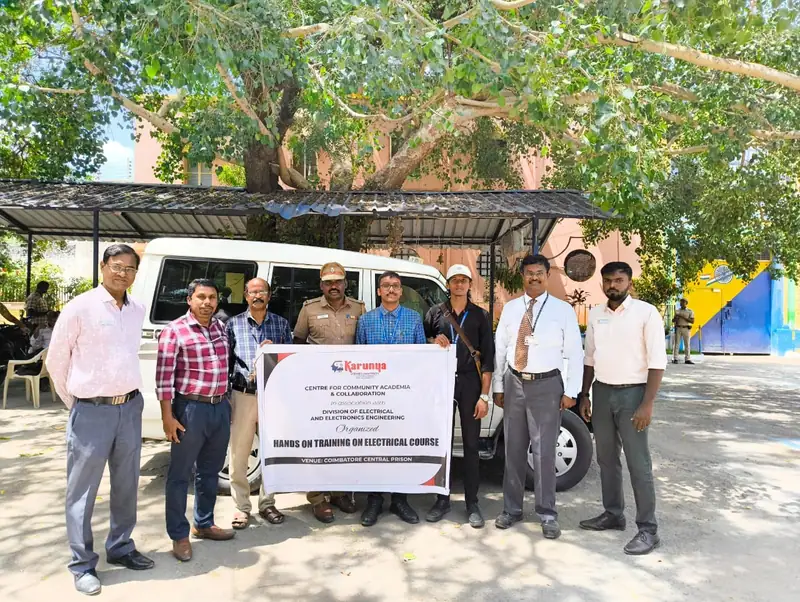
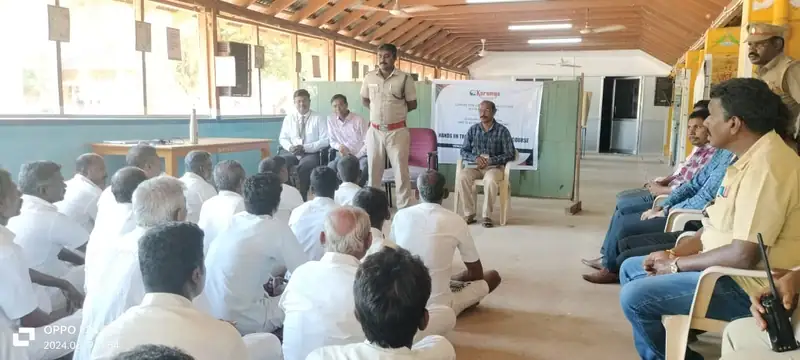
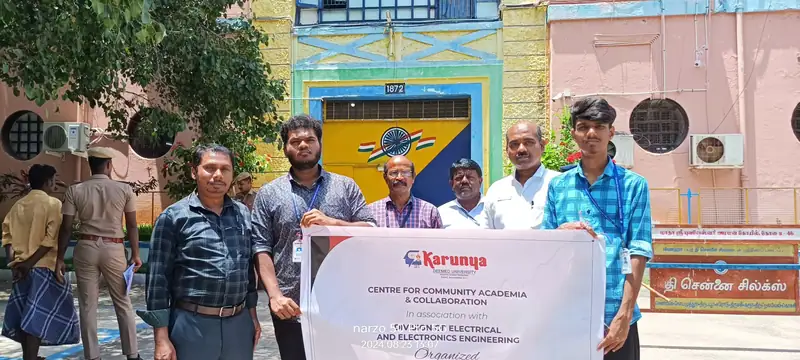
A team of faculty, staff and students from the division of EEE and Mechanical Engineering gave a hands-on training of Electrical and Plumbing works at Central Prison for 30 yet to released prisoners.
Activity 2:
An MoA has been signed with M/s. e-Royce Motors India Ltd., Coimbatore on 07.08.2024.
Major highlights of MoA:
Training for students of the B.Tech, M.Tech programs and faculty & staff of KITS at EROYCE premises with prior approval.
Industrial visits, Internships, Project work for students of the B.Tech, M.Tech programs and faculty & staff of KITS with prior approval.
Certificates to the students, faculty & staff of KITS who have successfully completed the training / industrial visit / internship / project work.
Support to write joined project proposal with the faculty of EEE based on the availability and feasibility of the work.
Inputs for curriculum modification towards the betterment of students who will be industry ready.
Model e-vehicles for study purpose to EEE-KITS towards establishment of centre of excellence in Electric Vehicle Technology / Electric Vehicle Laboratory.
Placement for eligible shortlisted students of KITS.
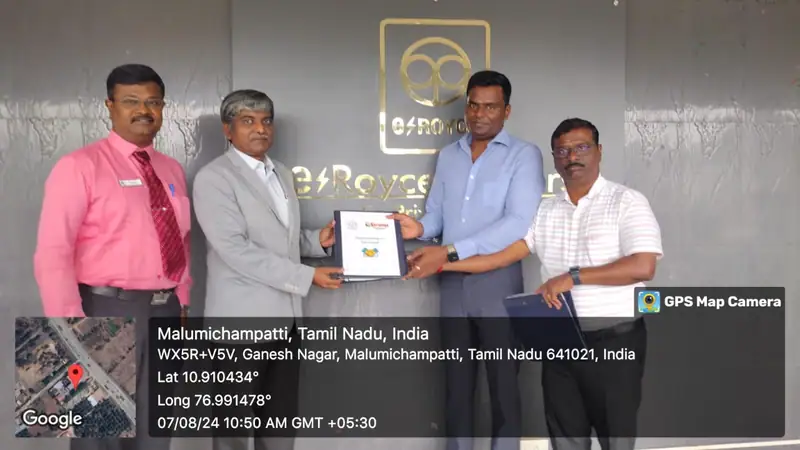
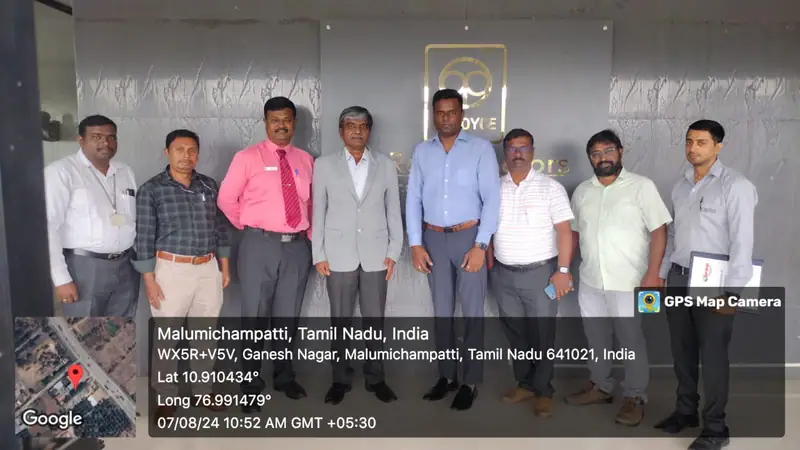

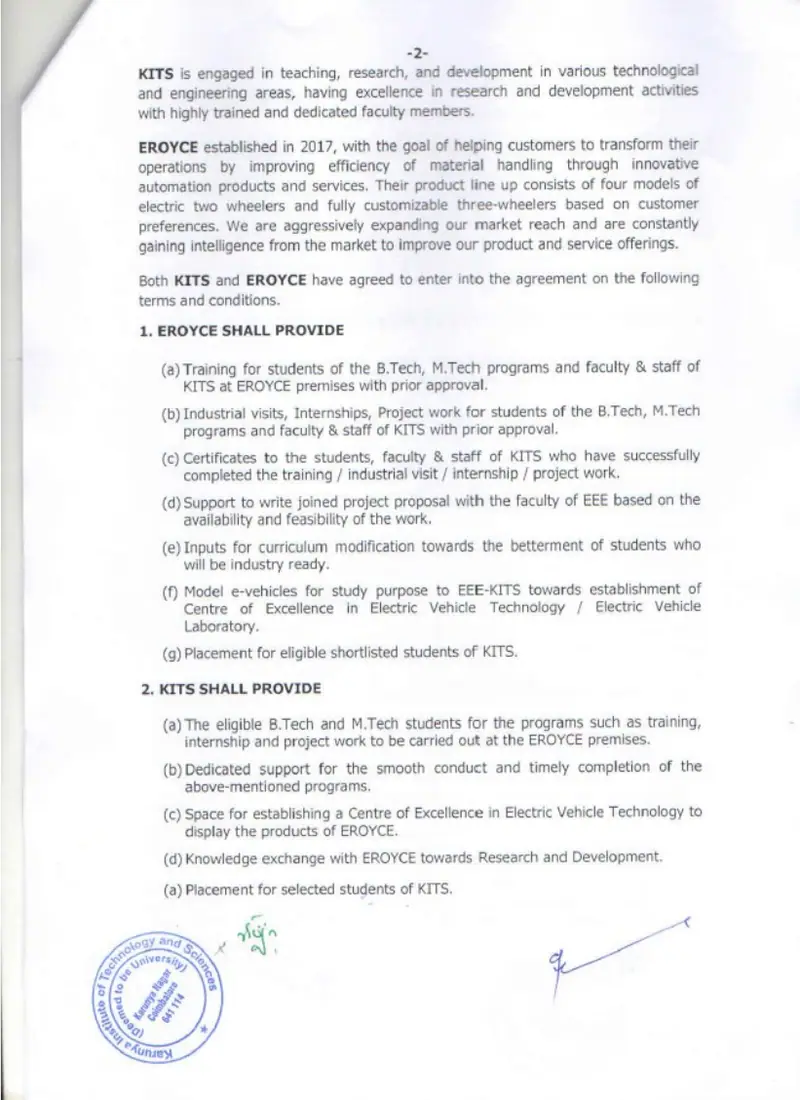
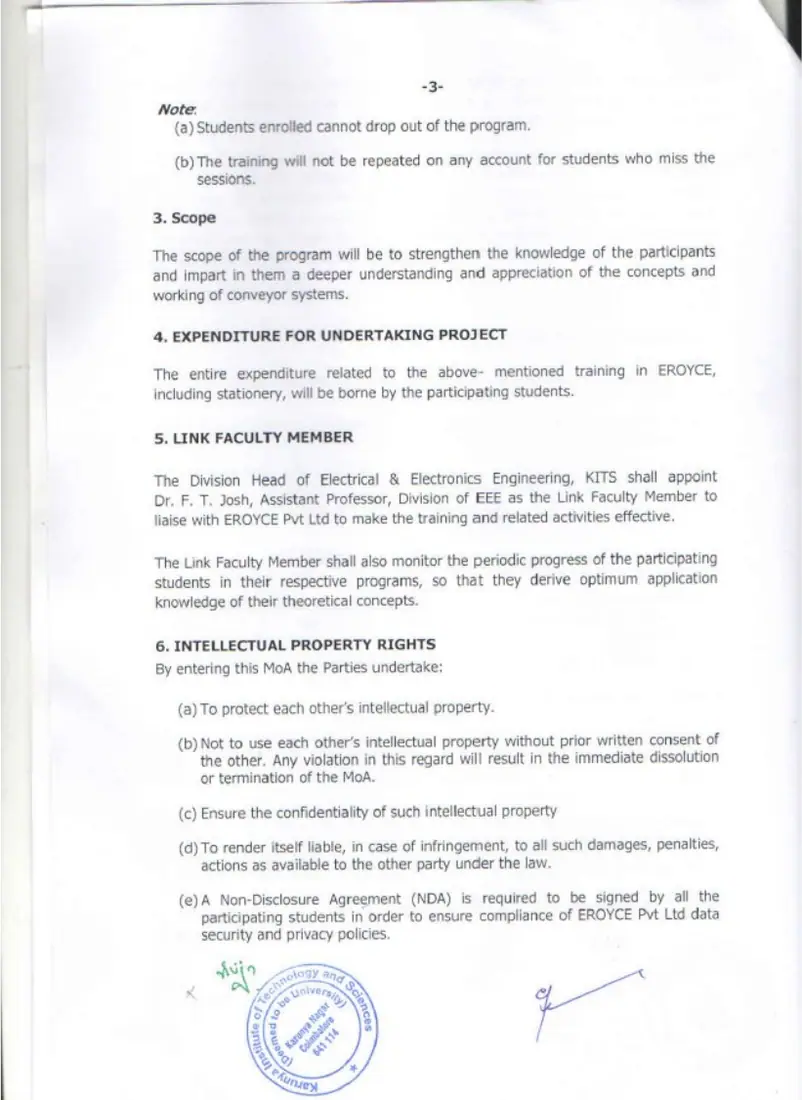
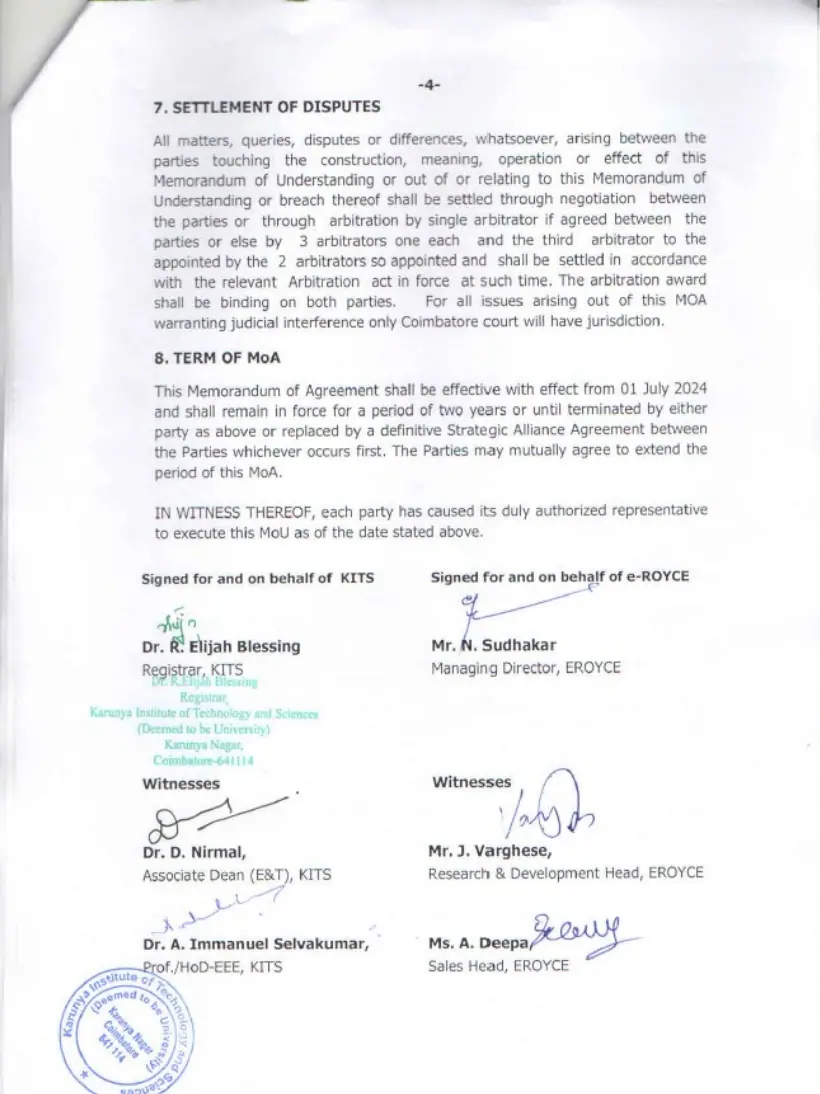
The Division of EEE signed a Memorandum of Agreement with M/s. e-Royce Motors Pvt. Ltd., Coimbatore, on 7 August 2024 under the Smart Vehicle Mission. The agreement provides for student and faculty training, industrial visits, internships, project work, certification, joint project proposals, curriculum inputs, access to model electric vehicles for academic study and support towards an Electric Vehicle Technology Centre of Excellence / EV Laboratory. Placement support is also identified for eligible shortlisted students.
KITS also undertook clean-energy and energy-efficient technology activities with government and research partners. These include a 2-tonne-per-day rotary-kiln gasification pilot plant with DST and CSIR-CMERI for converting non-recyclable plastic waste into syngas for steam generation; an ICSSR-supported study on the socio-economic impact of solar-powered technologies in Tamil Nadu agriculture; a DST i-Hub-supported blockchain-powered smart energy meter; and an IIT Palakkad Technology IHub Foundation-supported scale-up of a heat-pipe-assisted solar drying system for agricultural products in tribal areas.
At the local level, KITS documented orientation programmes for villages near the campus on solar-energy use and servicing of solar street lights. The institution also reported collaboration and data-sharing with NASA’s AERONET programme through the Karunya_University aerosol-monitoring site. These activities demonstrate engagement at national, state, local and global levels; only the activities with a direct energy or clean-technology connection are treated as SDG 7 evidence.
9. Best Practices
Best Practice 1: Integrated Solar Energy Generation and Solar Water Heating
Implemented infrastructure
Background: KITS has adopted on-campus renewable-energy generation to reduce dependence on conventional electricity and support its clean-energy commitments.
Objective: To increase renewable-energy use, reduce grid-electricity demand, and demonstrate practical applications of solar technology on a university campus.
Implementation:
Installation and operation of four solar power plants.
Deployment of 30 solar water heaters.
Integration of renewable-energy infrastructure into campus facilities.
Innovation: The initiative combines electricity generation through solar PV with solar thermal energy for water heating, addressing two different campus energy requirements.
Beneficiaries: Students, faculty, staff, and campus residential and administrative facilities.
Results: Institutional records report total renewable-energy production of 1,851,269.31 kWh. The reported infrastructure includes four solar plants and 30 solar water heaters.
Sustainability: Solar installations can continue producing energy over their service life with appropriate preventive maintenance, performance monitoring, and component replacement.
Replication: The model can be adapted by other universities, colleges, hostels, and institutional campuses according to rooftop area, energy demand, solar potential, and project economics.
Best Practice 2: Campus Energy Efficiency, Auditing, and Carbon Monitoring
Institutional energy management
Background: Renewable generation alone does not address energy wastage. KITS has also reported energy-efficiency measures and an institutional approach to monitoring energy use and emissions.
Objective: To reduce unnecessary electricity consumption, identify inefficient equipment and operating practices, and support measurable emissions reduction.
Implementation:
Replacement of conventional lighting with LED lighting.
Use of energy-efficient infrastructure and sensor-based controls where implemented.
Electrical inspections and energy audits to identify areas of energy wastage.
Monitoring of greenhouse-gas emissions using the GHG Protocol Corporate Standard.
Institutional sustainability and carbon-reduction policies.
Innovation: The approach combines physical efficiency improvements with auditing and carbon accounting. This provides a basis for identifying additional opportunities beyond renewable-energy installation.
Beneficiaries: The institution, campus occupants, facilities-management teams, and students involved in energy-related learning and projects.
Results: KITS reported Scope 1 and Scope 2 emissions of 4,705.11 tonnes CO₂ in 2024–25, a reduction of 146.89 tonnes compared with 2023–24. This is an institutional emissions result; it should not be attributed to a single measure without supporting analysis.
Sustainability: Continued energy audits, maintenance, periodic review of electricity consumption, and tracking of emissions can help sustain and improve performance.
Replication: Other institutions can adopt the approach through an energy audit, an energy-consumption baseline, prioritised efficiency upgrades, and annual reporting of electricity use and emissions.
Best Practice 3: Research and Innovation in Renewable Energy and Energy Storage
Research-led practice
Background: KITS conducts research in renewable-energy systems, power electronics, solar forecasting, energy management, electric vehicles, and energy storage. Its institutional research framework includes the Green Energy Technology Mission.
Objective: To develop technologies and methods that improve renewable-energy integration, conversion efficiency, energy storage, and energy-management performance.
Implementation:
Research on solar PV forecasting and optimisation.
Development and analysis of renewable-energy converters and maximum-power-point tracking methods.
Research into battery-state estimation and energy storage.
Work on smart-grid energy management and demand-side optimisation.
Support for research publications, patents, funded projects, and interdisciplinary collaboration.
Innovation: The research portfolio combines electrical engineering with artificial intelligence, optimisation, power electronics, and materials research. These approaches can support more effective integration and management of variable renewable generation.
Beneficiaries: Students, research scholars, faculty, energy-sector industries, technology developers, and potential end users of resulting technologies.
Results: The SDG 7 publication database contains 220 publication records. This demonstrates a substantial documented research portfolio, although publication counts alone do not establish commercial deployment or verified energy savings.
Sustainability: Research capacity can be sustained through continued funding, laboratory development, industry collaboration, student involvement, and translation of promising research into prototypes.
Replication: Other universities can establish a clean-energy research programme linking student projects, faculty research, industry-defined problems, prototyping, and field validation.
Best Practice 4: Biomass-Based Alternative Fuels and Waste-to-Energy Innovation
Circular-energy innovation
Background: KITS has documented student and entrepreneurship activities involving agricultural-waste-derived biofuel and biomass briquettes. These initiatives explore alternatives to conventional fuels and opportunities to valorise organic residues.
Objective: To investigate the conversion of biomass and agricultural residues into useful fuels or materials, potentially reducing waste and supporting alternative-energy supply chains.
Implementation:
Development of the product titled “Z waste-biofuel alternate from agricultural waste” by Mr. Dinesh T.
Development of biomass briquettes as an eco-friendly fuel alternative, with briquette manufacturing listed among the start-up activities.
Incubation and entrepreneurship support for selected innovations.
Innovation: The approach links waste management with fuel production. Briquetting can convert suitable biomass residues into a more manageable solid-fuel form, while waste-to-biofuel development explores alternative conversion pathways.
Beneficiaries: Potential beneficiaries include agricultural communities, biomass processors, small enterprises, and users of suitable solid fuels. Actual beneficiaries depend on product validation and deployment.
Results: The institutional records identify these products and the associated entrepreneurial activities. Verified production volumes, fuel-substitution rates, emissions reductions, and commercial sales were not established in the evidence reviewed.
Sustainability: Long-term viability depends on reliable biomass feedstock, conversion efficiency, product quality, emissions control, logistics, and economic feasibility.
Replication: The model may be adapted in agricultural regions where residues are available. Replication should begin with feedstock assessment, laboratory testing, pilot production, fuel-quality testing, and a techno-economic and environmental assessment.
Best Practice 5: Incubation and Entrepreneurship for Low-Carbon Technologies
Innovation ecosystem
Background: KITS supports student and faculty innovation through the Karunya Technology Business Incubation Park (K-TBIP) and Karunya Incubation Foundation. The institution's SDG 7 report describes incubation activities across multiple technology domains, including energy-related and environmentally oriented innovations.
Objective: To help promising ideas progress towards prototypes, start-ups, and potential commercial or community applications.
Implementation:
Incubation support for student and faculty innovators.
Development of products related to solar-panel maintenance, passive cooling, biomass-derived fuels, and waste valorisation.
Support for entrepreneurship and technology development within the institutional innovation ecosystem.
Innovation: The approach provides a pathway from academic work and student projects to potential products and ventures. Energy-related examples include a wall-climbing robot for solar-panel cleaning, advanced passive cooling solutions, and biomass briquettes.
Beneficiaries: Student and faculty innovators, prospective entrepreneurs, industry partners, and potential users of clean-energy and resource-efficiency technologies.
Results: KITS reports an active incubation ecosystem. The SDG 7 report identifies 31 student start-ups, 17 faculty-led start-ups, and 14 industry incubates across different domains. These are overall incubation figures, not counts of clean-energy ventures alone.
Sustainability: Incubation can be sustained through mentoring, prototyping facilities, intellectual-property support, industry connections, access to funding, and follow-up assessment of start-up progress.
Replication: Other institutions can adapt this model by establishing an incubation pathway, defining clean-energy innovation challenges, providing prototype support, connecting innovators with industry, and tracking technology readiness and deployment.
Summary of the five best practices
| No. | Best practice | Main SDG 7 contribution | Strongest evidence to retain |
|---|---|---|---|
| 1 | Integrated solar generation and solar water heating | Renewable-energy deployment | Four solar plants, 30 solar water heaters, and reported generation of 1,704,783.71 kWh |
| 2 | Energy efficiency, auditing, and carbon monitoring | Energy efficiency and emissions management | Scope 1 and 2 emissions data and year-on-year comparison |
| 3 | Renewable-energy and storage research | Clean-energy research and technology development | 220 SDG 7 publication records and documented research themes |
| 4 | Biomass-based alternative fuels and waste valorisation | Alternative fuels and resource recovery | Documented biofuel and biomass-briquette initiatives |
| 5 | Incubation for low-carbon technologies | Innovation, entrepreneurship, and technology transfer | Institutional incubation programme and documented energy-related innovations |
10. Conclusion
1. Renewable-energy generation: Karunya Institute of Technology and Sciences (KITS) operates four solar power plants, demonstrating institutional commitment to clean-energy generation.
2. Solar thermal applications: The installation of 30 solar water heaters supports the use of renewable energy for campus water-heating requirements.
3. Renewable-energy production: The institution reports total renewable-energy production of 1,851,269.31 kWh, demonstrating its contribution to on-campus clean-energy supply.
4. Energy-efficient infrastructure: LED lighting and energy-efficiency measures support efforts to reduce electricity consumption and improve campus energy performance.
5. Climate and sustainability policies: The Climate Change Mitigation and Sustainability Policy provides an institutional framework for emissions reduction, energy efficiency, and sustainability initiatives.
6. Sustainable investment: The Sustainable Investment Policy incorporates sustainability considerations into institutional investment decisions, including support for clean energy and efficient technologies.
7. Carbon accounting: KITS reports greenhouse-gas emissions using the GHG Protocol Corporate Standard, supporting systematic assessment of its environmental performance.
8. Emissions reduction: Reported Scope 1 and Scope 2 emissions decreased by 146.89 tonnes of CO₂ between 2023–24 and 2024–25, indicating progress in institutional emissions management.
9. Clean-energy research: Research publications documented in the SDG 7 database cover renewable energy, solar forecasting, energy conversion, smart grids, and energy management.
10. Energy-storage research: Institutional research includes battery technologies, lithium-ion battery state-of-charge estimation, supercapacitors, and materials for energy-storage applications.
11. Research funding and innovation: Funded projects and research activities provide opportunities to develop and validate technologies relevant to renewable energy, energy management, and sustainability.
12. Patents and technology development: Energy-related patents documented in the Annual Report include innovations in battery charging, supercapacitors, energy harvesting, and electric-vehicle battery control.
13. Clean-energy entrepreneurship: Incubated initiatives involving biomass briquettes, agricultural-waste-derived biofuel, passive cooling, and solar-panel cleaning demonstrate pathways for translating ideas into potential applications.
14. Education and stakeholder engagement: Sustainability awareness, training, student projects, and institutional research activities contribute to building knowledge and capacity in clean energy and energy efficiency.
15. Long-term commitment and scalability: KITS has established renewable-energy and net-zero commitments, providing a framework for further expansion of clean-energy infrastructure, efficiency measures, research, and community engagement.