Karunya Institute of Technology and Sciences (KITS) informs and supports government in clean energy and energy-efficient technology by carrying out studies and technology demonstrations sponsored by government agencies and reporting their data and findings to those agencies. It also works with communities and international agencies on clean energy and climate data. In the academic year 2024-25 this support covered the national, state, local and global levels (Table 1).
Table 1: Summary of support by level
| Level | Agency / partner | KITS contribution | Period |
|---|---|---|---|
| National | Department of Science and Technology (DST), Government of India, with CSIR-Central Mechanical Engineering Research Institute (CMERI) | 2 tonnes-per-day rotary kiln gasification pilot plant converting non-recyclable plastic waste into syngas for steam generation, supporting the goals of the Swachh Bharat Mission (Section 2.1) | 23.03.2021 – 22.06.2025 |
| National | Indian Council of Social Science Research (ICSSR), Government of India | Study assessing the socio-economic impact of solar-powered technologies in Tamil Nadu’s agricultural landscape (Section 2.2) | Sanctioned 19.12.2024 |
| National | DST i-Hub, IIT Palakkad; IIT Palakkad Technology IHub Foundation | Blockchain-powered smart energy meter; scale-up of a heat-pipe-assisted hybrid solar dryer for agricultural products in tribal areas (Section 2.3) | Sanctioned 29.01.2024 and 16.12.2024 |
| State | Government of West Bengal; Government of Jharkhand | Consultancy on solid waste management by CSIR-CMERI, the gasification project’s institutional partner, reported as an impact of the project (Section 3) | Reported impact of the project |
| Local | Villages near the campus | Orientation programmes on the use of solar energy and servicing of solar street lights (Section 4) | 2024-25 |
| Global | National Aeronautics and Space Administration (NASA), USA – AERONET | Operation of the ‘Karunya_University’ aerosol monitoring site and sharing of its data (Section 5) | Since 02.12.2013; data to 30.10.2024 |
1. Institutional commitment
Support to government and communities on clean energy is part of the Institute’s policies, which have been in place since July 2022 and were last revised on 29 August 2025 at the 28th meeting of the Internal Quality Assurance Cell (IQAC).
Table 2: Policy provisions
| Policy and clause | Provision |
|---|---|
| Energy and Carbon Management Policy (KITS/ECMP/2025/01), Rationale – Innovation & Leadership | “Foster research and innovation in renewable energy, green technologies, and energy-efficient infrastructure.” |
| ECMP, Article 3.6 – Inclusivity & Community Engagement | “Local communities shall be involved in awareness programs and benefit from campus-driven renewable projects. Initiatives like solar-powered community lighting and rural electrification pilots shall extend KITS’s role beyond its campus.” |
| Climate Change Mitigation and Sustainability Policy (KITS/CCMSP/2025/01), Article 3.3 – Governance and Policy Integration | “Alignment with local self-governments and community initiatives.” |
| CCMSP, Article 3.5 – Building Climate Resilience | “Knowledge sharing and regional climate partnerships.” |
2. National level: Government-sponsored clean energy programmes
Table 3 lists the government-sponsored clean energy and energy-efficiency projects at KITS that were active in 2024-25. Each project reports its data and findings to the sponsoring agency.
Table 3: Government-sponsored clean energy projects active in 2024-25
| Investigator(s) | Project | Sponsor | Sanction / duration; amount |
|---|---|---|---|
| Dr. Madhu Ganesh (PI); Dr. Joseph John Marshal; Shri Partha Das, CSIR-CMERI (Co-PIs) | Design of 2 Ton/day Rotary Kiln Gasification Pilot Plant with high Calorific Value Syngas Production | Department of Science and Technology (File No. DST/TDT/WM/2019/09(G)) | 23.03.2021 – 22.06.2025; Rs. 6.12 crore |
| Dr. B. Navaneetham | Assessing the socio-economic impact of solar-powered technologies in Tamil Nadu’s agricultural landscape | Indian Council of Social Science Research (ICSSR) | 19.12.2024; Rs. 10.00 lakh |
| Dr. J. Jayakumar | Block chain Powered Smart Energy Meter | DST i-Hub, IIT Palakkad | 29.01.2024; Rs. 10.00 lakh |
| Dr. A. Asha Monicka; Dr. A. Brusly Solomon | Scale Up of Heat Pipe-Assisted Hybrid Solar drying system for Agricultural Products in tribal areas | IIT Palakkad Technology IHub Foundation | 16.12.2024; Rs. 9.99 lakh |
2.1 Waste-to-energy pilot plant for the Department of Science and Technology
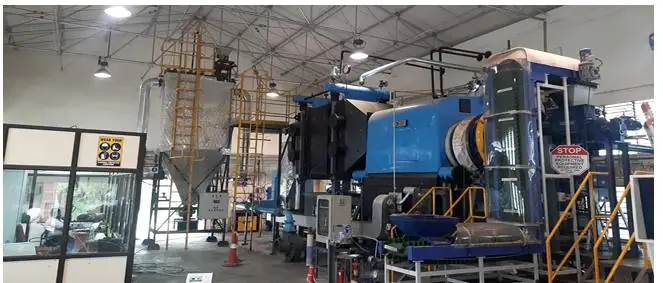
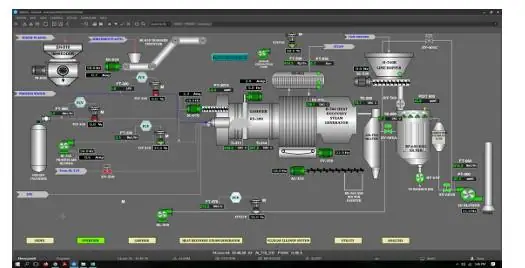
Under a project sponsored by the Department of Science and Technology, Government of India, KITS has set up an R&D prototype of a 2 tonnes-per-day (TPD) rotary kiln gasification pilot plant that converts non-recyclable plastic waste into high-calorific syngas for generating steam. The project was executed in collaboration with industry partner Techurja Inc. (Thiruvananthapuram) and institutional partner CSIR-Central Mechanical Engineering Research Institute (CMERI, Durgapur), operating from 23 March 2021 through 22 June 2025.
Outcomes reported for the project:
- Integration of the rotary kiln gasifier with a steam or power generator to treat hazardous and certain non-hazardous waste while complying with Pollution Control Board norms.
- Demonstration of sustainable solid waste-to-syngas production by rotary kiln gasification to achieve the goals of the Swachh Bharat Mission, processing 2 TPD of non-biodegradable solid waste.
- Creation of a technology platform and facility for pilot-scale and techno-economic analysis.
- Development of faculty and manpower in waste management and waste-to-energy conversion.
- Dissemination: poster “Design of 2 Ton/day Rotary Kiln Gasification Pilot Plant with high Calorific Value Syngas Production” at the Envision 2023 Conference, IIT Madras Research Park.
2.2 ICSSR study on solar-powered technologies in Tamil Nadu agriculture
The Indian Council of Social Science Research (ICSSR) sanctioned a study by Dr. B. Navaneetham of KITS on 19 December 2024 to assess the socio-economic impact of solar-powered technologies in Tamil Nadu’s agricultural landscape (Rs. 10.00 lakh). The study assesses the socio-economic impact of solar-powered technologies on agriculture in the state, and its findings will be reported to the Council.
2.3 Energy-efficient metering and solar drying technologies
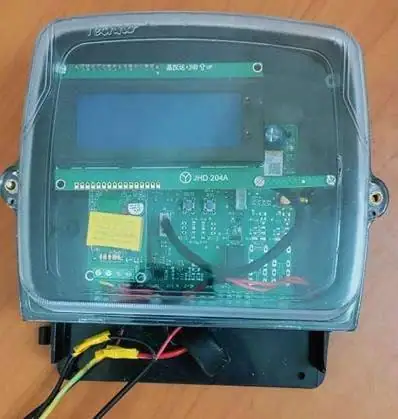
Two projects funded through IIT Palakkad develop clean energy and energy-efficient technologies: a blockchain-powered smart energy meter (Dr. J. Jayakumar; DST i-Hub, IIT Palakkad) and the scale-up of a heat-pipe-assisted hybrid solar dryer for agricultural products in tribal areas (Dr. A. Asha Monicka and Dr. A. Brusly Solomon; IIT Palakkad Technology IHub Foundation). KITS has also developed a prototype demand-response-based blockchain-powered electric energy meter with automated load control (Figure 2), and its researchers have published work on blockchain-based energy management for distributed energy resources (Section 6).
3. State level
The ICSSR study (Section 2.2) focuses on Tamil Nadu and assesses the socio-economic impact of solar-powered technologies on the state’s agriculture. The waste-to-energy project (Section 2.1) records the following impact at state level and beyond:
- CSIR-CMERI, the project’s institutional partner, has been appointed for consultancy services for solid waste management by the Panchayat & Rural Development Department, Government of West Bengal; the Urban & Housing Development Department, Government of Jharkhand; Damodar Valley Corporation, Maithon; Maithon Power Ltd (Tata Power); and the Indian Space Research Organisation – Satish Dhawan Space Centre, Sriharikota.
- ICT Mumbai and IIT Roorkee have shown interest in collaborating with KITS on new projects, and industry and corporations have shown interest in learning the technology.
KITS research has also evaluated household energy efficiency at the state level: a 2025 empirical study analyzes renewable energy integration in residential home energy management (International Journal of Applied Power Engineering, 14(2), pp. 459–466).
4. Local level: solar energy in nearby villages
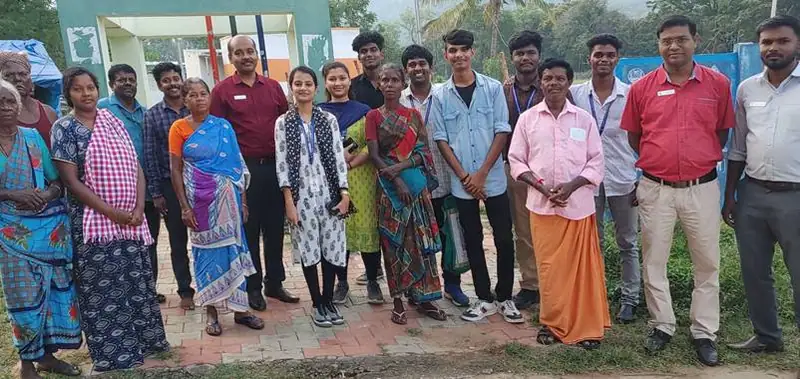
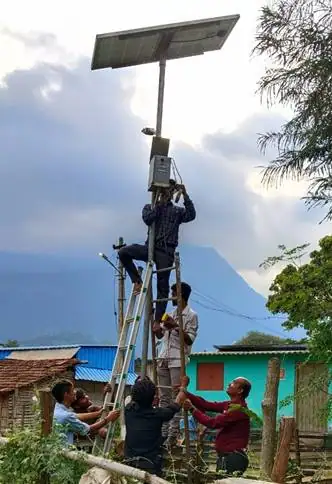
In line with Article 3.6 of the Energy and Carbon Management Policy, KITS extends its work on clean energy to nearby villages by organising orientation programmes on the use of solar energy. The programme includes the servicing of solar street lights to keep them working, promoting renewable energy in the community (Figure 3).
5. Global level: NASA AERONET site
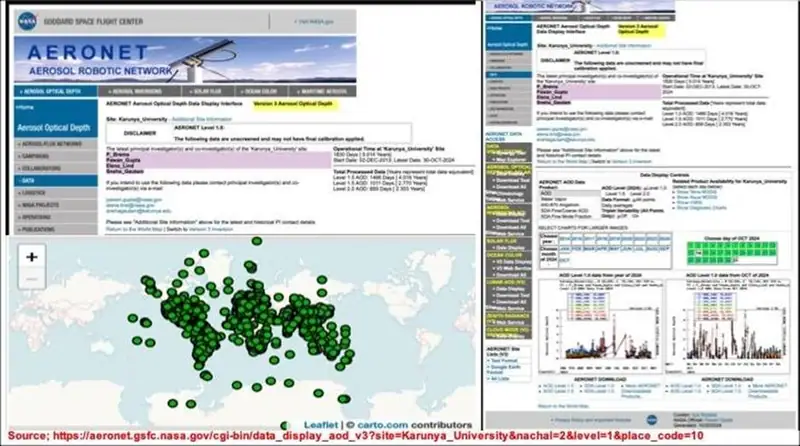
AERONET (AErosol RObotic NETwork) is a global federation of ground-based aerosol monitoring networks led by NASA and PHOTONS, with partners worldwide. KITS collaborates in data collection and sharing for this network through the ‘Karunya_University’ site, which has been operational since 02 December 2013, with data up to 30 October 2024 (1,830 days of operation). Investigators from NASA and from KITS are listed for the site. The collaboration contributes to global climate research and helps in evaluating air quality trends across regions (Figure 4).
6. Policy-relevant research, 2024 and 2025
KITS researchers have published work that bears on energy policy, including electricity tariff design, demand-side management, household energy use and decentralised renewable generation (Table 4).
Table 4: Selected policy-relevant publications
| Title | Authors | Source | Year |
|---|---|---|---|
| Smart home energy management systems in India: a socio-economic commitment towards a green future | George, T.; Selvakumar, A.I. | Discover Sustainability, 5(1) | 2024 |
| Renewable energy usage for home energy management and its adverse impact due to the increasing trend of electric load addition in homes in the State of Kerala, India | George, T.; Immanuel Selvakumar, A. | International Journal of Applied Power Engineering, 14(2), 459–466 | 2025 |
| Optimized Tariff Structures with Incentive-based Pricing for Demand-Side Management in Smart Grids | Akkara, S.; Selvakumar, A.I. | Proceedings of ICICV 2025, 1249–1255 | 2025 |
| Energy Meter Data Analysis and Tariff Optimization for Consumption Management | Akkara, S.; Selvakumar, A.I. | Proceedings of AREIS 2024 | 2024 |
| Energy Management System for Distributed Energy Resources using Blockchain Technology | Kavin, R.; Jayakumar, J. | Recent Patents on Engineering, 19(1), 93–102 | 2025 |
| A novel approach for solar combined open-ended winding induction machine for agriculture water pumping applications | Kavya, V.; Jegathesan, V.; Jarin, T. | Measurement: Sensors, 33 | 2024 |
Through government-sponsored studies and technology demonstrations, KITS supports government agencies in clean energy and energy-efficient technology at the national and state levels, and it extends this work through community engagement in nearby villages and international data cooperation with NASA.