
Evidence:
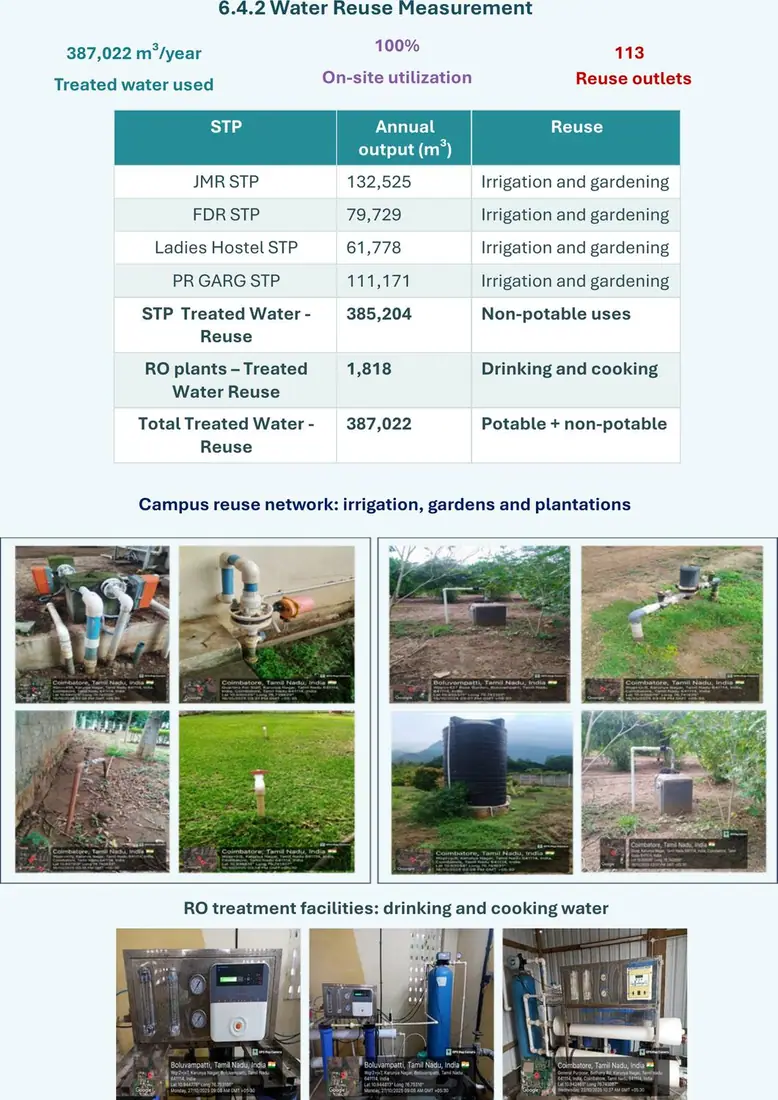
Four on-campus Sewage Treatment Plants (STPs) and two Reverse Osmosis (RO) plants together produced and reused approximately 387,022 m³/year of treated water for irrigation, flushing, and potable uses.
All treated water is utilized on-site, ensuring zero discharge outside the campus. Continuous IoT-based monitoring, 113 reuse outlets, and 3,436 self-closing taps promote efficiency and directly support SDG 6 (Clean Water and Sanitation) and SDG 12 (Responsible Consumption and Production).
1. Treated Water Reuse Calculation
| Parameter | Basis / Source | Value (m³/year) |
|---|---|---|
| STP Treated Water | Annual Flow-meter Data | 385,204 |
| RO Treated Water | RO Log Register | 1,818 |
| Total Treated Water Consumed (numerator) | — | 387,022 |
2. Treated Water Utilization Summary
| Source | Annual Output (m³) | Utilization | Monitoring |
|---|---|---|---|
| JMR STP | 132,525 | Irrigation & Gardening | Flow-Meter Flow-Meter Flow-Meter Flow-Meter |
| FDR STP | 79,729 | ||
| Ladies Hostel STP | 61,778 | ||
| PR GARG STP | 111,171 | ||
| Total STP Reuse | 385,204 | ||
| RO Plants | 1,818 | Drinking & Cooking | AMC / TDS Monitoring |
| Total Treated Water Used | 387,022 | — |
| Item | Quantity | Remarks |
|---|---|---|
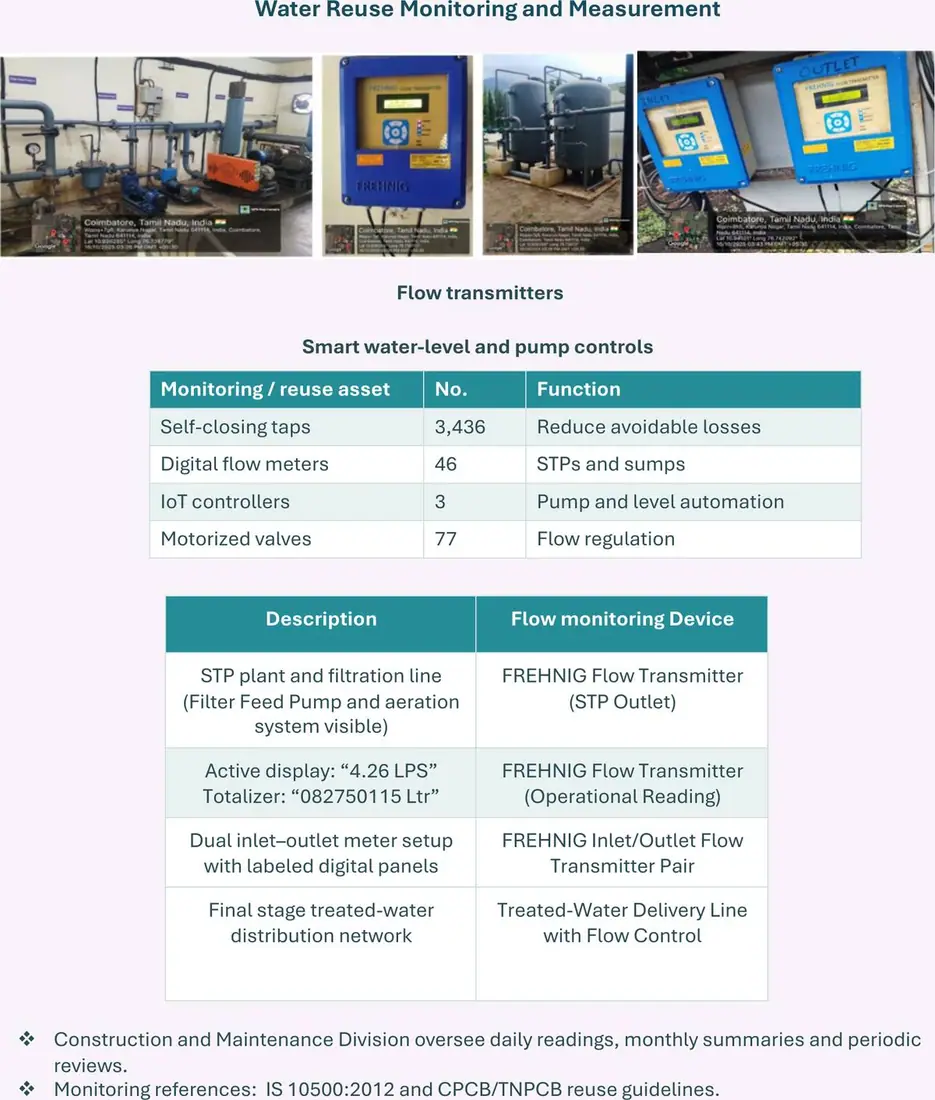
| Flow Meters (digital) | 46 | Across STPs and sumps |
| IoT Controllers | 3 | Pump & level automation |
| Motorized Valves | 77 | Flow regulation system |
3. Monitoring and Verification
IoT-Based Control System: Monitors water level, sump, and pump operations, reducing overflow losses (~10% water & energy saving).
Flow-Meters: Digital transmitters installed at all STP outlets record daily inflow/outflow.
RO Systems: Produce 1,818 m³/year of potable water (Gents Hostel & Staff Quarters).
Water Purifiers: 86 units maintained under AMC, quality tested (IS 10500:2012).
Reuse Network: 113 outlets ensure treated water is recycled for irrigation and sanitation
4. Governance and Monitoring Structure
Responsible Unit: Construction and Maintenance Division.
Oversight Authority: Chief Engineer, Construction and Maintenance Division
Audit and Review Mechanism: Regular monitoring and periodic auditing (internal and external)
Calibration and Verification
Monitoring and Reporting: Daily readings from IoT flow meters and sump-level sensors are compiled into a monthly summary.
Compliance Reference: All operations follow IS 10500 : 2012 for potable-water quality and CPCB / TNPCB guidelines for treated-water reuse.
The IoT-based Smart Water Control System regulates and monitors the water-level and pump operation in both sump and overhead tanks. Installed sensors and controllers (as shown above) prevent overflow and ensure optimal use of treated water for irrigation and flushing purposes. The system contributes to approximately 10% annual water and energy savings and is integrated into the institution’s digital dashboard under the Construction and Maintenance Division.