In recognition of the fundamental interdependence between humanity and the natural environment, KITS acknowledges its institutional responsibility to manage water resources sustainably and in strict accordance with national statutory frameworks.
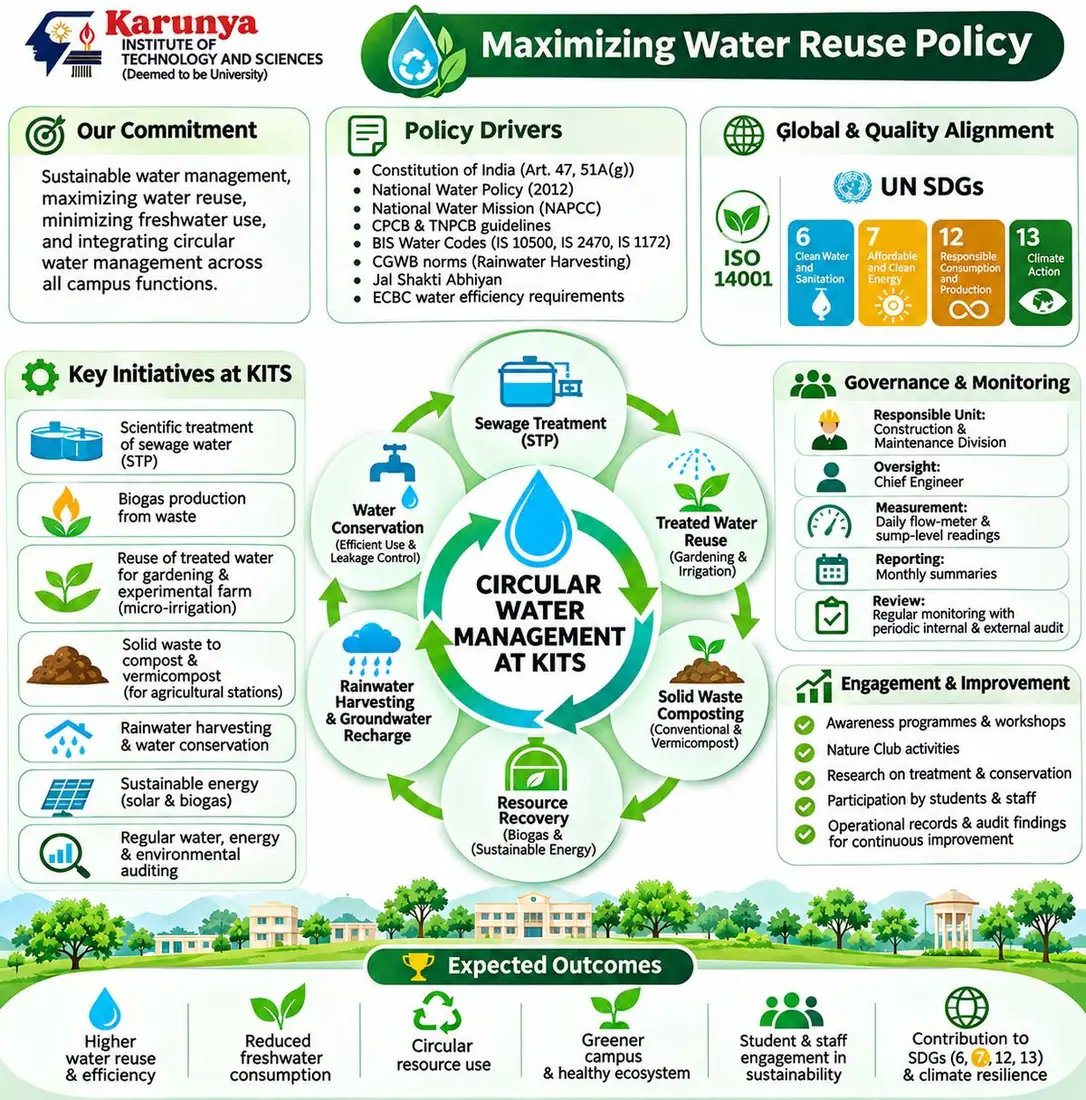
This prompted KITS to take initiatives to establish scientific treatment of sewage water and to produce biogas from the waste and to adopt solid waste management. The reuse of treated liquid waste for gardening and irrigating the plants in an experimental farm by using micro-irrigation technique has been introduced. Solid waste is converted into conventional and vermi-compost for the agricultural experimental stations. Rainwater harvesting and water conservation techniques are practised in the campus. Sustainable energy sources such as solar and biogas are harnessed, and wastage of energy is prevented. Regular energy, water and environmental auditing is conducted.
National & International Regulatory Drivers:
- Constitutional Mandate: Enacted under the directive principles of the Constitution of India (Article 47: Duty to improve public health; Article 51A(g): Fundamental duty to protect and improve the natural environment, forests, lakes, and rivers).
- National Frameworks: Aligned with the National Water Policy (2012), the National Water Mission under NAPCC, and the national Jal Shakti Abhiyan campaigns.
- Environmental Compliance: Conforms strictly to Central Pollution Control Board (CPCB) and Tamil Nadu Pollution Control Board (TNPCB) effluent discharge and land-application standards.
- Technical Standards: Adheres to Bureau of Indian Standards (BIS) specifications, including IS 10500 (Drinking Water Quality), IS 2470 (Design of Decentralized Treatment & Biogas Units), and IS 1172 (Basic Requirements for Water Supply, Drainage, and Sanitation).
- Management Systems: Governed within the institution's ISO 14001:2015 certified Environmental Management System, contributing directly to UN Sustainable Development Goals: SDG 6 (Clean Water & Sanitation), SDG 7 (Clean Energy), SDG 12 (Responsible Consumption), and SDG 13 (Climate Action).
Governance auditing and continuous improvement
The Construction and Maintenance Division is identified as the responsible unit for water reuse measurement, with oversight by the Chief Engineer. Daily flow-meter and sump-level readings are compiled into monthly summaries, supported by regular monitoring and periodic internal and external review. Regular water, energy and environmental auditing forms part of the policy commitment. Awareness programmes, workshops, Nature Club activities and research on treatment and conservation support participation by students and staff. Operational records, maintenance findings and audit observations provide a basis for reviewing and improving campus water-management practices.
Operational Oversight & Administrative Authority:
The Construction and Maintenance Division, headed by the Chief Engineer, is designated as the primary administrative unit responsible for enforcing the Water Reuse Policy, maintaining treatment infrastructure, and auditing daily flow metrics.
Measurement, Digital Metering & Verification:
- Digital Instrumentation: Flow rates and volumetric output are monitored continuously via 46 digital electromagnetic flow meters installed across all four STP treatment trains, RO facilities, and primary distribution conduits.
- Smart Level Control: The network utilizes 3 programmable IoT controllers and 177 automated water-level switches to log sump/overhead reservoir volumes, optimize pumping duty cycles, and eliminate overflow losses.
- Monthly Utility Summaries: Daily meter logs are synthesized into monthly operational summaries reviewed by the Director of Campus Infrastructure and submitted to the Internal Quality Assurance Cell (IQAC).
Auditing & Environmental Reviews:
The policy mandates regular internal monitoring and comprehensive annual third-party Green, Energy, and Environmental Audits. Audit recommendations guide preventative maintenance schedules, pipeline integrity testing, and infrastructure investments.
Community Engagement & Research Synergies:
The university actively fosters campus-wide participation in water conservation through the student-led Nature Club (comprising Environment, Green Campus, and Solid Waste Management wings). In addition, interdisciplinary research by faculty and scholars in Environmental and Civil Engineering focuses on advanced biological treatment, microplastic filtration, and biochar adsorption to continually enhance treated water quality.
Maximizing Water Reuse Policy (Policy No.: KITS/MWRP/2025/01)
Policy Declaration & Institutional Commitment
Karunya Institute of Technology and Sciences (Deemed to be University), through its Maximizing Water Reuse Policy (KITS/MWRP/2025/01), is committed to comprehensive water stewardship through the systematic conservation, multi-stage treatment, and 100% on-site reuse of wastewater and greywater across the campus.
Core Policy Mandates:
- Zero Liquid Discharge (ZLD): Mandates the complete collection and secondary/tertiary biological treatment of domestic greywater and blackwater, prohibiting the unmonitored discharge of untreated or partially treated effluent into off-campus drainage or water bodies.
- Non-Potable Substitution: Prioritizes treated recycled water for all non-potable applications, including landscape irrigation, agro-forestry maintenance, vehicle washing, construction curing, and HVAC cooling towers.
- Preservation of Freshwater: Prohibits the use of treated potable Siruvani municipal water or fresh groundwater for landscape watering and general surface irrigation.
- Decentralized Resource Recovery: Directs that high-strength residential blackwater undergo anaerobic digestion in biogas digesters for cooking fuel recovery prior to secondary polishing.
- Strategic Circularity Targets: Sustains 100% circular reuse of treated effluent on-site, with a strategic milestone to expand dual-plumbing infrastructure for recycled-water toilet flushing across 100% of campus buildings by 2035.