1. SDG Overview & Institutional Significance
United Nations Sustainable Development Goal 4 (SDG 4) mandates member institutions to “ensure inclusive and equitable quality education and promote lifelong learning opportunities for all.” Within this framework, UN SDG Targets 4.4, 4.6, and 4.7 emphasize broadening universal literacy, technical knowledge acquisition, and lifelong learning for citizens beyond formal academic enrollments.
Karunya Institute of Technology and Sciences (KITS) upholds the democratization of knowledge as an institutional mandate. Anchored by the Karunya Central Library, the university operates an open-door policy providing unrestricted on-site access to regional school students, rural teachers, and external university scholars. In parallel, KITS hosts the dedicated open web portal “One Library, All of Karunya”, delivering free global public access to over 35 e-book repositories, 150+ open journals, institutional Ph.D. theses, patent registries, and 116 full-length video lectures delivered by Karunya faculty.
Free Public Access Portal – “One Library, All of Karunya”
2. Digital Free Public Access Portal Repository
The Central Library operates a dedicated public access portal (www.karunya.edu/central-library/free-public-access/) under the tagline “Solving human problems through knowledge”, consolidating open-access digital learning assets across 11 key categories:
| Resource Category | Institutional Holdings & Coverage |
|---|---|
| Open-Access e-Books | 35 curated repositories (National Digital Library of India, Project Gutenberg, MIT Press Direct, Bookboon, Springer Nature Open, Free-Ebooks.net). |
| Open-Access e-Journals | Over 150 open-access journals across science, engineering, and social sciences (IAS, NISCAIR, DOAJ, MDPI, SSRN, SpringerOpen, IEEE Open Access). |
| Institutional Ph.D. Theses | Full-text Ph.D. theses spanning 25 academic departments. |
| Patent Information Databases | 15 national and international patent databases (IP India InPASS, Google Patents, Espacenet, WIPO PATENTSCOPE, USPTO). |
| Multilingual e-Newspapers | 42 national and regional daily newspapers across 10 languages (English: 15, Tamil: 7, Hindi: 8, Malayalam: 2, Telugu: 2, Kannada: 2, Marathi: 2, Bengali: 2, Gujarati: 1, Punjabi: 1). |
| Free Online Courses (MOOCs) | 16 platforms (SWAYAM, NPTEL, Coursera, edX, Alison, MIT OpenCourseWare, Infosys Springboard, Khan Academy, Harvard Online). |
| Competitive Exam Question Banks | Semester-wise question bank collections across 9 semesters (2022–2026) and competitive study kits for TNPSC and SSC. |
| Faculty Video Lecture Repository | Peer-reviewed video lectures on YouTube across 4 academic disciplines delivered by 14 faculty members. |
3. Institutional Policies and Commitments
Public access to lifelong learning resources is supported by formal institutional policies approved by the Board of Management:
| Policy / Framework Name | Year / Status | Purpose & Contribution to Metric 4.3.1 |
|---|---|---|
| Lifelong Learning Access Policy (KITS/LLAP/2024/01) | 2024 (Active) | Formally guarantees non-discriminatory, free access to campus library assets, reading halls, and digital learning portals for external scholars, school pupils, and community citizens. |
| Open Access & Digital Repository Policy | 2022 (Active) | Mandates that faculty video lectures, institutional Ph.D. dissertations, and intellectual property summaries be archived on open, paywall-free web domains. |
| Divyangjan (Barrier-Free) Accessibility Policy | 2022 (Active) | Mandates universal access for persons with disabilities, ensuring physical ramp/lift connectivity to libraries and installing NVDA screen readers and tactile aids. |
| Community Library Outreach & Extension Directive | 2023 (Active) | Requires the Central Library to host at least four regional school delegations annually and provide free technical internships for external library science students. |
4. Physical Public Access & External Educational Study Visits (AY 2024–25)
| Date | Visiting Institution / School Delegation | Visitor Count | Nature of Lifelong Learning Engagement |
|---|---|---|---|
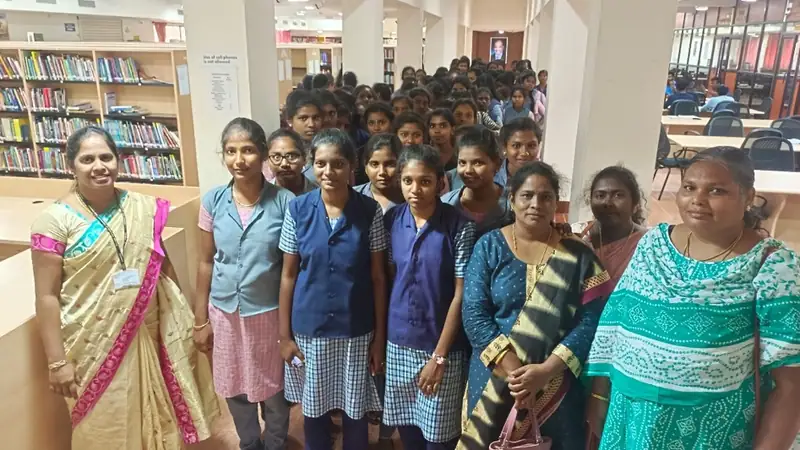
| 09.02.2024 | Sri Nachammal School Students, Avinashi | 95 Students, 6 Teachers | Orientation on library organization, digital cataloguing (OPAC), reading habits, and science demonstrations. |
| 2024–2025 | C.S.I. Girls Higher Secondary School, Dharapuram | 105 Students, 8 Teachers | Guided tour of reference collections, competitive exam sections, and science reading clinics. |
| 08.04.2025 | Kendriya Vidyalaya Staff (Chennai, Kochi & Thrissur) | 43 Teachers & Librarians | Professional training on RFID self-check-in kiosks, digital library management, and modern academic curation. |
| 28.04.2025 | South Asian Institute for Leadership and Cultural Studies | Faculty & Postgraduates | Study visit led by Principal Dr. Chacko evaluating library automation, digital repositories, and technological workflows. |
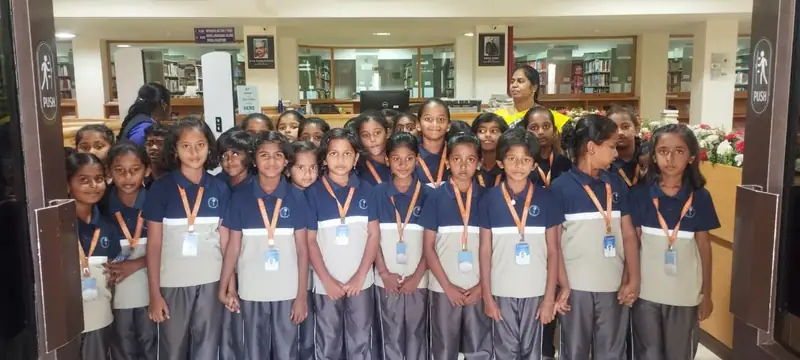
09.02.2024 A group of primary and high school students from Sri Nachammal School Students, Avinashi Visiting Central Library and have learnt the available collection and facilities. No. of Students: 95. Staff:6 LIBRARY VISITS 2024 – 2025
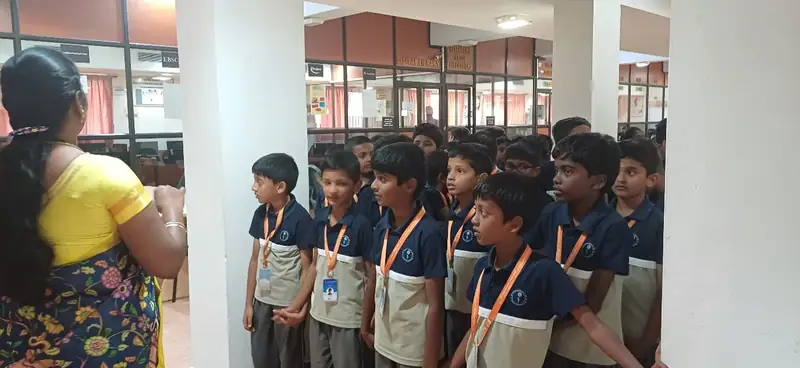
09.02.2024 Sri Nachammal School Students, Avinashi visiting Central Library. No. of Students: 95. Staff:6
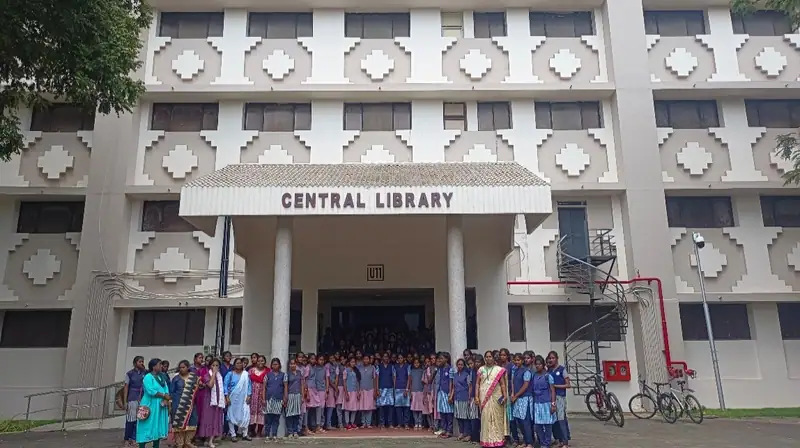
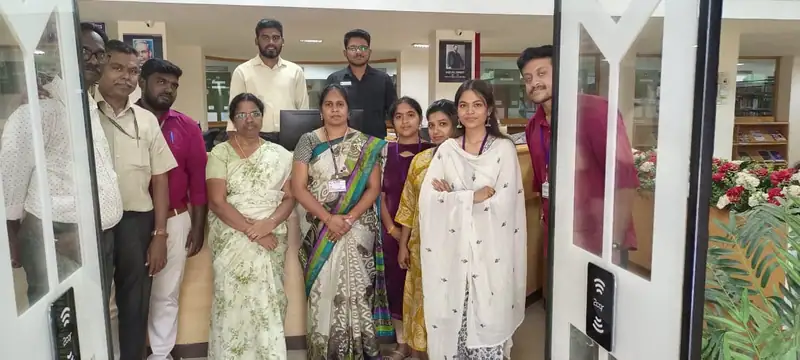
C.S.I Girls Higher Secondary School Students, Dharapuram Visiting Central Library. No. of Students:105 Internship Students, Department of Library and Information Science, Bharathiar University, Coimbatore. Internship Duration: 03.02.2025-28.02.2025. No. of Students:4
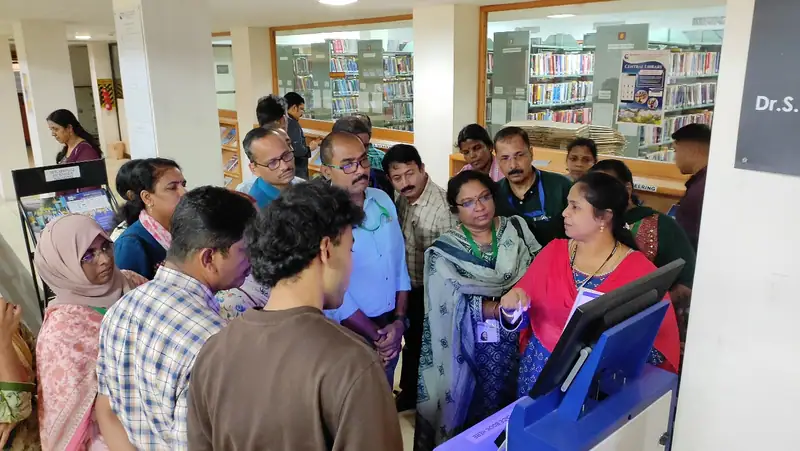
During the visit the Karunya Librarian explaining the Self Check-in process through RFID Kiosk to the KV staff members
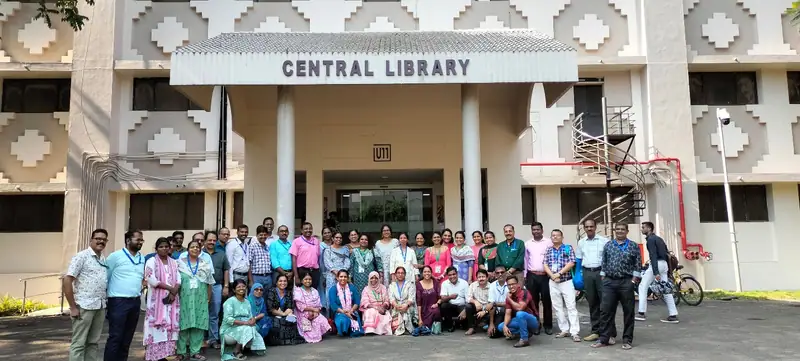
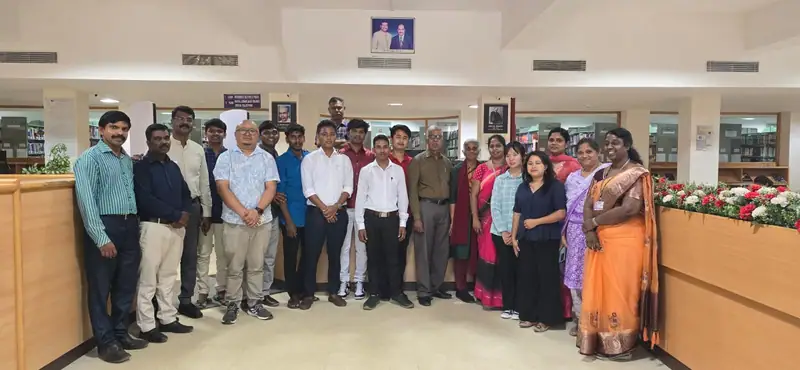
On 28-04-2025 A group of students from, South Asian Institute for Leadership and Cultural Studies, Periyanaickenpalayam, Coimbatore along with their Principal Dr. Chacko and faculty members visited the Central Library and learnt the housekeeping operations of the library and has appreciated the excellent use of technology in library management.
Karunya Chief Librarian demonstrating automated self-service check-in/out operations using the RFID Smart Kiosk to visiting students & teachers.
5. SDG Objectives for Metric 4.3.1
- Democratize Access to Scholarly Knowledge: Ensure that regional school students, competitive examination aspirants, and rural educators have free access to academic books, reference texts, and digital laboratories.
- Expand the Open Digital Learning Repository: Maintain and curate the “One Library, All of Karunya” portal, ensuring continuous public access across 12 digital resource streams without authentication barriers or subscription fees.
- Disseminate Free Multidisciplinary Video Courseware: Maintain the open YouTube repository of 116 Karunya faculty video lectures spanning Computer Science & Technology, Agricultural Sciences, Engineering & Technology, and Sciences & Humanities.
- Facilitate Practical Professional Capacity Building: Conduct structured, free practical internship attachments on modern library management systems (Koha ILS, DSpace, RFID kiosk automation) for postgraduate students from external universities.
- Ensure Inclusive Assistive Infrastructure: Maintain dedicated assistive learning terminals equipped with NVDA screen-reading software and wheelchair-accessible reading spaces for visitors with disabilities.
6. Conclusion
Karunya Institute of Technology and Sciences fulfills the mandate of THE Impact Rankings Metric 4.3.1. Through the “One Library, All of Karunya” digital gateway, the institution provides free public access to 12 open-access resource streams, including 35 e-book repositories, over 150 journals, 814 institutional Ph.D. dissertations, and 116 faculty video lectures across 4 core disciplines. Simultaneously, KITS maintains an open physical campus, hosting 200 school students from Avinashi and Dharapuram, 43 educators from Kendriya Vidyalaya, and providing free 21-day professional internships for external postgraduate library science scholars.