
KITS offers a wide range of specific courses that directly address sustainability and the SDGs. Representative examples include Sustainable Design of Campus; Environmental Studies; Basic Principles of Integrated Water Resources Management; Water and Wastewater Treatment; Climate Change and Fruit Crops; Breeding for Stress Resistance and Climate Change; Organic Fruit Culture; Bioethics and Biosafety; Low Power VLSI Design; Energy Harvesting for IoT Devices; Electric Vehicle Design; Industrial Safety Engineering; Food Safety Regulations and Control; Social Entrepreneurship; Professional Ethics and Value Education; and green/energy-efficient networking. Together with sustainability-related content embedded in agriculture, engineering, computing, health, food science, biotechnology and management curricula, these courses provide students with discipline-specific pathways to understand and address sustainability challenges.
Specific Program on Sustainability:
The following courses are offered under the M.Tech. (Integrated Water Resources Management) program during the academic year 2024-2025.
| S No. | Code | Course Name | L | T | P | C | Mapped SDGs |
|---|---|---|---|---|---|---|---|
| 1 | 24WI3001 | Basic Principles of IWRM | 3 | 0 | 0 | 3 | 6, 13, 17 |
| 2 | 24WI3002 | Hydrological Processes | 3 | 0 | 0 | 3 | 6, 13, 15 |
| 3 | 24WI3003 | Wastewater Management | 3 | 0 | 0 | 3 | 6, 3, 11, 12 |
| 4 | 24WI3004 | Irrigation Water Management | 3 | 0 | 0 | 3 | 2, 6, 12, 13 |
| 5 | 24WI3007 | Water Supply Distribution and Maintenance | 3 | 0 | 0 | 3 | 6, 3, 9, 11 |
| 6 | 24WI3008 | Water Quality and Water Distribution Network Analysis | 0 | 0 | 4 | 2 | 3, 6, 9 |
| 7 | 24WI3005 | Computational Methods and Applications | 3 | 0 | 0 | 3 | 6, 11, 13 |
| 8 | 24WI3006 | Water Resources Systems Analysis | 3 | 0 | 0 | 3 | 2, 6, 7, 13 |
| 9 | 24WI3009 | Fundamentals of Environmental Isotope Hydrology | 3 | 0 | 0 | 3 | 6, 13, 15 |
| 10 | 24WI3018 | Forest, Urban and Agricultural Watershed Management | 3 | 0 | 0 | 3 | 6, 13, 15 |
| 11 | 24WI3021 | Water Harvesting and Soil Conservation Structures | 3 | 0 | 0 | 3 | 2, 6, 13, 15 |
| 12 | 24WI3032 | Application of Electrochemistry in Water and Wastewater Treatment | 3 | 0 | 0 | 3 | 3, 6, 11, 12 |
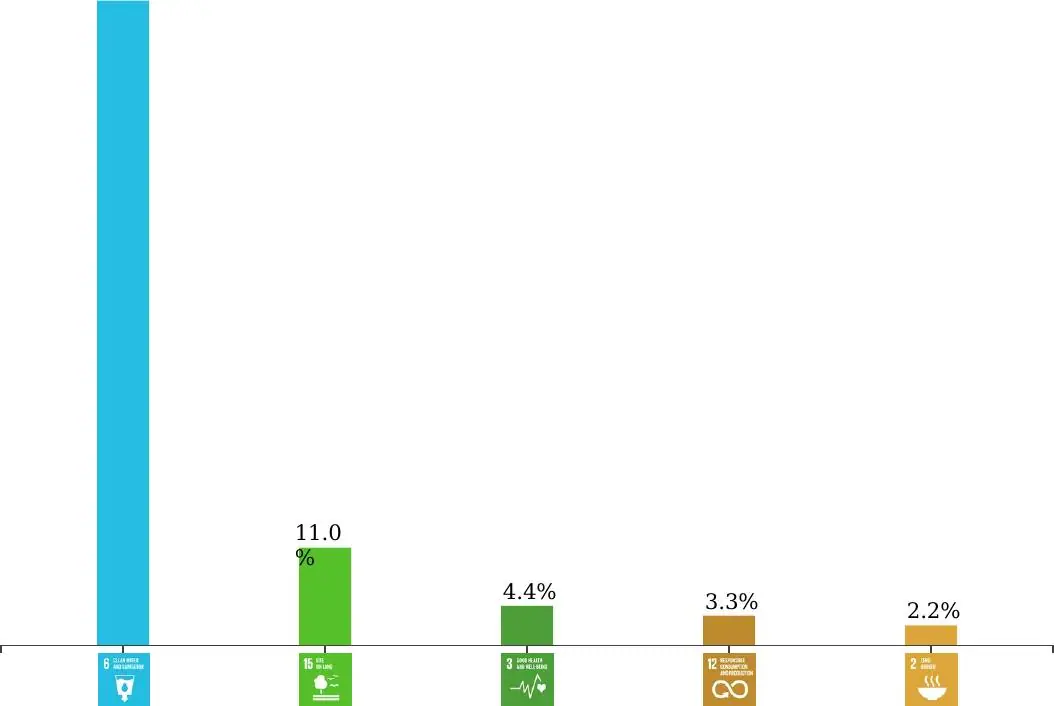
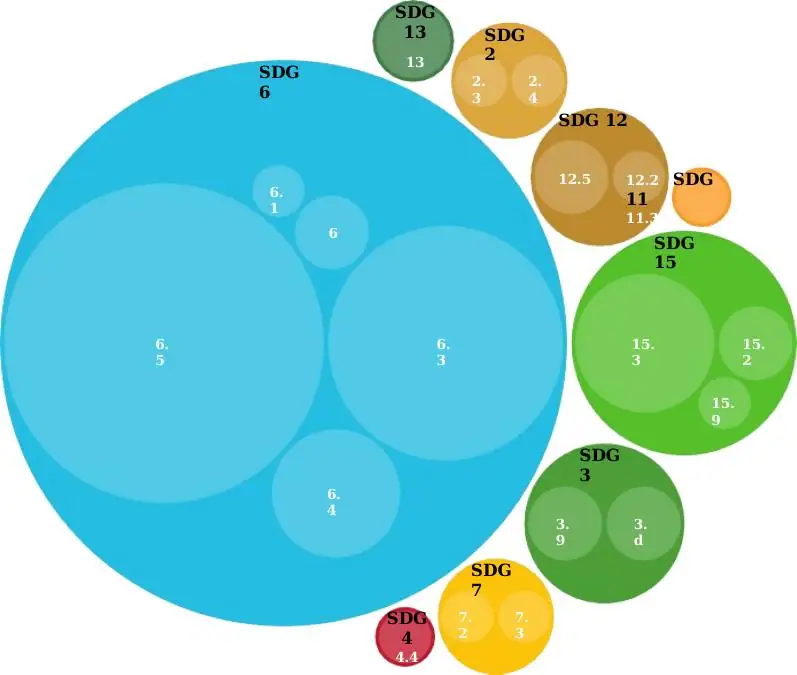
Based on the mapping of all courses of the Masters of Integrated Water Resources Management with SDGs using SDG Mapper developed by the European Commission, the following observations were made regarding the distribution of Sustainable Development Goals (SDGs) addressed across the curriculum: SDG 6 (Clean Water and Sanitation) represents the dominant focus at 72.5%, reflecting intensive training in water supply engineering, hydrological modelling, wastewater treatment, and catchment conservation. This is supported by SDG 15 (Life on Land) at 11.0%, emphasizing watershed protection and soil conservation; SDG 3 (Good Health and Well-being) at 4.4%, addressing water quality and environmental health; SDG 12 (Responsible Consumption and Production) at 3.3%, emphasizing industrial water recycling and resource efficiency; and SDG 2 (Zero Hunger) at 2.2%, supporting agricultural water management. The remaining 6.6% is distributed across SDG 13 (Climate Action), SDG 11 (Sustainable Communities), SDG 7 (Clean Energy), and SDG 4 (Quality Education). Overall, the curriculum demonstrates an integrated, cross-sectoral approach to water sustainability. Overall, the SDG mapping demonstrates that the curriculum predominantly supports SDG 6 while contributing to other sustainability goals through interdisciplinary water and environmental management education.
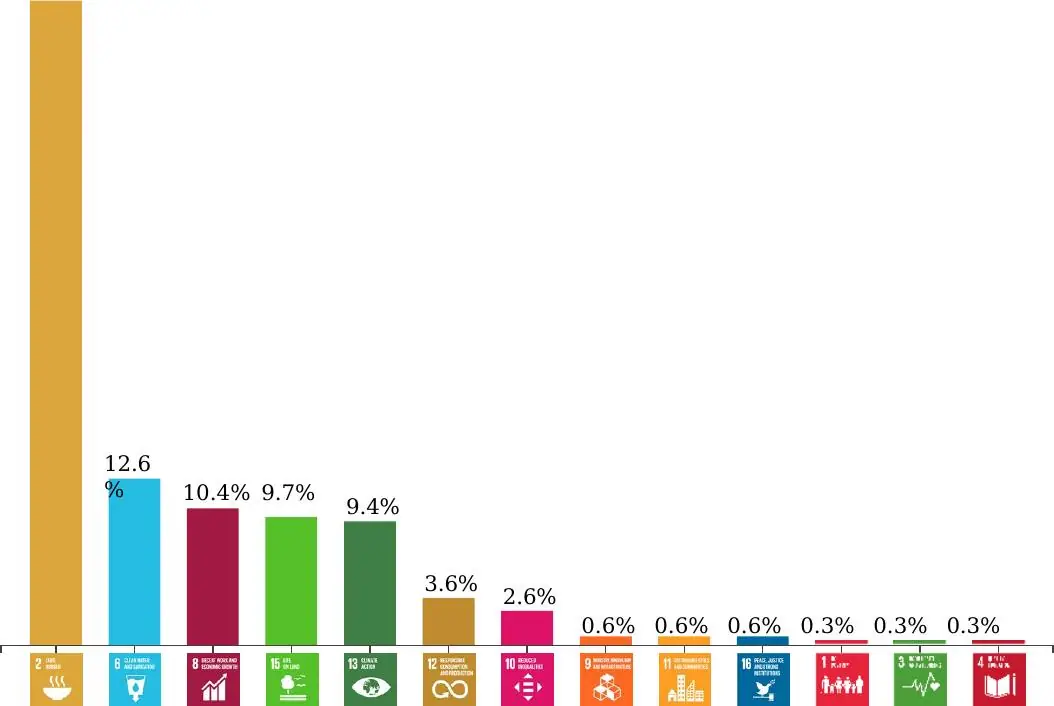
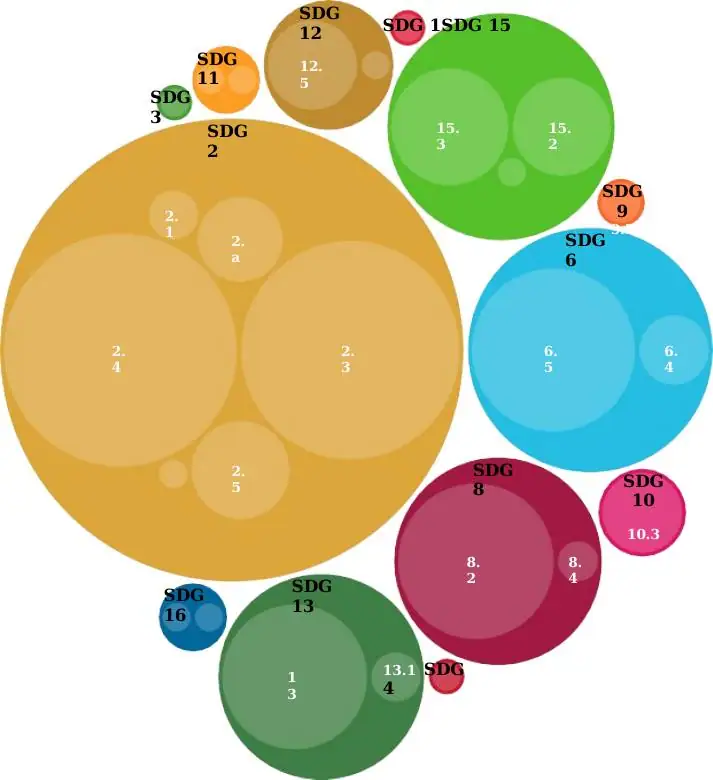
B. Sc. (Hons) Agriculture represents a dedicated undergraduate programme focused on agricultural sustainability. The chart below illustrates the distribution of Sustainable Development Goals (SDGs) addressed across the curriculum: addressed through the courses offered in the programme. SDG 2 – Zero Hunger accounts for the highest contribution of 48.9%, highlighting the emphasis on sustainable agriculture, irrigation practices, food security and efficient utilization of water resources. This is followed by SDG 6 – Clean Water and Sanitation (12.6%), reflecting the focus on water resource management, water supply, wastewater treatment and conservation. SDG 8 – Decent Work and Economic Growth (10.4%) and SDG 15 – Life on Land (9.7%) demonstrate the program's contribution towards sustainable economic development, natural resource management, biodiversity and ecosystem conservation. SDG 13 – Climate Action (9.4%) highlights the integration of climate-resilient water management and adaptation strategies. Furthermore, SDG 12 – Responsible Consumption and Production (3.6%) and SDG 10 – Reduced Inequalities (2.6%) reflect the focus on resource efficiency and inclusive development. The remaining contributions include SDG 9 – Industry, Innovation and Infrastructure (0.6%), SDG 11 – Sustainable Cities and Communities (0.6%), SDG 16 – Peace, Justice and Strong Institutions (0.6%), SDG 1 – No Poverty (0.3%), SDG 3 – Good Health and Well-being (0.3%), and SDG 4 – Quality Education (0.3%). Overall, the SDG mapping demonstrates the multidisciplinary contribution of the curriculum towards sustainable agriculture, integrated water resource management, environmental protection, climate resilience and inclusive socioeconomic development, with a predominant emphasis on SDG 2 – Zero Hunger.
Other Specific Courses on Sustainability:
| Programme / area | Course code | Course title | Sustainability focus evidenced in syllabus | Mapped SDGs |
|---|---|---|---|---|
| Agriculture | 24AG3004 | Principles and Practices of Water Management | Water use, irrigation, water-use efficiency and management | 2, 6, 12, 13 |
| Agriculture | 24AG3006 | Cropping Systems and Sustainable Agriculture | Sustainable cropping systems and resource management | 2, 12, 13, 15 |
| Agriculture | 24AG3011 | Conservation Agriculture | Resource-conserving and sustainable agricultural practices | 2, 12, 13, 15 |
| Agriculture | 24AG3012 | Principles and Practices of Organic Farming | Organic and environmentally responsible farming | 2, 12, 15 |
| Agriculture | 24AG3007 | Dryland Farming and Watershed Management | Climate-resilient farming and watershed management | 2, 6, 13, 15 |
| B.Sc. Forensic Science | 23CH1001 | Environmental Studies | Natural resources, biodiversity, pollution, green technologies, sustainable development, climate change, disaster management | 3, 6, 7, 11, 12, 13, 15 |
| B.Sc. Computer Science | 20CA2027 | Professional Ethics | CSR, environmental ethics, human values, professional responsibility | 4, 12, 16 |
| B.Sc. Information Security and Digital Forensics | 20CA2052 | Information Security Ethics | Professional ethics, privacy, responsible technology, safety-critical software | 9, 12, 16 |
| B.Sc. Optometry | 20OP2035 | Occupational Optometry | Occupational health, hygiene, safety, environmental monitoring and hazard control | 3, 8 |
| B.Sc. Optometry | 20OP2036 | Systematic Diseases | Disease management, malnutrition, immunology and public-health-related knowledge | 2, 3 |
| B.Tech. AI / Artificial Intelligence and Machine Learning | 23CS1013 | Ethics in Information Technology | Engineering/IT ethics, Industry 4.0 applications in food, water, energy and healthcare; green computing | 3, 6, 7, 9, 12, 16 |
| B.Tech. AI / AIML | 23CS1010 | Artificial Intelligence in IoT Lab | Temperature, soil moisture, garbage collection and smart healthcare monitoring | 3, 6, 9, 11, 12 |
| B.Tech. CSE | 18CS3027 | Cyber Physical Systems | Smart grid, medical CPS, energy CPS and sustainable cyber-physical systems | 3, 7, 9, 11 |
| B.Tech. CSE | 18CS3084 | Smart Sensors and Internet of Things | Environmental parameter monitoring, water-quality sensing and smart sensor applications | 6, 9, 11, 12 |
| B.Tech. CSE | 19CS2012 | Artificial Intelligence for Biotechnology | AI for healthcare, energy/environment, groundwater quality and agriculture | 2, 3, 6, 7, 9, 13 |
| B.Tech. Civil | 20CE2005 | Water Supply and Sanitary Engineering | Water conveyance, treatment, sanitation and public-health infrastructure | 3, 6, 11 |
| B.Tech. Civil | 20CE2017 | Disaster Preparedness and Planning | Natural/environmental disasters, preparedness and risk reduction | 11, 13 |
| B.Tech. Civil | 20CE2037 | Noise Pollution and its Control | Environmental pollution assessment and mitigation | 3, 11, 12 |
| B.Tech. Civil | 20CE2039 | Irrigation Engineering and Hydraulic Structures | Surface/groundwater irrigation and water infrastructure | 2, 6, 9 |
| B.Tech. Civil | 20CE2044 | Sustainable Design of Campus | Institutional sustainability and sustainable campus design | 7, 11, 12, 13 |
| B.Tech. ECE | 22EC1001 | Physical Electronics | Green energy physics: solar, wind, ocean/tidal energy, fuel cells and electric vehicles | 7, 9, 13 |
| B.Tech. ECE | 22EC2025 | Energy Harvesting for IoT Devices | Energy sources and harvesting for low-power connected devices | 7, 9, 12 |
| B.Tech. Mechanical | 23ME2010 | Electric Vehicle Design | Electric propulsion and cleaner mobility systems | 7, 9, 11, 13 |
| B.Tech. Mechanical | 18ME2060 | Industrial Safety Engineering | Occupational health, hazards, toxicology, hygiene, sanitation and safety management | 3, 8, 12 |
| B.Tech. Mechanical | 21ME2009 | Applications of AI Techniques in Mechanical Engineering | AI-based wind-turbine optimization, HVAC energy efficiency, predictive maintenance and supply-chain optimization | 7, 9, 12, 13 |
| B.Tech. Biomedical | 22BM2002 | Medical Ethics and Standards | Ethical healthcare practice, standards and responsible biomedical engineering | 3, 16 |
| B.Tech. Biomedical | 24BM2007 | Patient and Device Safety | Patient safety, device risk reduction and safe healthcare technology | 3, 9 |
| B.Tech. Biotechnology | 20BT2057 | Bioethics, IPR and Biosafety | Bioethics, biosafety and responsible biotechnology innovation | 3, 9, 12, 16 |
| B.Tech. Biotechnology | 23BT2011 | Entrepreneurship Development | Innovation, enterprise development and responsible economic participation | 8, 9 |
| B.Tech. Food Processing | 18CH2001 | Environmental Studies | Resources, ecosystems, biodiversity, pollution, water conservation, climate change and sustainable development | 3, 6, 7, 11, 12, 13, 15 |
| B.Tech. Food Processing | 23FP2011 | Food Standards and Regulations | Food safety, quality, standards and responsible food systems | 2, 3, 12 |
| B.Tech. Food Processing | 23FP1001 | Basics of Food Science and Technology | Food science foundations supporting safe and sustainable food systems | 2, 3, 12 |
| B.Tech. Robotics & Automation | 19RO2014 | Robotics and Automation in Food Industry | Automation for food production, quality and industrial efficiency | 2, 9, 12 |
| B.Tech. Aerospace | 23AE1001 | Aviation Industry | Professional/engineering ethics and environmental ethics in aviation context | 9, 12, 13, 16 |
| B.Tech. Aerospace | 20AE2052 | Wind Tunnel Techniques | Wind/aerodynamic testing supporting efficient aerospace design | 9, 12, 13 |
| B.Tech. DSCS - AI&DS / CE | 23DC1010 | Ethics in Information Technology | Professional ethics, social responsibility and green computing | 9, 12, 16 |
| B.Tech. DSCS - AI&DS / CE | 23DC2006 | IoT and its Applications | IoT systems for monitoring and smart applications | 9, 11, 12 |
| B.Tech. Electronics and Computer Engineering | 22EC2002 | Social Media Analytics | Analysis of social networks and digital societal systems | 9, 16 |
| M.Sc. Biotechnology | 20BT3012 | Bioethics and Biosafety | Biosafety regulations, GMO environmental containment, biodiversity/farmers rights, ethical/legal/social impacts of biotechnology | 3, 12, 15, 16 |
| M.Sc. Food Science & Technology | 22FT3002 | Food and Industrial Microbiology | Water and food microbiology, food-borne pathogens, safe processing and industrial microbiology | 2, 3, 6, 12 |
| M.Sc. Food Science & Technology | 22FT3009 | Nutrition and Metabolism | Human nutrition, nutritional status and health, specialized nutrition and metabolism | 2, 3 |
| M.Sc. Food Science & Technology | 22FT3010 | Food Quality Systems and Management | Food quality and safety systems supporting safe, responsible food production | 2, 3, 12 |
| M.Sc. Food Science & Technology | 22FT3003 | Principles of Food Preservation | Food preservation, reduction of spoilage and safe food processing | 2, 3, 12 |
| M.Sc. Fruit Science | 24HO3138 | Organic Fruit Culture | Organic fruit production and environmentally responsible horticultural practices | 2, 12, 15 |
| M.Sc. Fruit Science | 24HO3139 | Climate Change and Fruit Crops | Climate-change impacts and adaptation in fruit production | 2, 13, 15 |
| M.Sc. Fruit Science | 24HO3136 | Nutrition of Fruit Crops | Nutrient and resource management for productive fruit systems | 2, 12, 15 |
| M.Sc. Genetics & Plant Breeding | 24AG3033 | Breeding for Stress Resistance and Climate Change | Climate-resilient crop breeding and stress resistance | 2, 13, 15 |
| M.Sc. Genetics & Plant Breeding | 24AG3042 | Germplasm Characterization and Evaluation | Plant genetic resource characterization and conservation-oriented crop improvement | 2, 15 |
| M.Tech. Biomedical Engineering | 21BM3001 | Biomedical Instrumentation Design | Patient safety, medical instrumentation, AI/ML-enabled diagnosis and healthcare technology | 3, 9 |
| M.Tech. Computer / Cyber | 24CS3001 | Advanced Computer Networks | Green networking, energy-efficient protocols, IoT/edge security and next-generation infrastructure | 7, 9, 12, 16 |
| M.Tech. VLSI | 20EC3002 | Low Power VLSI Design | Low-power circuits, system-level power reduction and energy-efficient electronics | 7, 9, 12, 13 |
| M.Tech. Food Processing | 20FP3003 | Food Safety Regulations and Control | Food safety regulation, control systems and responsible food production | 2, 3, 12, 16 |
| M.Tech. Food Processing | 20FP3022 | Food Supply Chain Management | Efficient and responsible food supply-chain management | 2, 8, 9, 12 |
| MBA | 18MS2001 | Professional Ethics | Business ethics, ethical leadership, social/environmental obligations and responsible governance | 8, 12, 16 |
| MBA | 22MS2001 | Professional Ethics and Value Education | Human rights, stewardship of environment/resources, digital ethics and responsible citizenship | 4, 10, 12, 16 |
| MBA | 23MS3027 | Social Entrepreneurship | Social/environmental impact, sustainable practices, social innovation and mission-driven enterprise | 8, 10, 12, 17 |
| MBA | 23MS3022 | Entrepreneurship Development | Rural and women entrepreneurship, innovation, start-ups and inclusive economic participation | 5, 8, 9, 10 |
| MBA | 23MS3018 | Logistics Management | Sustainable transportation and green fleet management | 9, 11, 12, 13 |
Syllabus Evidence
| Course | Remarks | Programme | SDGs |
|---|---|---|---|
| Sustainable Design of Campus (20CE2044) | Direct sustainability course covering campus waste management, energy conservation, sustainable food systems, water conservation, health, sanitation, walkability/cycling and implementation of a sustainability concept. | B.Tech Civil | 7, 11, 12, 13 |
| Environmental Studies (23CH1001 / 18CH2001) | Covers renewable/non-renewable resources, biodiversity, pollution, green technologies/chemistry, sustainable development, water conservation, climate change, legislation, human health and disaster management. | UG programmes | 3, 6, 7, 11, 12, 13, 15 |
| Basic Principles of IWRM (24WI3001) | Explicitly teaches three pillars of sustainability, water security, climate impacts, water economics/governance, PPP and IWRM in the context of SDG 6. | M.Tech Water Infrastructure | 6, 13, 17 |
| Climate Change and Fruit Crops (24HO3139) | Dedicated course addressing climate-change implications for fruit production and adaptation. | M.Sc Fruit Science | 2, 13, 15 |
| Breeding for Stress Resistance and Climate Change (24AG3033) | Crop improvement for stress resistance and climate resilience. | M.Sc Genetics & Plant Breeding | 2, 13, 15 |
| Low Power VLSI Design (20EC3002) | Power-dissipation analysis and circuit/logic/architecture/system-level power reduction techniques. | M.Tech VLSI | 7, 9, 12, 13 |
| Bioethics and Biosafety (20BT3012) | Biosafety regulation, hazardous material handling/disposal, environmental containment of GMOs, biodiversity/farmers rights and ethical/legal/social impacts. | M.Sc Biotechnology | 3, 12, 15, 16 |
| Social Entrepreneurship (23MS3027) | Social/environmental outcomes, societal challenges, sustainable practices, governance, social innovation and financial sustainability. | MBA | 8, 10, 12, 17 |
| Professional Ethics and Value Education (22MS2001) | Human rights, responsible citizenship, environmental/resource stewardship and digital ethics. | MBA | 4, 10, 12, 16 |
| Advanced Computer Networks (24CS3001) | Green networking and energy-efficient protocols alongside secure IoT/edge infrastructure. | M.Tech Computer/Cyber | 7, 9, 12, 16 |
| Course code | SUSTAINABLE DESIGN OF CAMPUS | L | T | P | C |
|---|---|---|---|---|---|
| 20CE2044 | 3 | 0 | 0 | 3 | |
| Course Objective: | |||||
| To understand the importance of sustainability in Institute To learn the implementation of sustainability in the thrust areas To learn the design for sustainability for the Institute | |||||
| Course Outcome: | |||||
| At the end of the course students will be able to Identify the Waste management concepts in the institute Apply sustainability principles for Energy Analyze the importance of food and sustainability Apply Water related sustainability concepts Analyse the concepts related to health and sustainability Evaluate a strategy for developing sustainable institute | |||||
| Module: 1 | Green Engineering for Waste Management in Institute | 8 Hours | |||
| Recycling program for University waste - Reduce the use of plastic and paper in campus - Organic and inorganic waste treatment - Sewerage disposal Case Study: University Gadjah Mada | |||||
| Module: 2 | Sustainability Principles for Energy | 8 Hours | |||
| Energy flow analysis in buildings - Waste to energy in campus - Methods of conservation of energy - Case Study: Osaka University, Japan, NTU Singapore | |||||
| Module: 3 | Sustainability in Food production | 7 Hours | |||
| Sustainable food systems and agriculture: Food security - Self-production with available resources - Food conservation methods - Case Studies: Illinios University | |||||
| Module: 4 | Sustainability in Water Conservation | 8 Hours | |||
| Recycling and Reuse of Water - Water conservation methods - Efficient building operation - Low water landscape strategies - Case Study: George town University | |||||
| Module: 5 | Sustainability in Health | 7 Hours | |||
| Design of Walkable/cycling spaces - Sick building syndrome - Thermal comfort in classrooms - Sanitation and Hygiene in campus - Air pollution control methods inside campus - Case Study | |||||
| Module: 6 | Applications of sustainability concepts | 7 Hours | |||
| Design and Execute a sustainable concept in the campus focussing on the thrust areas on the University | |||||
| Total Lectures | 45 Hours | ||||
| Text Books | |||||
| 1. | Abu Zahrim Yaser, “Green Engineering for Campus Sustainability”, Springer Singapore, 2019 | ||||
| 2. | Andrew Braham , “Fundamentals of Sustainability in Civil Engineering”, CRC Press, 2017 | ||||
| Reference Books | |||||
| 1. | Yates J. K., Daniel Castro-Lacouture, “Sustainability in Engineering Design and Construction”, CRC Press 2018 | ||||
| 2. | Sivakumar Babu G.L., Sireesh Saride, B. Munwar Basha,” Sustainability Issues in Civil Engineering”, Springer Singapore2018 | ||||
| 3. | Jan Seidel,” Sustainability in Civil Engineering”, GRIN Verlag 2007 | ||||
| 4. | Toolseeram Ramjeawon ,” Introduction to Sustainability for Engineers” CRC Press 2020 | ||||
| 5. | Barbara A. Luke, Richard Newport Wright, William Edward Kelly ,”Engineering for Sustainable Communities Principles and Practices” ASCE, 2017 | ||||
| Recommended by Board of Studies | |||||
| Approved by Academic Council | 25th September 2021 | ||||
| Course Code | ENVIRONMENTAL STUDIES | L | T | P | C |
|---|---|---|---|---|---|
| 23CH1001 | 3 | 0 | 0 | 3 | |
| Course Objectives | |||||
| Enable the student to: Acquire adequate knowledge on environment related aspects. Assess the impact of environmental issues on the ecosystem. Solve real time challenges in the environment caused due to anthropogenic, social, and natural factors. | |||||
| Course Outcomes | |||||
| Student will be able to: Identify environmental hazards and its impact on the biosphere. Apply practical skills for solving pollution related problems. Design strategies to combat environmental issues adopting green technologies. Adopt appropriate methods to preserve the environment for sustainable development. Assess environmental and social issues by integrating facts, concepts, and trending technologies. Recommend innovative solutions to the policy makers of the Nation to save Planet Earth. | |||||
| Module: 1 | ENVIRONMENT AND NATURAL RESOURCES | 09 Hours | |||
| Basic science of environment and its types - Renewable and Non-Renewable Resources – Natural resources and associated problems – Water in Science: over-utilization of surface and ground water, floods, drought, dams-benefits and problems - Forest in Science: over-exploitation, deforestation, mining and their effects on forests and tribal people - Energy Science: renewable and non-renewable energy sources, and use of alternate energy sources– Land structure science: land degradation, soil erosion and desertification – conservation of natural resources – Activity: Field study or documentation of environmental assets. | |||||
| Module: 2 | ECOSYSTEMS AND BIODIVERSITY | 09 Hours | |||
| Concept of an ecosystem – Structure and function of an ecosystem – Ecological succession – Food chains, food webs -Introduction to Biodiversity – Definition: Types – Bio geographical classification of India – Value of biodiversity– Biodiversity at global, National and local levels -Hot-spots of biodiversity – Threats to biodiversity – Case studies - Endangered and endemic species of India – Conservation of biodiversity: In-situ and Ex-situ conservation of biodiversity – Activity: Documentation of available ecosystems/Biodiversity within Campus. | |||||
| Module: 3 | ENVIRONMENTAL POLLUTION | 09 Hours | |||
| Definition, Causes, effects and control measures (two) – Air pollution (Cyclone separator, Electrostatic Separator) – Water pollution – Soil pollution – Noise pollution – Thermal pollution – Nuclear hazards – Role of an individual in prevention of pollution - Pollution case studies – Green Chemistry– principles and its uses in industries. Activity: Visit-nearby Sewage treatment Water Plant or case studies. | |||||
| Module: 4 | SOCIAL ISSUES AND ENVIRONMENTAL LEGISLATION | 09 Hours | |||
| Solid waste management: Causes, effects and control measures of urban and industrial wastes – E – wastes - Sustainable development – Urban problems related to energy – Water conservation methods - global warming, acid rain, ozone layer depletion, case studies – Environment Production Act – Air (Prevention and Control of Pollution) Act – Water (Prevention and control of Pollution) Act – Wildlife Protection Act – Forest Conservation Act –Public awareness – Activity: Any Online courses / Ecofriendly technology projects. | |||||
| Module: 5 | HUMAN POPULATION AND DISASTER MANAGEMENT | 09 Hours | |||
| Population growth, Population explosion— Family Welfare Program – Environment and human health. Human rights – HIV/AIDS – Women and Child Welfare – Role of Information Technology in environment and human health – Disaster management: Foods, earthquake, cyclone and landslides – Case Studies – Activity: Observation in NDRF, FIRE Service / One Online course certificate / Ecofriendly technology projects. | |||||
| Total Lectures | 45 Hours | ||||
| Reference Books | |||||
| 1. | Trivedi. R.K. “Handbook of Environmental Laws, Rules, Guidelines, Compliances and Standards” Vol. I and II, Enviro Media. | ||||
| 2. | Cunningham, Cooper. C.P. and Gorhani, T.H. “Environmental Encyclopedia” Jaico Publ., House, Mumbai, 2001. | ||||
| 3. | Abnubha Kaushik, C.P.Kaushik,“Perspectives in Environmental Studies” New Age International Publishers, 3rd Edition, 2009. | ||||
| 4. | B..K.Sharma, “Environmental Chemistry” Comprehensive covering the UGC Syllabus, 11th Edition, Goel Publishing House, Meerut, 2007. | ||||
| 5. | Deeksha Dave, S. S. Katewa, “Text Book of Environmental Studies”, 2nd Edition. Cengage Learning India Pvt. Ltd., New Delhi, 2012. | ||||
| Recommended by Board of Studies | |||||
| Approved by Academic Council | 25 Aug 2023 | ||||
| Course Code | BASIC PRINCIPLES OF IWRM | L | T | P | C |
|---|---|---|---|---|---|
| 24WI3001 | 3 | 0 | 0 | 3 | |
| Course Objectives: | |||||
| Gain understanding on the principles of IWRM and its inter-disciplinary nature. Acquaint with approaches towards sustainable water resources management, water security and public-private participation issues. Explore integrated multi-sectoral and multi-dimensional issues, role of PPP in developing water resource management plans. | |||||
| Course Outcomes: | |||||
| At the end of the course, the students will be able to: Explain the concepts and principles of IWRM in the context of three pillars of sustainability to assess water crisis. List the salient features of national water policy and relate the concepts of the river basin approach and watershed management towards sustainability. Identify and correlate the problems related to water & soil and their impacts on human and environment. Compare the effectiveness of traditional and modern techniques for water security, considering environment, society and economics. Describe the case studies of Public-Private Partnerships (PPPs) in the context of IWRM. Articulate the role and impact of IWRM framework in SDG. | |||||
| Module: 1 | Concepts, Principles and Terminologies | 8 Hours | |||
| IWRM: definition and principles - Social, economic, environmental and institutional factors in water management – Water needs for human beings and nature-Concepts of ‘blue’, ‘green’ and ‘grey’ water - Ecosystem approach - Global climate change and its effect on water resources. | |||||
| Module: 2 | Sustainable Water Resources Management | 7 Hours | |||
| Concept of sustainable development-Dublin Conference and Earth Summit- National Water Policy: highlights and limitations –River basin approach – Small watershed management –-Environmental flows- Minimum water table. | |||||
| Module: 3 | Water related Environmental and Health Problems | 8 Hours | |||
| Floods –Droughts- Soil erosion- Reservoir sedimentation-Salinity intrusion into surface and groundwater sources-Soil salinity- Waterlogging in command areas-Sand mining-Impact of population and anthropogenic activities on water resources. | |||||
| Module: 4 | Traditional and Modern Techniques for Water Security | 7 Hours | |||
| Role of water in development - Rainwater harvesting – Artificial recharge – Conjunctive use of surface and groundwater-Interbasin transfer-Conservation of ‘green’ water – Treatment of ‘grey’ water- Basics of desalination and water treatment and recycling. | |||||
| Module: 5 | PPP and Private Markets | 8 Hours | |||
| Introduction to water economics and governance of water utility - Water pricing - Private sector involvement in water resources management: PPP objectives, options, process and limitations-PPP case studies. | |||||
| Module: 6 | IWRM in the context of SDG6 | 7 Hours | |||
| IWRM frame work in SDG 6 – Successful case studies for implementation of IWRM. | |||||
| Total Hours | 45 Hours | ||||
| Reference Books: | |||||
| 1 | Nicolas Spulber, Asghar Sabbaghi "Economics of Water Resources: From Regulation to Privatization", Springer, 2012. | ||||
| 2 | Roberto Lenton, Mike Muller "Integrated Water Resources Management in Practice: Better Water Management for Development", Earthscan, 2009. | ||||
| 3 | Pedro Martinez-Santos, Maite M. Aldaya, M. Ramón Llamas "Principles of Integrated Water Resources Management", IWA Publishing, 2014. | ||||
| 4 | Cech Thomas V.,” Principles of Water Resources: History, Development, Management and Policy”, John Wiley and Sons Inc., New York, 2003. | ||||
| 5 | Cap-Net, Tutorial on basic principles of Integrated Water Resources Management, Cap-Net, IRC, IWMI, HRWallingford, IUCN, WSS, UNDP (www.cap.net.org). | ||||
| Recommended by Board of Studies | 17/07/2024 | ||||
| Approved by Academic Council | 20/08/2024 | ||||
| Course Code | Climate Change and Fruit Crops | L | T | P | C |
|---|---|---|---|---|---|
| 24HO3139 | 1 | 0 | 0 | 1 | |
| Course Objectives: | |||||
| Enable the students to Gain knowledge on the climatic variability and factors affecting climate change Acquint the importance of sensors in the assessment of climate change Recommend mitigation measures to overcome the effects of climate change | |||||
| Course Outcomes: | |||||
| The students will be able to Examine the importance of global warming and climate variability Analyze the factors responsible for climate change Evaluate the methods to record the climatic parameters Apply conventional and advanced cultivational practices to overcome the effects of drastic climate Adopt strategic planning and appropriate measures to tackle invasive insect, disease and weeds Disseminate practices of sustainable farming in fruits with enhanced yield and quality. | |||||
| Theory | |||||
| Block 1: General Aspects | |||||
| Unit: I | |||||
| Introduction, Global Warming and Climatic Variability: Introduction to climate change. Factors directly affecting climate change. Global warming, effect of climate change on spatio-temporal patterns of temperature and rainfall, concentrations of greenhouse gasses in atmosphere. pollution levels such as tropospheric ozone, change in climatic variability and extreme events. | |||||
| Block 2: Climate Change and Management | |||||
| Unit: I | |||||
| Impact Assessment and Mitigation: Sensors for recording climatic parameters, plants response to the climate changes, premature bloom, marginally overwintering or inadequate winter chilling hours, longer growing seasons and shifts in plant hardiness for fruit crops. Climate mitigation measures through crop management- use of tolerant rootstocks and varieties, mulching – use of plastic windbreak- spectral changes- protection from frost and heat waves. Climate management in greenhouse- heating – vents – CO2 injection – screens – artificial light. Impact of climate changes on invasive insect, disease, weed, fruit yield, quality and sustainability. Climate management for control of pests, diseases, quality, elongation of growth and other plant processes- closed production systems. | |||||
| Block 3: Case Studies | |||||
| Unit: I | |||||
| Response to Climate Change: Case studies – responses of fruit trees to climatic variability vis-a-vis tolerance and adaptation; role of fruit tree in carbon sequestration. | |||||
| References Dhillon WS and Aulakh PS. 2011. Impact of Climate Change in Fruit Production. Narendra Publishing House, New Delhi. Peter KV. 2008. Basics in Horticulture. New India Publishing Agency, New Delhi. Ramirez F and Kallarackal J. 2015. Responses of Fruit Trees to Global Climate Change. Spinger- Verlag. Rao GSLHV. 2008. Agricultural Meteorology. Prentice Hall, New Delhi. Rao GSLHV, Rao GGSN, Rao VUM and Ramakrishnan YS. 2008. Climate Change and Agriculture over India. ICAR, New Delhi. Schafeer B and Anderson P. 1994. Handbook of Environmental Physiology of Fruit Crops.Vol. 1 & 2. CRC Press. USA. | |||||
| Recommended by the Board of Studies | 02.02.2024 | ||||
| Approved by the Academic Council | 24.02.2024 | ||||
| Course Code | Breeding for Stress Resistance and Climate Change | L | T | P | C |
|---|---|---|---|---|---|
| 24AG3033 | 2 | 0 | 1 | 3 | |
| Course Objectives: | |||||
| Enable the students to Gain knowledge on special breeding methods for stress resistance Comprehend the mechanism of biotic and abiotic stress tolerance in crop plants Understand the protocols for the development of stress-tolerant hybrids in varieties in various crop species | |||||
| Course Outcomes: | |||||
| The students will be able to Acquire skills in the development of breeding populations to identify elite stress-tolerant genotypes Apply different breeding protocols to develop durable stress-tolerant varieties in plants Evaluate the breeding materials for different types of biotic and abiotic stresses using standard screening protocols Acquire skills in gene pyramiding and stacking techniques to enhance the stress resistance potential of the crop Adopt marker-assisted selection to identify pyramided genotypes for stress tolerance Apply genomic approaches to develop climate-resilient crop varieties | |||||
| Theory | |||||
| Unit: I | |||||
| Concept and impact of climatic change; Importance of plant breeding with special reference to biotic and abiotic stress resistance; Classification of biotic stresses – major pests and diseases of economically important crops. | |||||
| Unit: II | |||||
| Concepts of resistance to insect and pathogen resistance; Analysis and inheritance of resistance variation; Host defence responses to pathogen invasions- Biochemical and molecular mechanisms; Acquired and induced immunity and systemic acquired resistance (SAR); Host-pathogen interaction, gene-for-gene hypothesis, molecular evidence for its operation and exceptions; Concept of signal transduction and other host-defence mechanisms against viruses and bacteria. | |||||
| Unit: III | |||||
| Types and genetic mechanisms of resistance to biotic stresses –Horizontal and vertical resistance in crop plants; Quantitative resistance/ adult plant resistance and slow rusting resistance; Classical and molecular breeding methods – Measuring plant resistance using plant fitness; Behavioural, physiological and insect gain studies; Phenotypic screening methods for major pests and diseases; Recording of observations; Correlating the observations using marker data – Gene pyramiding methods and their implications. Classification of abiotic stresses - Stress inducing factors, moisture stress/ drought and water logging and submergence; Acidity, salinity/ alkalinity/ sodicity; High/ low temperature, wind, etc.; Stress due to soil factors and mineral toxicity; Physiological and Phenological responses; Emphasis of abiotic stresses in developing breeding methodologies. | |||||
| Unit: IV | |||||
| Genetics of abiotic stress resistance; Genes and genomics in breeding cultivars suitable to low water regimes and water logging and submergence, high and low/ freezing temperatures; Utilizing MAS procedures for identifying resistant types in important crops like rice, sorghum, wheat, cotton, etc.; Breeding for resistance to stresses caused by toxicity, deficiency and pollutants/ contaminants in soil, water and environment. | |||||
| Unit: V | |||||
| Use of crop wild relatives as a source of resistance to biotic and abiotic factors in major field crops; Transgenics in management of biotic and abiotic stresses, use of toxins, protease inhibitors, lectins, chitinases and Bt for diseases and insect pest management. | |||||
| Practical | |||||
| Understanding the climatological parameters and predisposal of biotic and abiotic stress factors- ways of combating them for diseases caused by fungi and bacteria; Symptoms and data recording; use of MAS procedures; Phenotypic screening techniques for sucking pests and chewing pests – Traits to be observed at plant and insect level; Phenotypic screening techniques for nematodes and borers; Ways of combating them; Evaluating the available populations like RIL, NIL, etc. for pest resistance; Use of standard MAS procedures. Breeding strategies - Weeds – ecological, environmental impacts on the crops; Breeding for herbicide resistance; Screening crops for drought and flood resistance; factors to be considered and breeding strategies; Screening varieties of major crops for acidity and alkalinity- their effects and breeding strategies; Screening forage crops for resistance to sewage water and tannery effluents; Quality parameters evaluation. | |||||
| References Blum A. 1988. Plant Breeding for Stress Environments. CRC Press. Christiansen MN and Lewis CF. 1982. Breeding Plants for Less Favourable Environments. Wiley International. Fritz RS and Simms EL. (Eds.). 1992. Plant Resistance to Herbivores and Pathogens: Ecology, Evolution and Genetics. The University of Chicago Press. Li PH and Sakai A. 1987. Plant Cold Hardiness. Liss, New York Springer Luginpill P. 1969. Developing Resistant Plants - The Ideal Method of Controlling Insects. USDA, ARS, Washington DC. Maxwell FG and Jennings PR. (Eds.). 1980. Breeding Plants Resistant to Insects. John Wiley & Sons. Wiley-Blackwell. Roberto F. 2018. Plant Breeding for Biotic and Abiotic Stress Tolerance. Springer. Russel GE. 1978. Plant Breeding for Pest and Disease Resistance. Butterworths. Sakai A and Larcher W. 1987. Frost Survival in Plants. Springer-Verlag. Singh BD. 2006. Plant Breeding. Kalyani Publishers, New Delhi. Turener NC and Kramer PJ. 1980. Adaptation of Plants to Water and High Temperature Stress. John Wiley & Sons. van der Plank JE. 1982. Host-Pathogen Interactions in Plant Disease. Academic Press. | |||||
| Recommended by the Board of Studies | 02.02.2024 | ||||
| Approved by the Academic Council | 24.02.2024 | ||||
| Course code | LOW POWER VLSI DESIGN | L | T | P | C |
|---|---|---|---|---|---|
| 20EC3002 | 3 | 0 | 0 | 3 | |
| Course Objective: | |||||
| To impart knowledge on To expose the students to the basic principles of low power design. To make the students to acquire knowledge on circuit ,logic ,architecture and system level power reduction techniques To make the students to understand low power clock networks, bus , SRAM and adiabatic circuits . | |||||
| Course Outcome: | |||||
| On successful completion of the subject, students can be able to Understand the various sources of power dissipation. Acquire the knowledge on simulation power analysis and Probabilistic power analysis Techniques. Learn the various low power reduction techniques at circuit and logic level. Analyze the various low power techniques at Architecture and system level. Design low power clock Networks, bus and low power SRAM circuits. Design various adiabatic logic circuits | |||||
| Module: 1 | SOURCES OF POWER DISSIPATION | 7 Hours | |||
| Need for Low Power VLSI Chips- Charging and Discharging of Capacitance- Short Circuit Current- Leakage Current- Static Current- Basic Principles of Low Power Design. | |||||
| Module: 2 | SIMULATION POWER ANALYSIS AND PROBABILISTIC POWER ANALYSIS | 7 Hours | |||
| Gate Level Logic Simulation- Architectural Level Analysis- Data Correlation Analysis in DSP Systems- Random Logic Signals - Probability and frequency - Probabilistic Power Analysis Techniques. | |||||
| Module: 3 | CIRCUIT AND LOGIC LEVEL LOW POWER TECHNIQUES | 8 Hours | |||
| Transistor and Gate Sizing- Equivalent Pin Ordering- Network Reconstructing and Reorganization- Special Latches and Flip-flops -Gate Reorganization- Signal Gating - Logic Encoding- State Machine Encoding- Pre-Computation Logic | |||||
| Module: 4 | ARCHITECTURE AND SYSTEM LEVEL POWER ESTIMATION | 7 Hours | |||
| Power and Performance Management- Switching Activity Reduction- Parallel Architecture- Flow Graph Transformation –low power arithmetic components | |||||
| Module: 5 | SPECIAL LOW POWER TECHNIQUES AND LOW POWER SRAM CIRCUITS | 8 Hours | |||
| Power Reduction in Clock Networks- CMOS Floating Node- Low Power Bus- Delay Balancing. MOS Static RAM- Memory Cell- Banked SRAM- Reducing Voltage Swing on Bit Lines- Reducing Power in the Write Driver and Sense Amplifier Circuits. | |||||
| Module: 6 | ADIABATIC LOGIC CIRCUITS | 8 Hours | |||
| Adiabatic Charging-Adiabatic Amplification-Adiabatic Logic Gates-Pulsed Power Supply-Stepwise Charging Circuits-Partially Adiabatic Circuits. | |||||
| Total Lectures | 45 Hours | ||||
| Text Books | |||||
| 1. | - | ||||
| Reference Books | |||||
| 1. | Gary Yeap, “Practical Low Power Digital VLSI Design”, Springer; 1998 edition (2012). | ||||
| 2. | Kaushik Roy, Sharatprasad, “Low Power CMOS VLSI Circuit Design”, John Wiley & Sons Inc., 2009. | ||||
| 3. | Anantha Chadrasekaran and Robert Broderson, “Low Power CMOS Design”, Standard Publishers, 2000. | ||||
| 4. | Kiat,Seng Yeo, Samir S.Rofail, Wang,LingGoh, “CMOS/BiCMOSULSI Low Voltage, Low Power”, Pearson Education India; First Edition edition ,2011. | ||||
| 5. | Ajit Pal, “Low-Power VLSI Circuits and Systems”, Springer India 2015 | ||||
| Recommended by Board of Studies | |||||
| Approved by Academic Council | 12th September 2020 | ||||
| Course code | BIOETHICS AND BIOSAFETY | L | T | P | C |
|---|---|---|---|---|---|
| 20BT3012 | 3 | 0 | 0 | 3 | |
| Course Objective: | |||||
Course Objectives: To Understand Biosafety regulations and IPR To discuss environmental containments of GMO and ethics of stem cell research To appraise ethical issue of transgenics in plant, animal and microorganisms
Course Outcomes: The students will be able to Recall different rDNA technology of transgenic in animals, humans and plants Understand the various biosafety regulations in transgenics Illustrate IPR and patent procedures Comprehend on various techniques of genome, stem cells and organ research in humans Aware of modern rDNA research and its ethical procedures Comprehend on recent ethical, legal and social economic impacts of rDNA research in biotechnology and its applications
Module 1: Legal Impacts of Biotechnology - Biosafety Regulations and Bioethics (7 hrs)
National and International Level Biosafety Regulations, Trials On-field, Upscaling of Field Trials, Coordination and Capacity Establishment, Screen–A Newsletter on Biosafety, Hazardous Materials Used in Biotechnology—Handling and Disposal, Good Manufacturing Practices, Good Laboratory Practices, Good Laboratory Practice Principles. Bioethics: Introduction to ethics and bioethics, framework for ethical decision making. Ethical, legal and socioeconomic aspects of gene therapy.
Module 2: Intellectual Property Rights (9 hrs)
Introduction to IPR, Types of IP - Patents, Trademarks, Copyright & Related Rights, Industrial Design, Traditional Knowledge and Geographical Indications, Filing of a patent application; Precautions before patenting-disclosure/non-disclosure; Procedure for filing a PCT application, Patenting and the Procedures Involved in the Application for Grading of a Patent, Steps to a Patent, Examples of Patents in Biotechnology
Module 3: Environmental containments of GMO and Farmers rights (9 hrs)
The GM-food debate and biosafety assessment procedures for biotech foods & related products, including transgenic food crops, case studies of relevance. Key to the environmentally responsible use of biotechnology. Environmental aspects of biotech applications. Use of genetically modified organisms and their release in environment. Discussions on recombinant organisms and transgenic crops, with case studies of relevance. Plant breeder’s rights. Legal implications, Biodiversity and farmers rights. Ethical implications of GM crops and GMO’s.
Module 4: Stem Cell Research (8hrs)
Introduction, Applications of Stem Cells, Ethics Involved in Stem-cell Research, Use of Cell-cultures as Alternatives to Use of Animals, Replacement, Use of Animals for Research and Testing, Animal Cloning, Ethics and Animal Cloning, Human Cloning, Why Cloning Humans is Ethically Unacceptable?, Controlling Someone Else’s Genetic Makeup, Instrumentality, Infertility–An Exception to Instrumentality.
Module 5: Organs Transplantation in Human Beings (8 hrs)
Organs Transplantation in Human Beings, Ethics in Xenotransplantation, Bioethical Issues, Transgenesis, Informed Consent, Allocation of Health Care Resources, Patentability and Xenotransplantation, Organ Culture, Ethical Issues.
Module 6: Transgenic guidelines (5 hrs)
DBT - rDNA guidelines and regulatory affairs for transgenics- plants, animals and microorganisms
Text Book: Sree Krishna. Bioethics and Biosafety in Biotechnology. New Age International Publishers, New Delhi, 2007 .Reference Books: Jonathan, Y.R., Anthology of Biosafety (Vols. 1-4), American Biological Safety Association (2005). Encyclopedia of Ethical, Legal and Policy issues in Biotechnology, John Wiley & Sons Inc. (2005).
| Course Code | SOCIAL ENTREPRENEURSHIP | L | T | P | C |
|---|---|---|---|---|---|
| 23MS3027 | 3 | 1 | 0 | 4 | |
| Course Objectives: | |||||
| Enable the student to: Apply strategies for assessing and appraising the social and environmental outcomes achieved by a social enterprise. Understand the global context of social entrepreneurship and learn from international case studies. Implement sustainable practices within the social enterprise's operations and supply chain. | |||||
| Course Outcomes: | |||||
| The student will be able to: Conducts needs assessments and identify opportunities for innovative solutions to address social and environmental problems. Apply strategies for scaling a social enterprise's impact while maintaining mission integrity. Make ethical and responsible decisions in the face of complex social and environmental challenges. Cultivate leadership skills and build effective, mission-driven teams within a social enterprise. Apply marketing and branding strategies tailored to social enterprises to effectively communicate their mission and impact. Identify and pursue diverse funding sources for social enterprises, including grants, impact investing, donations, and earned income streams. | |||||
| Module: 1 | Introduction to Social Entrepreneurship | 12 Hours | |||
| Understanding Social Entrepreneurship: Definitions, concepts, and historical context. Significance of Social Entrepreneurship: Addressing societal challenges through innovative ventures. Key Principles: Exploring the guiding principles and values of social entrepreneurship. Case Studies: Analyzing successful social entrepreneurship initiatives from various sectors. | |||||
| Module: 2 | Identifying Social Issues and Market Opportunities | 12 Hours | |||
| Identifying Social Challenges: Analyzing pressing societal problems and unmet needs. Market-Based Solutions: Leveraging market-driven approaches to create social impact. Opportunity Recognition: Identifying opportunities for social innovation and entrepreneurship. Ideation and Problem-Solving: Techniques for generating and refining social enterprise ideas. | |||||
| Module: 3 | Social Enterprise Models and Legal Structures | 8 Hours | |||
| Social Enterprise Models: Exploring different organizational models, including nonprofits, hybrids, and for-profits. Legal and Regulatory Considerations: Understanding legal structures and compliance requirements. Governance and Leadership: Developing effective governance structures and leadership models. Funding and Resource Mobilization: Strategies for financial sustainability and resource acquisition. | |||||
| Module: 4 | Business Planning and Strategy for Social Enterprises | 12 Hours | |||
| Mission and Vision Development: Defining the social mission and long-term vision of a social enterprise. Social Business Planning: Creating comprehensive business plans tailored for social impact. Marketing and Outreach Strategies: Developing marketing plans to reach target beneficiaries and stakeholders. Financial Projections and Budgeting: Budgeting and financial planning to ensure sustainability. | |||||
| Module: 5 | Social Innovation and Impact Measurement | 8 Hours | |||
| Social Innovation Strategies: Approaches for fostering innovation in the social sector. Impact Assessment: Tools and methodologies for measuring and evaluating social impact. Scaling for Greater Impact: Strategies to expand the reach and influence of social ventures. Ethical Considerations: Addressing ethical challenges and dilemmas in social entrepreneurship. | |||||
| Module: 6 | Sustainability and Scaling for Social Impact | 8 Hours | |||
| Sustainability Strategies: Ensuring the long-term viability and resilience of social enterprises. Scaling for Social Impact: Strategies for growing and replicating successful social ventures. Collaboration and Partnerships: Building strategic alliances and partnerships to amplify impact. Case Studies of Successful Social Enterprises: In-depth analysis of exemplary social entrepreneurship initiatives from around the world. | |||||
| Reference Books | |||||
| 1. | Stephanie E. Raible, 2022, “Social Entrepreneurship: A Practice-Based Approach to Social Innovation”, 3rd Edition, SAGE Publications. | ||||
| 2. | Thomas S. Lyons, 2022, “Understanding Social Entrepreneurship: The Relentless Pursuit of Mission in an Ever-Changing World”, 3rd Edition, Routledge. | ||||
| 3. | Arthur C. Brooks, 2022, “Social Entrepreneurship: A Modern Approach to Social Value Creation”, 3rd Edition, Pearson Education. | ||||
| 4. | Teresa Chahine, 2021, “Introduction to Social Entrepreneurship”, 4th Edition, SAGE Publications. | ||||
| 5. | Constant D. Beugré, 2021, “Social Entrepreneurship: Managing the Creation of Social Value” 3rd Edition, Routledge. | ||||
| Recommended by Board of Studies | 04.05.2023 | ||||
| Approved by Academic Council | 25 Aug 2023 | ||||
| 22MS2001 | PROFESSIONAL ETHICS AND VALUE EDUCATION | L | T | P | C |
|---|---|---|---|---|---|
| 0 | 0 | 2 | 2 |
Course objectives Equip the students to: Teach and illustrate the importance of value-based living. Extend a deeper understanding about the purpose of life. Recommend essential qualities to become a good leader.
Course Outcomes At the end of this course the students will be able to: Recognize the importance of value-based living. Discover the purpose of their life. Apply the essential steps to become good leaders. Construct themselves as responsible citizens with clear conviction to practice values and ethics in life. Emulate as professionals with value. Discover their role in building a healthy nation
S. No Topic Description 1 Values & Ethics To create an awareness about the significance of values and ethics in human life. 2 Human Excellence Integration of values (Personal values, family values, social & Institutional values) 3 Making a difference How we can be unique and make a difference through the life of integrity and healthy relationships. 4 Human Rights Human life is sacred and the dignity of the human person is the foundation of a moral vision for society. . (Forced labor. Human trafficking, organ stealing) 5 Stewardship How we can be a good steward of environment, time, finance and other resources. 6 Purposeful Living To understand the purpose of our existence in this world. 7 Digital Ethics How to handle real-life situations from an ethical standpoint in this technological world. 8 Ethical Decision Making Ethical decisions generate and sustain trust, demonstrate respect, responsibility, fairness and caring. These behaviors provide a foundation for making better decisions. 9 Train Your Brain Building mind strength ---- (courage, hope, positive attitude, Knowledge, resilience, perseverance.) 10 Good to Great Raising leaders to solve the problems of the humanity. 11 The Virtuous Citizen Patriotic and loyal citizens of India. 12 Real life Heroes Giving voice to the voiceless, selfless service, sacrificial giving. persecuted heroes life stories.
Reference: Dr. N. Venkataiah, “Value Education”, 2007, APH Publishing Corporations Aruna Goel, S. L. Goel, “Human Values and Education”, 2005, Deep & Deep Publications Pvt. Ltd B. L. Sharma, B. K. Maheshwari, “Education for Values, Enviroment & Human Rights”, 2006, Surya Publication. M.S. Singh, “Value Education”, 2007, Adhyayan Publishers & Distributors Nalin K. Shastree, B.R. Dugar, J.P.N Mishra and A.K. Dhar, “Value Management in Professions”, 2006, Concept Publishing Company
| Course Code | Advanced Computer Networks | L | T | P | C |
|---|---|---|---|---|---|
| 24CS3001 | 3 | 0 | 0 | 3 | |
| Course Objectives: | |||||
| Recall the principles of network applications, including peer - to - peer applications and video streaming. Comprehend the functionalities of ICMP and its role in network troubleshooting. Apply the principles of cryptography to ensure message integrity and authentication in computer networks. | |||||
| Course Outcomes: | |||||
| Students will be able to Recognize different addressing schemes in ipv4 and ipv6 and explain their significance in network communication. Identify the key components and functionalities of SDN and its role in modern network architectures. Recall the operation and significance of control plane protocols. Explain the principles of wireless and mobile networks. Apply cryptographic techniques to ensure secure communication and data integrity in computer networks. Identify edge computing principles to design and deploy iot solutions effectively. | |||||
| Module: 1 | Application and Network Layer | 8 Hours | |||
| Principles of Network Applications - Peer - to - Peer Applications - Video Streaming and Content Distribution Networks. IPv4 and IPv6 addressing - Network Address Translation - Generalized Forwarding and SDN - Middleboxes. | |||||
| Module: 2 | Control Plane and Link Layer | 7 Hours | |||
| Routing Among the ISPs: BGP - The SDN Control Plane - ICMP: The Internet Control Message Protocol - Network Management - SNMP - and NETCONF/YANG - Switched Local Area Networks - Link Virtualization (MPLS) - Data Center Networking: Architecture & Trends. | |||||
| Module: 3 | Wireless and Mobile Networks | 8 Hours | |||
| Wireless Links and Network Characteristics - Wireless LANs - Cellular Networks: 4G and 5G - Mobility Management: Principles - Mobile Management in Practice - Wireless and Mobility: Impact on Higher - Layer Protocols. | |||||
| Module: 4 | Security in Computer Networks | 7 Hours | |||
| Principles of Cryptography - Message Integrity and Digital Signatures - End - Point Authentication - Network - Layer Security: IPsec and Virtual Private Networks - Securing Wireless LANs and 4G/5G Cellular Networks - Operational Security: Firewalls and Intrusion Detection Systems. | |||||
| Module: 5 | Internet of Things (IoT) and Edge Computing | 8 Hours | |||
| Internet of Things (IoT) Architecture - IoT Protocols and Communication Technologies - IoT Security and Privacy Challenges - Edge Computing Fundamentals - Edge Computing Architecture and Deployment Models - Integration of IoT and Edge Computing. | |||||
| Module: 6 | Emerging Trends in Computer Networks | 7 Hours | |||
| Next - Generation Networking Technologies: 5G - Wi - Fi 6 - and Beyond - Network Automation and Orchestration - Blockchain Technology and its Impact on Networking - Quantum Networking and Cryptography - Green Networking and Energy - Efficient Protocols. | |||||
| Total Hours | 45 Hours | ||||
| Reference Books: | |||||
| 1 | James F. Kurose and Keith W. Ross (2021), Computer Networking: A Top - Down Approach (8th Edition), Pearson, ISBN: 978 - 0133594140 | ||||
| 2 | Larry L. Peterson and Bruce S. Davie (2020), Computer Networks: A Systems Approach, (6th Edition), Morgan Kaufmann, ISBN: 978 - 0123850591 | ||||
| 3 | Thomas D. Nadeau and Ken Gray (2013), SDN: Software Defined Networks (1st Edition), O'Reilly Media, ISBN: 978 - 1449342302 | ||||
| 4 | William Stallings (2016), Network Security Essentials: Applications and Standards (6th Edition), Pearson, ISBN: 978 - 0134527338 | ||||
| 5 | Rajkumar Buyya, Amir Vahid Dastjerdi, Internet of Things: Principles and Paradigms, (1st Edition), Morgan Kaufmann, ISBN: 978 - 0128053959 | ||||
| Recommended by Board of Studies | 24.04.2024 | ||||
| Approved by Academic Council | 11.05.2024 | ||||
Consolidated SDG Coverage by the Reviewed Curricula
| SDG | Curriculum themes |
|---|---|
| SDG 2 - Zero Hunger | Sustainable agriculture, climate-resilient breeding, organic horticulture, food science, nutrition, food safety and processing. |
| SDG 3 - Good Health and Well-being | Biomedical instrumentation, patient safety, occupational health, nutrition, food safety, disease studies and environmental health. |
| SDG 4 - Quality Education | Outcome-based, application-oriented learning; ethics/value education; interdisciplinary sustainability literacy. |
| SDG 5 - Gender Equality | Women entrepreneurship appears in entrepreneurship education; broader institutional evidence should be added for stronger coverage. |
| SDG 6 - Clean Water and Sanitation | IWRM, water resources/watershed management, wastewater treatment, sanitation, water conservation and water-quality/IoT applications. |
| SDG 7 - Affordable and Clean Energy | Renewable/green energy, energy harvesting, low-power VLSI, EVs, energy-efficient computing/networking and conservation. |
| SDG 8 - Decent Work and Economic Growth | Occupational safety, entrepreneurship, social enterprise, supply chains, professional practice and responsible business. |
| SDG 9 - Industry, Innovation and Infrastructure | AI/IoT, cyber-physical systems, smart sensors, biomedical devices, resilient infrastructure, automation and innovation. |
| SDG 10 - Reduced Inequalities | Human rights, responsible citizenship, social entrepreneurship and inclusive entrepreneurship themes. |
| SDG 11 - Sustainable Cities and Communities | Sustainable campus, sanitation, sustainable transport, disaster preparedness, smart monitoring and resilient infrastructure. |
| SDG 12 - Responsible Consumption and Production | Waste/pollution management, green chemistry, food quality/safety, low-power design, resource efficiency and responsible supply chains. |
| SDG 13 - Climate Action | Climate-change curricula, climate-resilient agriculture, water-resource impacts, clean energy, EVs and disaster preparedness. |
| SDG 15 - Life on Land | Biodiversity conservation, organic/sustainable agriculture, germplasm, watershed/soil systems and environmental protection. |
| SDG 16 - Peace, Justice and Strong Institutions | Professional/business ethics, human rights, privacy/cybersecurity, bioethics, governance, standards and responsible innovation. |
| SDG 17 - Partnerships for the Goals | PPP and governance in IWRM, social entrepreneurship and interdisciplinary SDG education; institutional partnership evidence should supplement curriculum evidence. |